

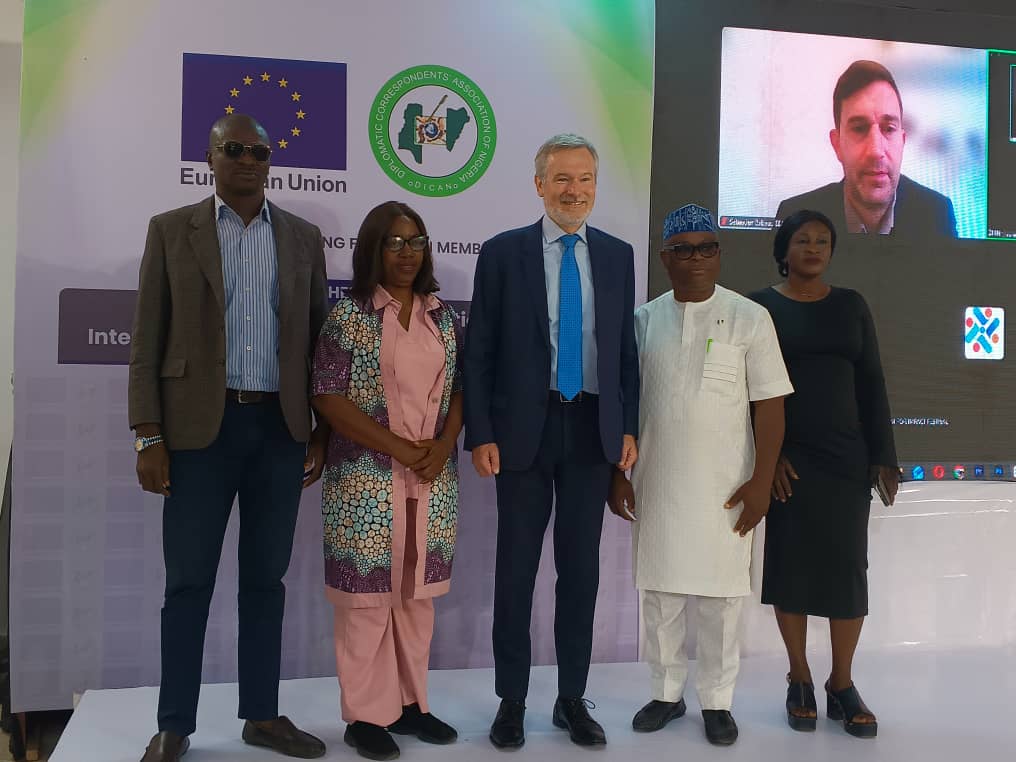
The European Union has charged journalists to remain credible in their service as the country’s strongest defence against Information Manipulation and Interference, describing them as the pillars of free democracy.
The EU Ambassador to Nigeria and ECOWAS, Gautier Mignot, speaking in Abuja at a one-day workshop on Foreign Information Manipulation and Interference (FIMI) organised by EU Commission in Nigeria, for members of the Diplomatic Correspondents Association of Nigeria (DICAN), warned that Nigeria faces a rapidly escalating threat from disinformation, saying false and misleading content is gravely endangering democracy and undermining trust in institutions and the remains the critical player in fight did and misinformation.
“Media remains one of the pillars of a free, democratic society. when citizens lose trust in journalism, democracy is at risk, and the society itself is gravely endangered. One of the pillars of a free, democratic society. when citizens lose trust in journalism, democracy is at risk, and the society itself is gravely endangered. Media must remain reliable, they must be fact-checkers and make sure in particular that the research for the scoop does not beat the research for the truth. The public must be aware of the danger of false information and willing to escape from it and not prefer pleasant lies to unpleasant truth. such a dire situation, media and information literacy, both within and outside the Fourth Estate, has become an urgent compulsion rather than a choice”, he said
The Ambassador noted that : As one of the pillars of a free, democratic society. when citizens lose trust in journalism, democracy is at risk, and the society itself is gravely endangered.
Media must remain reliable, they must be fact-checkers and make sure in particular that the research for the scoop does not beat the research for the truth. The public must be aware of the danger of false information and willing to escape from it and not prefer pleasant lies to unpleasant truth. such a dire situation, media and information literacy, both within and outside the Fourth Estate, has become an urgent compulsion rather than a choice”, he said.
He stressed that the situation becomes catastrophic when deception is intentional.
“The consequences become more dire when misleading information is deliberately crafted with an intent to deceive, and pushed into the public space to unsuspecting helpless citizenry. Journalist are multipliers in the information value-chain and therefore natural targets of foreign and domestic manipulation. Once the media is misinformed or disinformed, the entire society is at risk of being deceived,” he said.
The Ambassador noted that modern technologies have made communication easier but also far more dangerous.
“Their ability to falsify or even recreate realities has enhanced the ease and rapidity of producing and spreading deceptive content which are more and more difficult to distinguish from original contents.”
Citing a July 2024 report of the European Parliament, he said; “global concern over disinformation is widespread.
“Some 85 percent of people worldwide are concerned about the impact of disinformation on their fellow citizens; 87 percent think disinformation has already affected political life in their country; and 38 percent of EU citizens list false and/or misleading information as a threat to democracy.”
Mignot warned that Nigeria, is facing similar dangers, he referenced a 2020 report by the Centre for Democracy and Development (CDD) which concluded that Nigeria’s “unprecedented” level of disinformation has worsened ethnic and religious tensions.
He said; “Both falsehoods and accurate information could now spread faster and in a multitude of formats, including text, audio, images, memes and videos, all thanks to technology. False information, in whatever guise and for whatever motive, harms the society. It compromises the integrity of the media, undermines trust in public institutions, and weakens people’s capacity to take informed decisions on issues that affect them.”
Mignot argued that despite the disruption of social media, the chaos online has reaffirmed the value of professional journalism.
He said; “The role of traditional media is again legitimised by their reliability compared with the informative chaos on the social networks. But he cautioned that this legitimacy depends on accuracy and integrity. The research for the scoop must not beat the research for the truth.”
Mignot cautioned that disinformation often begins online but quickly crosses into radio, television and print spaces, blurring the lines between verified news and manipulated content.
The drift, he said, has created problems around transparency and accountability, key features underlining media credibility.
The envoy stressed that media literacy has become “an urgent compulsion rather than a choice, stressing that a well-informed public is more capable of identifying trusted sources and participating meaningfully in national debates.
He said; “Disinformation erodes democratic values; breeds mutual suspicion and disaffection; and undermines peace, security and stability at both national and regional levels.”
He said that growing disinformation campaigns in West Africa, including well-organised campaigns pretending to oppose the starling successes of young leaders of AES countries to what they present as a failure of Nigeria’s democratic government.
Mignot reiterated that the EU is responding aggressively both within Europe and internationally, explaining that the Union is monitoring and analysing disinformation campaigns, especially those targeting elections or sensitive political issues.
Mignot said; “We are also building up critical capacity for fact checking in the media, and to help journalists strengthen their resilience to disinformation, information manipulation and propaganda. Besides the support we offer locally through our media-focussed interventions, we also directly facilitate the participation of Nigerian journalists in trainings on media literacy in Europe.We are engaging with young people, including university students, to provide direct information on our programme. This is in addition to what our Member States do”.
He noted that the EU is promoting media literacy and equipping citizens with resources to critically evaluate information.
“Within its borders, the EU has adopted far-reaching measures to combat disinformation. Internationally, the EU is working with partners, including the media and the civil society to protect the integrity of the information matrix, Nigeria inclusive. As part of a comprehensive response, the European Union works to support actions that guarantee media freedom and pluralism and ensure that citizens have access to quality news and information they can trust. We support fact-checkers and researchers working to debunk disinformation and foster collaboration among them. Our previous work with Nigeria’s foremost fact-checking platform, Dubawa, is an example,” he noted.
Mignot also highlighted that Nigerian journalists have been sponsored to participate in media literacy trainings in Europe, including trips this year that covered nations such as war-torn Ukraine.
According to the Ambassador, the EU also works closely with Nigerian institutions, civil society organisations and online platforms to counter disinformation, providing resources, training and collaboration opportunities across various sectors.
Explaining why DICAN journalists were selected for the training, Mignot said they are “first-line purveyors of public information, with a considerable weight of responsibility,” and stand at a crucial intersection between Nigeria and the world.
“We have selected members of the Diplomatic Correspondents of Nigeria (DICAN) for this training for four main reasons: As field reporters, you are first-line purveyors of public information, with a considerable weight of responsibility to your media organisations and the larger society. As diplomatic and foreign affairs correspondents, you stand at the intersecting point between your country and the outside world in terms of how information of foreign origin or foreign orientation are filtered into society. This is an enormous responsibility, and we must recognise this. You report the activities of the EU and its Member States the most in the country; so, you are our closest partners in Nigeria’s mediacommunity,” Mignot said.
In his presentation, Mr. Sebastien Babaud of the EU Strategic Communication Division, External Action Service (EEAS), explained that how global disinformation networks are quietly dismantling democratic institutions, rewriting public narratives, and turning technology into a weapon of political subversion.
“Democracy is under attack. Information manipulation is no longer a nuisance, it is a global security threat eroding the very foundations of governance. Today’s disinformation is intentional, industrial, and strategic. It is financed, coordinated, and deployed with military precision.”
The EU is optimistic that the workshop would strengthen journalists’ professional competence, add value to their professional portfolio and make them more effective as they discharge the critical responsibility to the society and the world at large.
Lateefah Ibrahim