


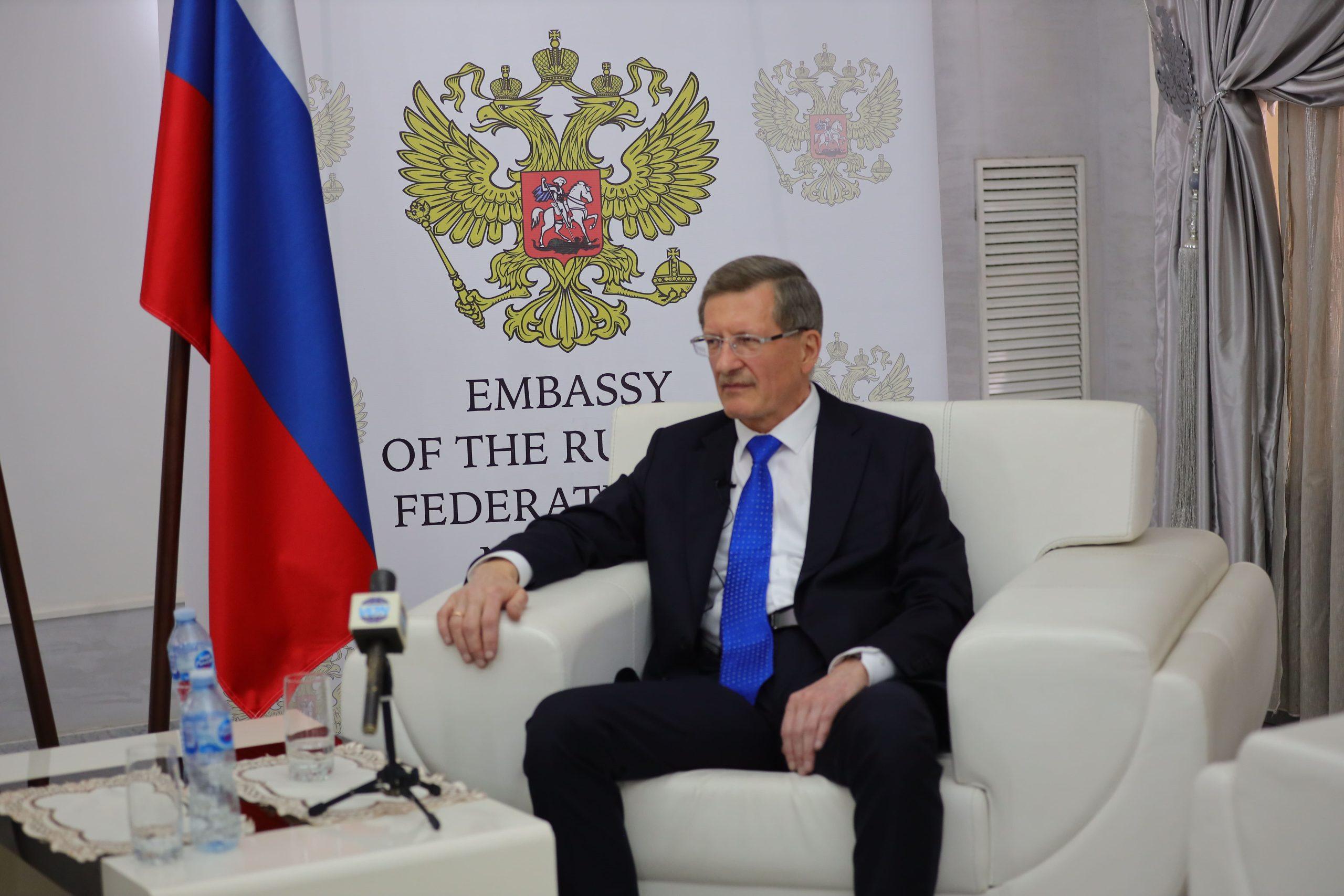
Russia’s Ambassador to Nigeria, Andrey Podelyshev, says Moscow will continuously give diplomatic support to Nigeria – especially in the areas of regional stability and reformation of the UN Security Council.
Ambassador Podelyshev made this vow in an exclusive interview with Voice of Nigeria (VON) in Abuja.
This assurance comes as both countries celebrate Sixty-Five Years of diplomatic ties later this year.
The Russian envoy noted that Nigeria is a leading political and economic power house in Africa, leveraging on its comparative advantage in human and material resources to resolve crises on the continent while promoting peace and security.
He added that this policy thrust complements Russia’s global outlook of promoting territorial integrity, anchored on the right of nations to pursue their political and economic aspirations devoid of foreign interference and control.
“This year, on November 25th, marks the 65th anniversary of the establishment of diplomatic relations between our two countries. The Soviet Union was among the first to recognize Nigeria’s independence.
“Since then, a great deal has been accomplished, and a solid foundation for bilateral cooperation has been laid. The Soviet Union extended support to Nigeria during a particularly difficult period — in the late 1960s — when the country was facing a challenge to its national unity,” he said.
“Moscow became the only major power to provide military assistance to the Federal Government, which, as acknowledged by the Nigerian side, played a key role in preserving the country’s territorial integrity.
“Following the civil war, the Soviet Union assisted in Nigeria’s post-war economic recovery. In 1979, a contract was signed with Technopromexport for the construction of the Ajaokuta Steel Mill — the largest metallurgical plant in West Africa.”
“Nigeria also received assistance in the training of professionals for various sectors of the economy, including healthcare, industry, and agriculture. Tens of thousands of Nigerians received higher education in the universities of the Soviet Union, and later in Russia,” he added.
Revived Diplomacy
Ambassador Podelyshev confirmed that following the dissolution of the Soviet Union in the 90s, Russia undertook massive internal reforms which forced a temporary retreat from diplomatic engagement with Africa.
But he said all that has changed, following Russia’s full-scale return to the African continent.
“This commitment is evidenced by the two Russia–Africa Summits — the first held in Sochi in 2019 and the second in St. Petersburg in 2023. H.E. President Muhammadu Buhari represented Nigeria at the first Summit in Sochi, where he held very positive and productive talks with the President of the Russian Federation, H.E. Vladimir Putin.
“At the second Russia–Africa Summit, Nigeria was represented by a high-level delegation led by Vice President H.E. Kashim Shettima. The second Summit concluded with the adoption of the Russia–Africa Partnership Forum Action Plan for 2023–2026.
“We believe that the implementation of its provisions will positively contribute to the development of our bilateral relations with all African states, including Nigeria. Naturally, bilateral contacts continue to play an important role in advancing our cooperation.”
“The most recent official high-level visit took place in 2009, when the President of Russia, H.E. Dmitry Medvedev, visited Nigeria. Earlier, in 2001, the President of Nigeria, H.E. Olusegun Obasanjo, paid an official visit to Moscow, during which the Declaration on the Principles of Friendly Relations and Partnership was signed. In October 2017, on the sidelines of the 137th Assembly of the Inter-Parliamentary Union in St. Petersburg, a meeting was held between the Chairperson of the Federation Council of the Russian Federation, H.E. Valentina Matviyenko, and the President of the Nigerian Senate, H.E. Bukola Saraki. The Minister of Foreign Affairs of Russia, H.E. Sergey Lavrov, visited Abuja in 2010, while his then Nigerian counterpart, H.E. Geoffrey Onyeama, visited Russia in May 2017 and October 2019.”
“In March 2024, H.E. Minister Sergey Lavrov held talks in Moscow with Nigeria’s Minister of Foreign Affairs, H.E. Yusuf Tuggar. In November of the same year, a delegation of Nigeria’s Ministry of Foreign Affairs participated in the first ministerial conference of the Russia–Africa Partnership Forum. It is very important to maintain such an active political dialogue between our countries at different levels. I see it as my personal mission to fully contribute to this effort.”
The Russian Ambassador stated that during the meeting, both Moscow and Abuja reaffirmed their mutual commitment to the further steady development of Russian–Nigerian cooperation in the political, trade and economic, humanitarian, and other spheres.
He said the parties discussed prospects for expanding business contacts and implementing joint projects in the fields of energy, mineral extraction and processing, infrastructure construction and modernization, and agriculture.
“The Foreign Ministers held a comprehensive exchange of views on key issues on the global and African agenda, with a particular focus on the reform of the UN Security Council, the settlement of regional conflicts, and the situation in the Sahara–Sahel region. The importance of political and diplomatic methods for resolving crises on the continent was emphasized, with a leading role to be played by Africans themselves and with the support of the international community.”
“The sides noted the convergence of positions on the Middle East peace process and expressed readiness to further strengthen coordination within the United Nations and other multilateral platforms. Special attention was also given to the issue of advancing Russia–Africa partnership, particularly in the context of implementing the decisions adopted following the Second Russia–Africa Summit.”
Sochi Roadmap
Ambassador Podelyshev told VON that the first Russia–Africa Summit, held in Sochi in 2019, undoubtedly opened new opportunities and provided a powerful impetus to the development of Russia’s relations with African countries, including Nigeria.
He opined that one of the key events of that summit was the bilateral meeting between the President of the Russian Federation and Nigeria, which have over the years served as practical steps to strengthen economic and political cooperation, as well as to discuss prospects for expanding contacts in the fields of security, energy, infrastructure, and education.
“Russia intends to further develop its relations with Nigeria in a comprehensive manner, taking into account the many areas of convergence and shared interests between our two countries.
“The goals and objectives of mutually beneficial cooperation, which guide Russia’s work with its African partners, were reflected and consolidated in the final declaration of the first Russia–Africa Summit. Russia and Nigeria share a commitment to the fundamental principles of the UN Charter and hold largely convergent views on key issues of the global and regional agenda,” he said.
“The summit also launched new partnership mechanisms with African countries, including Nigeria. Since then, inter-parliamentary contacts have intensified, and cooperation has expanded in high technology, science and technology, humanitarian and information fields.
“We have also observed growing interest from the business community in establishing direct links and implementing joint projects in such areas as energy, infrastructure, and agriculture. Thus, the Sochi Summit opened a new chapter in the strategic partnership with Nigeria, setting long-term guidelines for its further deepening,” he stated.
He lauded Nigeria’s global leadership role – being a key member of major international and regional organizations such as the Organization of the Petroleum Exporting Countries (OPEC), the African Union, the African Development Bank, the African Continental Free Trade Area, the Economic Community of West African States (ECOWAS), the Organization of Islamic Cooperation, as well as other international groupings.
According to him, all these facts eloquently attest to Nigeria’s weight and authority, both in Africa and on the international stage.
“We view Nigeria as a locomotive of economic growth and political influence in the region and across the continent. Russia regards Nigeria as one of its principal partners in Africa and an advocate of the fundamental principles of international law on the continent. Nigeria, like Russia, stands for the establishment of an equitable multipolar world order, based on respect for state sovereignty and non-interference in internal affairs. It adheres to the fundamental principles of the UN Charter and does not support the imposition of the so-called “rules-based order,” whereby rules are determined by a narrow group of states to the detriment of others.”
“Nigeria consistently opposes unilateral sanctions and other measures that undermine the common interests of the international community. We highly appreciate Abuja’s balanced and independent foreign policy, as well as its contribution to strengthening regional stability, whether within the framework of ECOWAS, the African Union, or the United Nations.”
Priorities
The strategic priorities of Russia’s cooperation with African states, including Nigeria, are enshrined in the final documents of the Russia–Africa Summits held in 2019 and 2023.
These documents clearly define the key areas of collaboration forming the basis of our partnership with Nigeria. They include, in particular, the development of trade and economic ties, investment activities, joint projects in energy, industry, agriculture, science and technology, as well as enhanced cooperation in education, culture and security.
In practical terms, in the near future we intend to intensify work on the preparation of a number of bilateral agreements.
These include agreements on the mutual protection of investments, cooperation in criminal justice, education, electric power, outer space, military-technical cooperation, and other spheres.
Ambassador Podelyshev concluded by revealing that a special focus will be placed on the early resumption of the full-scale work of the Intergovernmental Russian–Nigerian Joint Commission on Economic, Scientific and Technical Cooperation, which is an important mechanism for coordinating bilateral interaction.
“We will continue to welcome Nigerian youth to Russian universities, promote exchanges of delegations at different levels, and diversify cultural and humanitarian cooperation,” he promised
“We are convinced that the consistent implementation of these priorities in the coming years will raise the Russian–Nigerian partnership to a new and even higher level.”