


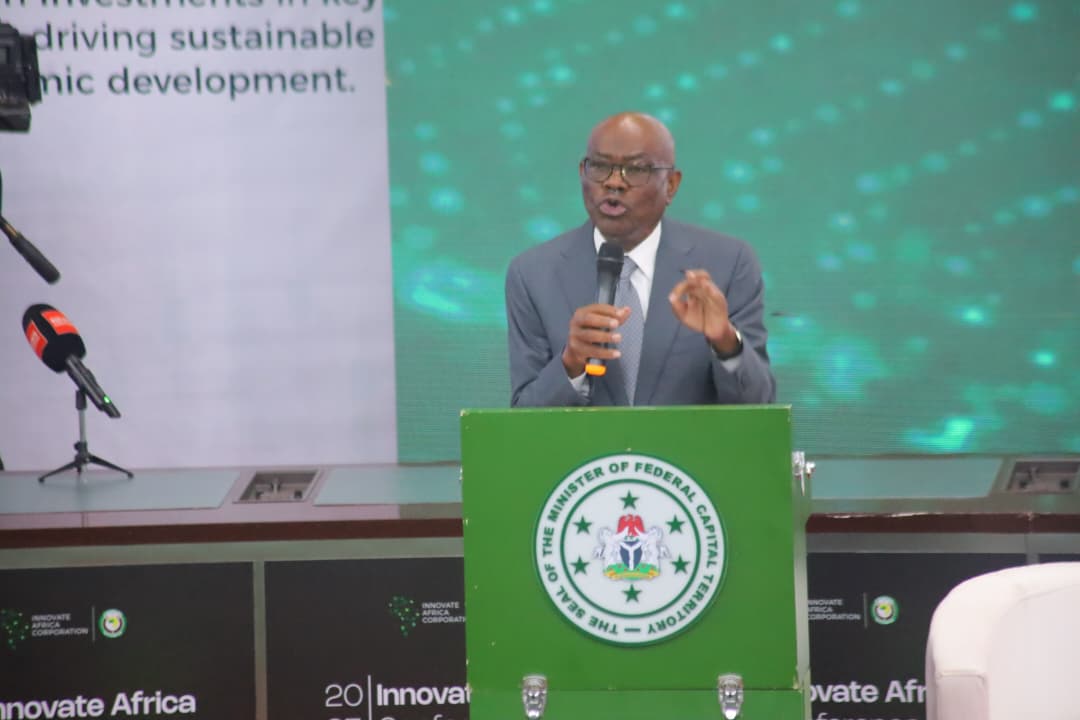
The Minister of the Federal Capital Territory (FCT), Mr. Nyesom Wike, has emphasized the need for Nigeria to move beyond transactional leadership driven by personal interests, patronage, and short-term gains.
Mr. Wike called for the adoption of transformational leadership anchored on vision, courage, service, and accountability to drive sustainable national development.
The Minister stated this during while delivering a lecture organized by Innovate Africa Conference in Abuja Nigeria’s capital with the theme: Reimagining Africa’s Leadership and investment.
While delivering his lecture, the Minister stated that, “Leadership must not exploit, but empower; it must not rule, but serve; it must not merely transact, but transform”.
He said that, many commentators have agreed that the greatest impediment to Africa’s progress is poor leadership.
The Minister further stressed that consequently, many African nations have been saddled with leaders unprepared for the enormity of leadership.
He disclosed further that, “the 21st century calls for a new kind of African leaders who are prepared, principled, and passionate. Leaders who embody vision, moral character, and resilience.”
Wike went further to explained that, ” Leaders who believe in Africa’s boundless possibilities and act decisively to unlock them. They must be bold enough to make difficult but necessary decisions; proactive enough to anticipate the future; and committed enough to build systems that prioritize excellence over mediocrity and performance over politics.”
Wike said that, the leadership that Africa deserves in the 21st century is one that is about caring rather than controlling.
” A true leader must see himself as a servant, humbled by the weight of responsibility he carries for the welfare of the people. Africa is in urgent need of servant-leaders—leaders who do not see themselves as bosses but as mentors genuinely committed to the building of communities and the upliftment of people. Harry Gordon Selfridge and John C. Maxwell capture this distinction beautifully: “A boss drives his team; a leader guides them. A boss relies on authority; a leader relies on trust and goodwill. A boss inspires fear; a leader inspires enthusiasm. A boss says, “I”; a leader says, “We.” A boss demands punctuality; a leader arrives early to lead by example. A boss blames when things go wrong; a leader fixes the problem. A boss knows the path; a leader walks it with the team. A boss says, “Go”; a leader rallies his people with, “Let’s go together!” True leadership, then, is not about position or power, but about inspiring, serving, and journeying with those you lead
“This is the kind of leadership Africa must embrace if we are to move from stagnation to transformation“, he stated.
Wike further said that Transformational leadership is not an abstract ideal; but a living reality where bold vision meets purposeful action.
He stressed that in Abuja, they have witnessed how infrastructural renewal anchored on political will and strategic investment can turn aspiration into achievement.
” Roads that were once impassable are now open; bridges connect communities; public spaces once abandoned now thrive with life, enterprise, and hope. These are not mere structures of concrete and steel; they are symbols of what is possible when leadership dares to dream and to deliver“, he boosted.
Wike hinted that, President Bola Ahmed Tinubu’s commitment to difficult but necessary reforms further reminds the nation that leadership is ultimately about sacrifice for the greater good.
The Minister also stated that, from the first day in office, Tinubu demonstrated uncommon courage by confronting one of Nigeria’s most intractable challenges, the removal of the fuel subsidy.
He said; “While previous administrations acknowledged the dangers, none took decisive action. President Bola Ahmed Tinubu did, fully aware of the cost but confident in the long-term benefits. According to the Minister, this bold decision is now yielding results as states and local governments receive higher revenues for development, the burden of debt accumulation is easing, and petrol prices are gradually aligning with market realities under sound regulatory oversight.”
Mr. Wike noted that equally transformative is President Tinubu’s effort to decentralize governance and correct the structural imbalance caused by over-centralization.
He explained that through the establishment of zonal and regional commissions, the President is bringing development closer to the people — a key step toward achieving genuine federalism.
The Minister also stated that the Tinubu administration has made significant investments in national security, including the training and retraining of the armed forces and the approval of forest guards’ recruitment nationwide to reclaim ungoverned spaces from bandits and terrorists.
Mr. Wike stressed that these and other strategic measures are repositioning Nigeria toward stability, productivity, and sustainable growth.