

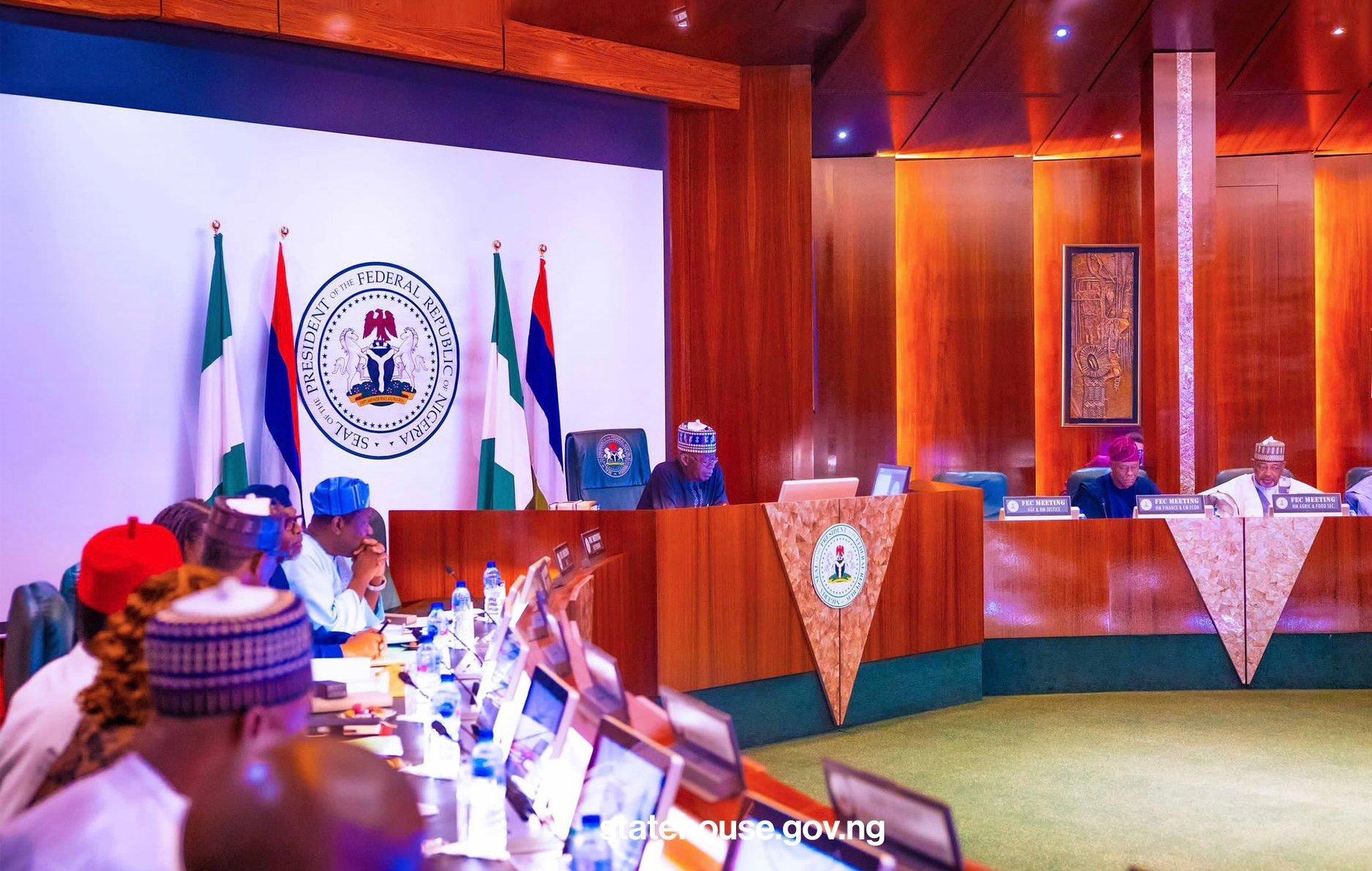
The Federal Executive Council has approved a ₦58.47 trillion 2026 Appropriation Bill and an amendment to the Medium-Term Expenditure Framework (MTEF), paving the way for President Bola Tinubu to transmit the budget to the National Assembly.
Briefing journalists after the council meeting on Friday Chaired by Vice President Kashim Shettima, the Minister of Information and National Orientation, Mohammed Idris, said the sole item on the agenda was the consideration and approval of the 2026 budget proposal for onward transmission to the legislature later.
The Minister of Budget and Economic Planning, Abubakar Bagudu, told State House Correspondents that Council also approved a downward revision of the exchange rate assumption in the MTEF from ₦1,512/$ to ₦1,400/$, with consequential adjustments to the overall budget size.
According to him, the proposals were earlier presented by the Ministry of Budget and the Budget Office and reviewed by members of the Executive Council of the Federation before approval.
“This afternoon, the Federal Executive Council considered the 2026 budget proposal that is going to the National Assembly, as well as an amendment to the medium term expenditure framework, which we propose, a revision downwards of the exchange rate from the 1512 to 1400 and the consequential changes in budget size. So the federal executive council approved both the amendment to the MTEF as well as the 2026, budget proposal for presentation to the National Assembly.”
Providing details, the Director-General of the Budget Office, Tanimu Yakubu, said aggregate expenditure for 2026 is projected at ₦58.47 trillion, representing a six per cent increase over the 2025 budget estimate.
He explained that the figure includes ₦4.98 trillion in projected spending by Government-Owned Enterprises (GOEs) and ₦1.37 trillion for grant- and donor-funded projects.
A breakdown of the spending plan shows statutory transfers of ₦4.1 trillion and debt service of ₦15.52 trillion, which includes ₦3.188 trillion for the sinking fund to retire maturing bonds issued to local contractors and creditors. Personnel costs, including pensions, are estimated at ₦10.75 trillion, incorporating ₦1.02 trillion for GOEs and reflecting a seven per cent increase over the 2025 provision.
Overhead costs are projected at ₦2.22 trillion, while capital expenditure stands at ₦25.68 trillion about 1.8 per cent lower than the 2025 capital allocation reflecting what officials described as a more conservative approach focused on completing ongoing projects.
Capital Allocation Priorities
Capital allocation priorities include ₦11.3 trillion for Ministries, Departments and Agencies (MDAs), ₦2.052 trillion for multilateral and bilateral loans, and ₦1.8 trillion as the capital component of the Development Levy.
“The aggregate expenditure for 2026 is projected at ₦58.47 trillion, 6% higher than the 2025 budget estimate.
“This includes projected spending of government owned enterprises amounting to ₦4.98 trillion and ₦1.37 trillion for grant and donor funded projects, the projected aggregate spending includes statutory transfers, ₦4.1 trillion debt service, ₦15.52 trillion including ₦3.188 trillion for the sinking fund to retire maturing bonds issued to local contractors and creditors, personnel cost, including pensions, ₦10.75 trillion, which includes ₦1.02 trillion for government owned enterprises, and 7% higher than the 2025 provision overhead cost, ₦2.22 trillion capital expenditure, ₦25.68 trillion, 1.8% lower than the 2025 capital provision, reflecting a more conservative approach to capital planning and the focus on completing ongoing projects. “
Yakubu said the 2026 budget is designed to balance macroeconomic stabilisation with development objectives under the Renewed Hope Agenda.
He noted that budget assumptions are conservative and realistic, particularly on oil price, exchange rate and GOE dividends.
While revenues are projected to decline year-on-year, he said non-oil revenues now account for about two-thirds of total receipts, underscoring a structural shift away from oil dependence. Corporate income tax, value-added tax, customs duties and independent revenues are expected to remain the main fiscal anchors.
“The revenues decline year on year, but non oil revenues now account for roughly two thirds of total receipts, confirming a structural shift away from oil dependence. Corporate tax, VAT customs and independent revenues remain in the main fiscal ankles. Expenditure growth is driven primarily by debt service wages and pensions, rather than discretionary expansion, capital spending is marginally reduced to prioritize completion of ongoing projects and value for money. The larger deficit reflects legacy fiscal rigidities, rather than policy loosening. Financing relies on domestic borrowing complemented by concessional multilateral loans” he stated.
According to the Budget Office, expenditure growth is driven largely by debt service, wages and pensions rather than discretionary expansion, while the larger deficit reflects legacy fiscal rigidities rather than policy loosening.
Financing of the deficit will rely mainly on domestic borrowing, complemented by concessional multilateral loans.
President Tinubu is expected to formally transmit the 2026 Appropriation Bill to the National Assembly for consideration on Friday,19th December.
Lateefah Ibrahim