

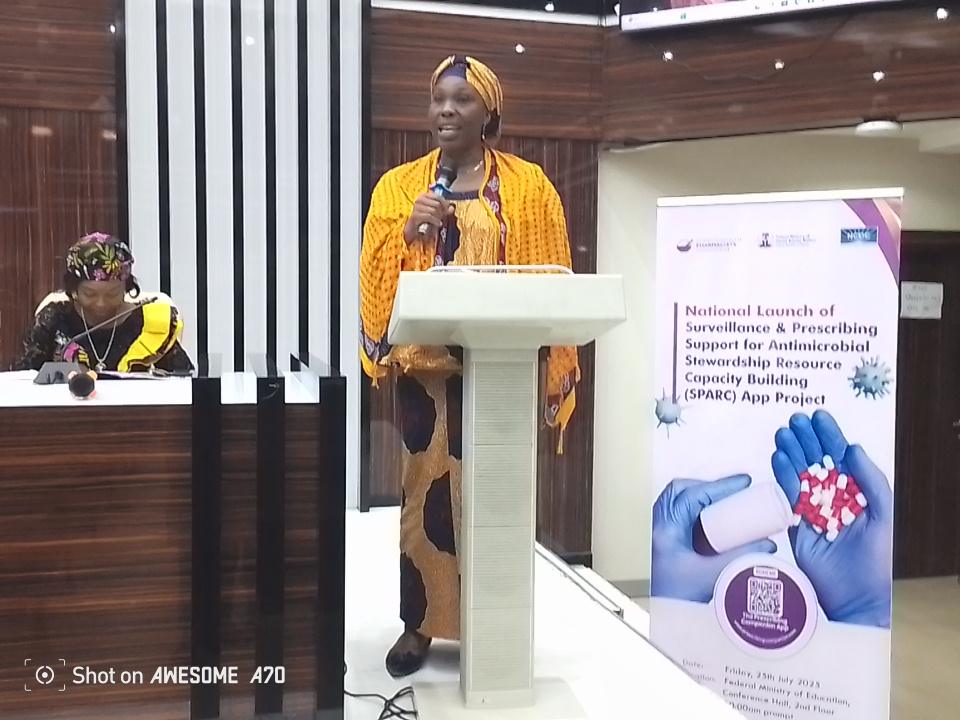
The Federal Government of Nigeria has launched the Surveillance and Prescribing Support for Antimicrobial Stewardship Resource Capacity Building (SPARC) App, a revolutionary digital tool designed to tackle the growing threat of Antimicrobial Resistance (AMR) and promote responsible antibiotic use among healthcare professionals across the country.
Speaking on behalf of the Coordinating Minister of Health and Social Welfare, Professor Ali Pate, the Director of the Food and Drug Services Department, Pharmacist (Mrs.) Olubunmi Aribeana described the SPARC App as a critical innovation in Nigeria’s AMR response.
She declared the app “live in Nigeria,” affirming that it would empower prescribers with up-to-date, evidence-based treatment guidelines.
Professor Pate, in his remarks delivered through his representative, emphasised that AMR is one of the most pressing public health challenges globally.
The SPARC App, he noted, is Nigeria’s strategic digital response to support prescribers with reliable guidance for rational antibiotic use. “This is not just a digital platform; it’s a weapon in our fight to protect lives and preserve the effectiveness of medicines,” he said.
Developed through a collaborative effort between the Federal Ministry of Health, the Commonwealth Pharmacists Association (CPA), and other international partners, and funded by the Fleming Fund, the SPARC App offers Nigeria’s Standard Treatment Guidelines (NSTG) for infectious diseases.
It also integrates treatment protocols for COVID-19 and will soon include national guidelines on antimicrobial use in animals, pending approval.
The app is intended solely for trained health professionals, such as doctors, pharmacists, and licensed prescribers and is not for general public use.
Its core purpose is to help healthcare providers make informed decisions by ensuring antimicrobials are used only when necessary, at the appropriate dose, and for the correct duration. These practices are essential in slowing the development and spread of drug-resistant infections.
The launch of the SPARC App is in alignment with Nigeria’s National Action Plan on Antimicrobial Resistance (NAP 2.0), which is coordinated by the Nigeria Centre for Disease Control and Prevention (NCDC).
Professor Pate highlighted that AMR occurs when bacteria, viruses, fungi, and parasites evolve and stop responding to medications, leading to prolonged illnesses, higher treatment costs, and increased mortality.
The app supports the Antimicrobial Stewardship (AMS) pillar of NAP 2.0, which advocates for the rational and evidence-based use of antibiotics in humans, animals, and the environment under the One Health framework.
In her welcome address, Pharm. Aribeana, represented by Mr. Tunde Atanda, Director of the National Food Safety Quality Programme, applauded the SPARC App as a symbol of strong multisectoral collaboration.
She acknowledged the contributions of the Pharmaceutical Services Division and past leadership that helped facilitate the successful upload of Nigeria’s treatment guidelines onto the digital platform.
She added that the app, already in use in 22 Commonwealth countries, has the potential to transform Nigeria’s antibiotic prescribing culture.
Yakubu James, Deputy Director and Nigeria’s SPARC App Champion, delivered a technical presentation on the country’s role in advancing AMR policy and digital health innovation.
He highlighted ongoing reforms, including the review of the National Drug Formulary, the Essential Medicines List, and the development of a National Antimicrobial Stewardship Policy for Human Health.
He reiterated the Federal Ministry of Health’s commitment to leveraging digital tools, building capacity, and supporting policies that safeguard public health and enhance healthcare delivery.
The launch of the SPARC App signals Nigeria’s deepening commitment to public health innovation and positions the country among nations adopting smart solutions to address complex global health threats.
With this initiative, the federal government aims to preserve the effectiveness of antibiotics, improve treatment outcomes, and secure the health of future generations.
Jide Johnson.