


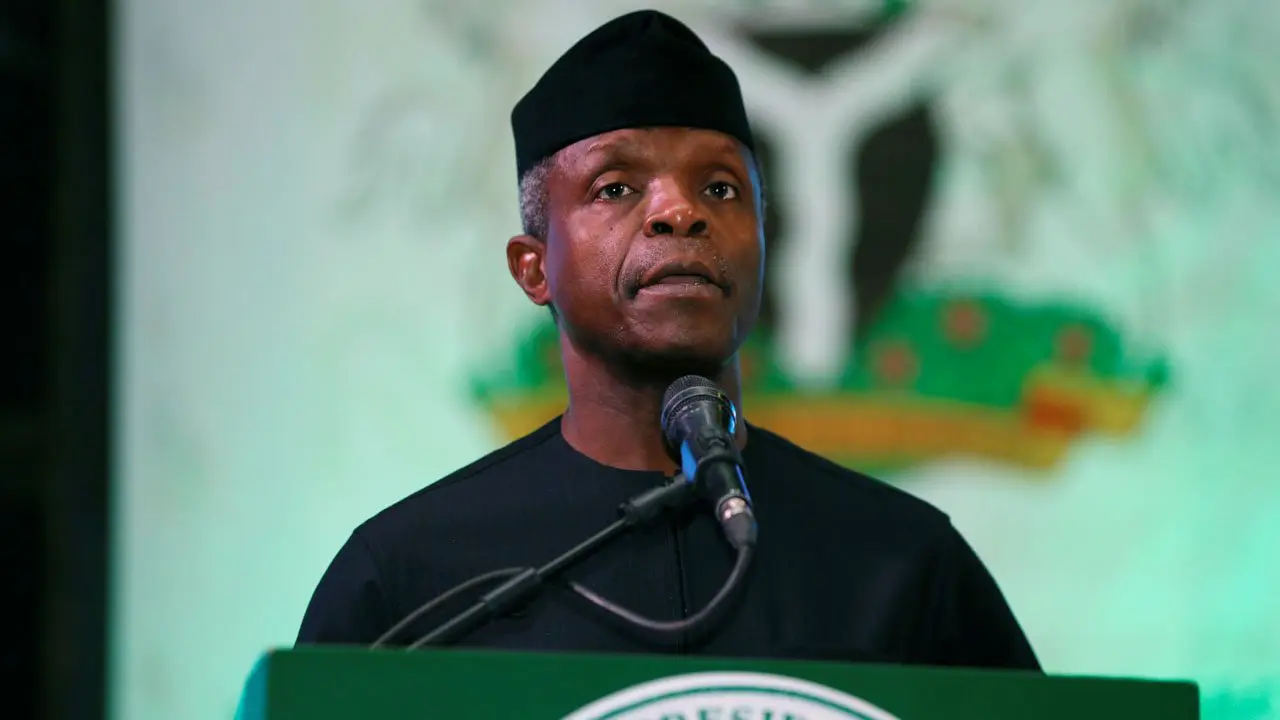
Nigeria’s former Vice President Yemi Osinbajo has called for Africa’s operational sovereignty, noting that the continent has moved beyond rhetorical independence and is now actively shaping global systems through trade architecture, mineral leverage, demographic weight, and climate strategy.
While delivering a keynote address at the International Lecture and Leadership Conference in honour of the former Head of State General Murtala Muhammed, Osinbajo recalled Muhammed’s 1976 declaration that “Africa has come of age” and recast it as a living doctrine rather than a historical slogan.
Doctrine and Historical Continuity
Osinbajo situated his argument within the ideological arc that began in the post-independence era, when political sovereignty was the overriding objective. He recalled Muhammed’s insistence that Africa would define its own interests and reject external prescriptions.
He argued that while the 1976 moment consolidated political confidence, the present moment demands economic and institutional consolidation. Coming of age, he suggested, is not about the absence of constraints but about the assertion of agency and the capacity to build systems aligned with continental priorities. “The shift,” he said, “is from symbolic sovereignty to operational sovereignty.”
Economic Sovereignty and Industrial Strategy
Central to that operational shift is the African Continental Free Trade Area, which he described as the most consequential economic reform of the post-independence era. The agreement integrates 1.4 billion people across 54 countries with a combined GDP exceeding 3.4 trillion dollars, creating the largest free trade area by number of participating states.
Osinbajo pointed to the growing share of industrial goods in intra-African trade, including machinery, pharmaceuticals, and processed products, as evidence that the continent is gradually moving beyond raw commodity dependence.
“The debate is no longer about access to markets abroad but about strengthening value chains within Africa,” he said.
On critical minerals, he underscored that Africa holds roughly 30 percent of global reserves essential to the energy transition, including cobalt, lithium, and manganese. Increasingly, countries are adjusting export regimes to prioritise local beneficiation and value addition before export. He linked mineral policy to industrial diplomacy, arguing that “control over processing and supply chains translates into bargaining power in a decarbonising global economy.”
Demographics, he noted, reinforce this leverage. “By mid-century, Africa will account for a quarter of the global workforce, positioning it as a labour and innovation frontier at a time when ageing populations are reshaping advanced economies.”
Also Read: Coup d’état in West Africa: VP Osinbajo calls for proactive steps
Energy Transition and Climate Leverage
Osinbajo framed the energy transition as both a risk and an opportunity. Africa remains energy deficient, yet it holds significant renewable potential and natural gas reserves that can serve as transition fuels.
He pointed to expanding renewable projects across North, East, and Southern Africa, alongside emerging green hydrogen initiatives, as signals that the continent is positioning itself within the next generation of industrial fuels.
“Climate strategy,” he said, “must align growth with sustainability. Africa’s forests, wetlands, and biodiversity assets, including the Congo Basin, represent global carbon sinks of strategic importance. These natural assets must be recognised within international financing and carbon markets.”
Governance, Institutions, and Political Will
Osinbajo stressed that structural opportunity will not translate into power without institutional coherence and political will. Trade agreements, mineral policies, and climate frameworks require regulatory discipline, infrastructure investment, and continuity across administrations.
He highlighted financial and payment integration mechanisms designed to ease cross-border transactions, describing them as foundational to deeper market integration.
“The decisive test,” he suggested, “is whether African states can align national reforms with continental commitments in ways that strengthen credibility and investor confidence.”
Strategic Signal to the World
Beyond economics, the address carried geopolitical undertones. Osinbajo indicated that Africa’s expanding economic footprint and resource leverage position it to negotiate from strength rather than dependency.
The continent’s engagement with global powers, he implied, should be guided by interest-based partnerships rather than ideological alignment. Strategic autonomy, in this sense, is expressed through diversified trade, industrial capacity, and climate relevance.
Returning to Muhammed’s assertion that “Africa has come of age,” Osinbajo suggested that the measure of maturity today lies in institutional depth and bargaining confidence rather than rhetorical defiance.
“If the continent converts trade integration, mineral leverage, demographic momentum, and climate positioning into durable industrial capacity over the next three to five years, Africa’s role in global supply chains and climate negotiations will materially expand,” he said.
He added that the variables to watch are beneficiation enforcement, AfCFTA implementation depth, energy infrastructure build out, and governance continuity.