

Rebecca Mu’azu, Gombe
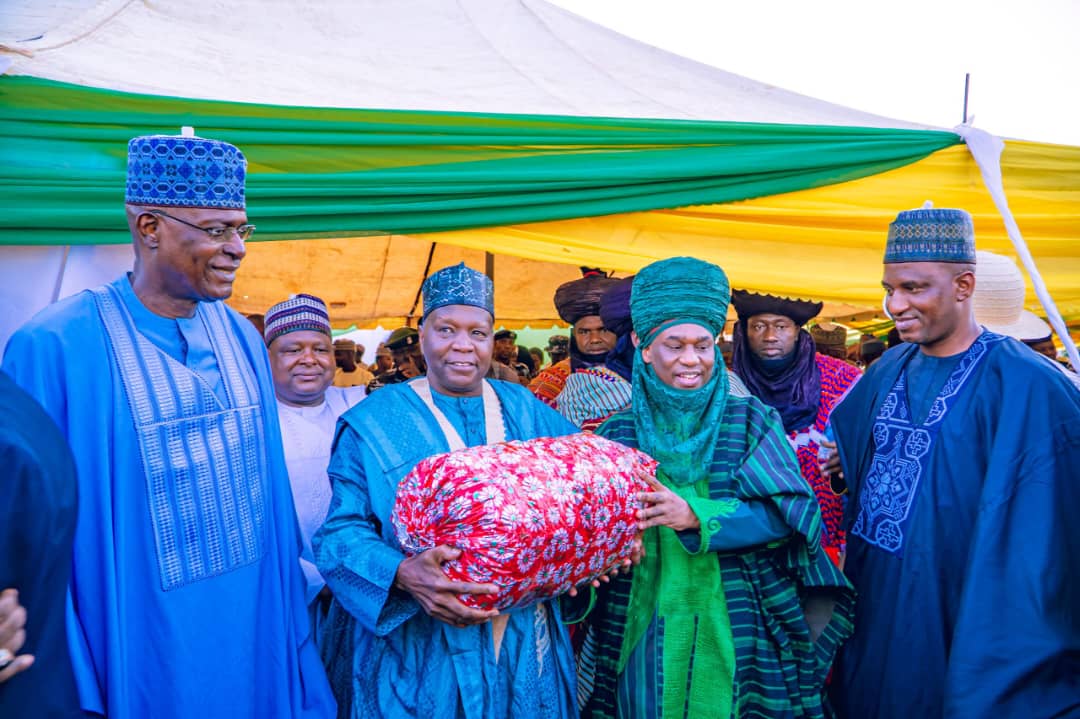
Governor Muhammadu Inuwa Yahaya of Gombe State has received the Emir of Gombe, His Royal Highness Dr Abubakar Shehu Abubakar III, as part of the traditional Sallah homage, known locally as Hawan Gidan Gwamnati.
The annual event, held at the Government House in Gombe, is a deeply rooted cultural tradition in the Gombe Emirate. It features a colourful procession of the Emir, flanked by district heads, council members, traditional titleholders, and hundreds of horsemen adorned in regal attire, paying respects to the governor during the Eid al-Adha (Eid el-Kabir) celebrations.
This year’s ceremony was particularly notable, with dignitaries in attendance including Mr Mohammed Fall, Assistant Secretary-General of the United Nations and the UN Resident and Humanitarian Coordinator in Nigeria. Mr Fall, a Senegalese national, chose to mark the 2025 Eid celebration in Gombe, citing the state’s peaceful atmosphere.
A highlight of the occasion was the durbar procession, where traditional horsemen showcased their equestrian skills in a dazzling display that captivated onlookers.
Addressing attendees, Governor Yahaya expressed gratitude to Almighty Allah for the blessings of Eid and for the continued peace and unity in Gombe State. He commended the Emir for upholding the tradition of the Sallah homage and for his enduring counsel and support to the state government.
“The fatherly guidance of His Royal Highness has been instrumental in shaping government policies that reflect the values and aspirations of our people,” the governor said.
Governor Yahaya also used the occasion to announce the upcoming construction of a 184-hectare Agro-Livestock Industrial Zone. The facility will feature an ultramodern abattoir, an international livestock market, and an international grains market — all equipped with modern infrastructure aimed at boosting the agro-economy, enhancing food security, and generating employment.
He reaffirmed his administration’s commitment to completing key legacy projects, including the inland dry port, a state-of-the-art State Secretariat, a new House of Assembly, and a High Court Complex.
These developments are intended to end decades of office rentals for Ministries, Departments, and Agencies (MDAs).
On the Kolmani oil project, Governor Yahaya restated his commitment to ensuring that Gombe State benefits from the natural resources discovered within its borders.
He highlighted ongoing collaboration with Bauchi State and development partners to fast-track full-scale oil exploration.
The governor also underscored his administration’s resolve to uphold the rule of law and urged citizens to take ownership of public infrastructure, protecting them as shared assets for future generations.
In his remarks, the Emir of Gombe praised the governor’s commitment to inclusive governance and acknowledged several key achievements of the Yahaya administration. These include the construction and renovation of over 3,000 classrooms, the establishment of five mega schools, efforts to enrol out-of-school children, healthcare revitalisation, and the expansion of the Gombe Regional Water Supply Scheme.
The Emir also lauded the state government’s strides in agricultural development, particularly the procurement and distribution of subsidised fertilisers, establishment of the Muhammadu Buhari Industrial Park, erosion control, road infrastructure, and sustained efforts to realise the Kolmani oil project.
He singled out the activation of the Balanga Dam — operational for the first time since its construction in 1978 — as a transformative step, noting that the state’s collaboration with development partners is also enabling canal construction for irrigation and power generation.
Additionally, the Emir praised the planned Gombe Northern Bypass and the modern abattoir project as strategic interventions that would eliminate the risky and costly transport of live animals to distant markets in southern Nigeria.
In a symbolic gesture, Governor Yahaya presented the Emir with a traditional Sallah gift (Goron Sallah), reaffirming the enduring relationship between the state government and the traditional institution.
Oyenike Oyeniyi