


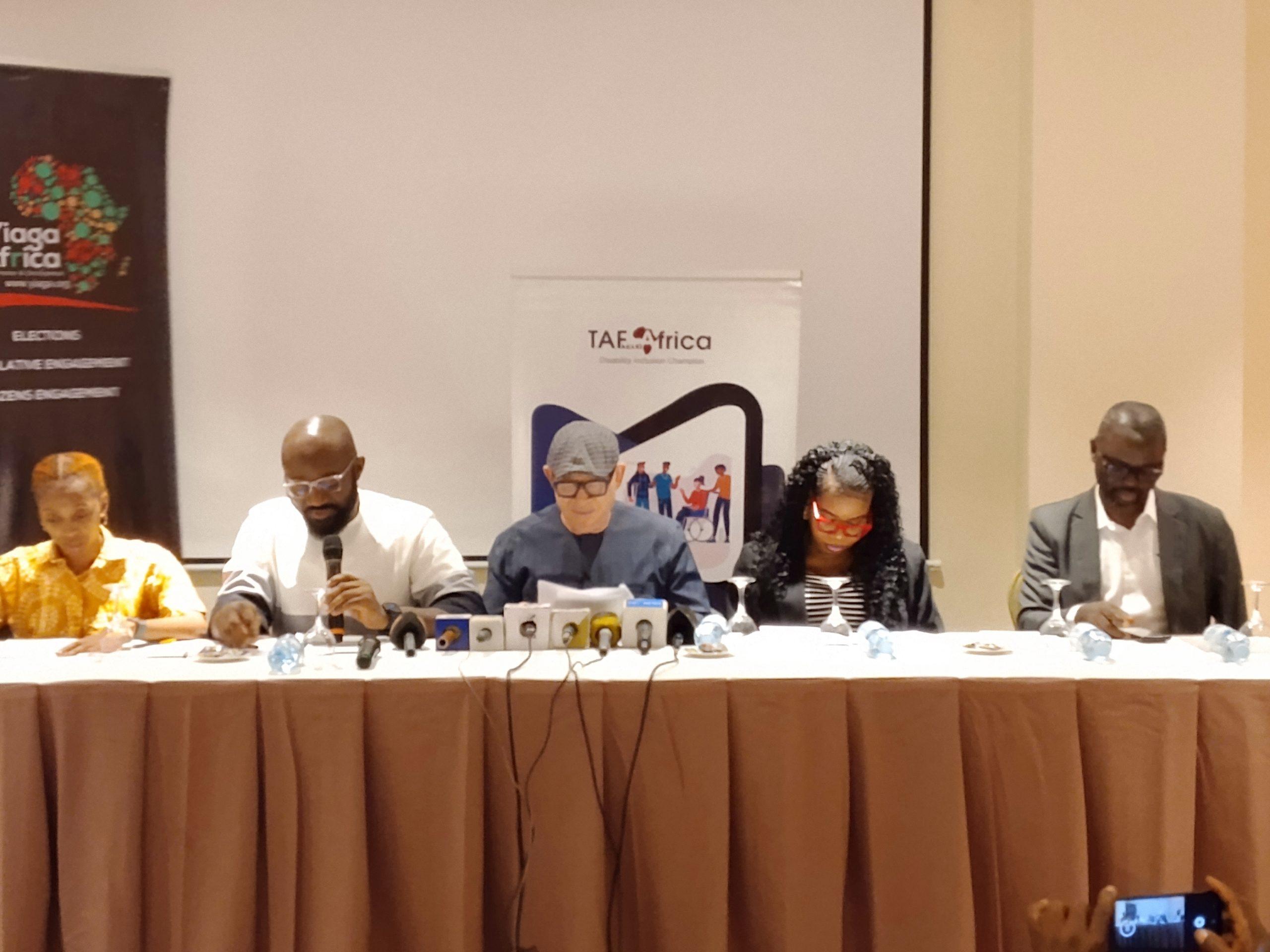
A group of Civil Society Organisations (CSOs) has called for the full implementation and monitoring of the recently signed Electoral Act 2026, as they welcome the downloadable voters card aimed at reducing citizens’ disenfranchisement.
Spokesperson of the group, Jake Eppelle, made the call at a Media briefing held in Abuja, Nigeria.
He said the provision allowing a downloadable voter card from INEC’s website will increase voter “participation and reduce disenfranchisement often associated with missing or unissued voter cards.”
He said the disability-Inclusive Voter Registration provisions of the Act, involving the process whereby the voter register is required to be disaggregated by disability type is commendable, stressing that it is the first time in Nigeria’s electoral history.
“This is a significant advance in line with Nigeria’s obligations under the UN Convention on the Rights of Persons with Disabilities (CRPD). We call on INEC to work closely with the National Commission for Persons with Disabilities (NCPWD) and disability inclusion organisations to ensure this provision is operationalised with dignity and accuracy.”
The group also appreciated the enhanced Penalties for Result Falsification as contained in the Act, which ensures that returning officers who deliberately falsify results now face a mandatory minimum of 10 years’ imprisonment without the option of a fine, just as Presiding officers who fail to sign result sheets face mandatory 3-year imprisonment.
“These are among the strongest anti-fraud sanctions in Nigeria’s legislative history and represent a commitment to accountability that we strongly support.”
Despite these gains of the Act, the group expressed reservations in the areas of
Electronic transmission of results under Section 60(3), which mandates electronic transmission but includes a proviso: if transmission ‘fails as a result of communication failure,’ the physical EC8A form becomes the primary source for collation.
“This language is unchanged from the version civil society flagged. ‘Communication failure’ is undefined. There are no consequences for deliberate sabotage disguised as technical failure.”
According to them, the Compressed timelines for the release of notice of elections from 360 days to 300 days, among others, increase logistics risk and put the electoral system under pressure.
They expressed concern over the imposition of a ₦50 million administrative fee for new political party registration.
“Which could exclude grassroots movements, youth-led parties, and non-elite political formations from formal competition.”
According to them, the restriction of party primaries candidates’ nominations to only two options of direct primaries or consensus reduces flexibility.

They, however, agreed that the assent to the Electoral Act 2026 is not the end of the reform process as contributions continue, noting that it is the beginning of the implementation phase and civil society will be present, vigilant, and vocal at every stage.
Going forward, the CSOs urged INEC to promptly issue a Revised 2027 Election Timetable Without Delay: In light of the new 300-day notice requirement under the Electoral Act 2026.
They also urged INEC to organise a national simulation exercise of IReV electronic transmission across all 176,866 polling units.
They called on political parties to insist on electronic transmission at every polling unit and to escalate concerns through lawful channels.
In the same vein, they urged the National Assembly to promptly publish the final version of the Electoral Act 2026 as signed into law to ensure public awareness, legal clarity, and stakeholder engagement.
The group added that despite the concerns raised on the 2026 Electoral Act, it remains the legal framework within which the 2027 elections will be conducted, urging citizens, media, civil society, etc., to ensure that the elections conducted under the law are credible, transparent, inclusive, and reflective of the will of the Nigerian people.
Spokesperson of the House of Representatives, Akin Rotimi, informed that the bill went through parliamentary processes and procedural requirements before being passed.
He clarified that the Law mandates electronic transmission of results, while manual submission serves only as a fallback where transmission fails for a valid reason.
“The law mandates that the EC8A Form be uploaded to IREV where there is no network and accessed where and when there is a network,” he said.
Rotimi corroborated the call for simulation or testing of the INEC IREV across polling units.
He said ongoing discourse will equally be taken into consideration, as the signed electoral bill is not a perfect one.
The group of CSOs includes: Centre for Media and Society (CEMESO), The Kukah Centre, International Press Centre (IPC), Elect Her, Nigerian Women Trust Fund, TAF Africa and Yiaga Africa.