


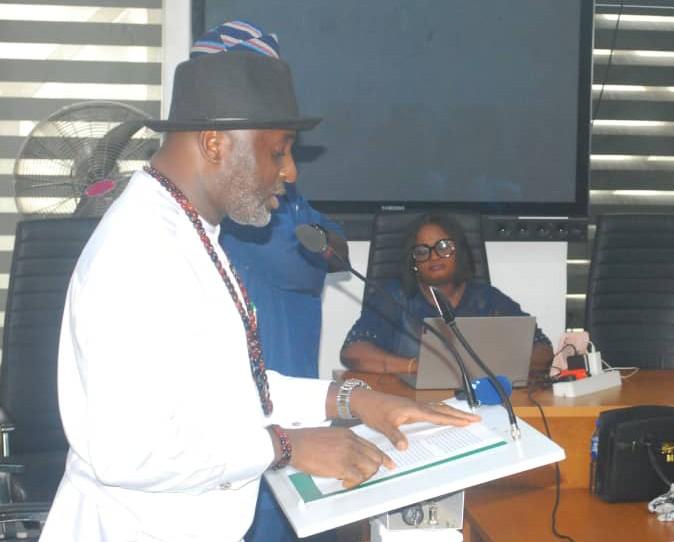
The House of Representatives has passed for first reading, a bill seeking to bann public and civil servants and their immediate families from using private schools and hospitals.
The Bill titled, ‘Private Institutions and Health Care Service Providers (Prohibition) Bill, 2025’, is sponsored by Mr. Amobi Ogah.
At a press briefing, Mr. Ogah said that the bill intends to “prohibit all public and civil servants, including their immediate family members, from patronising private schools and healthcare services”.
The lawmaker also said that the bill would prevent “conflict of interest, maintain public trust, and ensure high, uncompromised standards and integrity” of public schools and healthcare centres.
He recalled that the nation’s foremost politicians, including Ahmadu Bello, Nnamdi Azikiwe, Obafemi Awolowo, and Tafawa Balewa, attended public schools before Nigeria gained independence.
The Abia lawmaker said that the “penchant” for patronising private educational institutions and healthcare services “was alien to NIgeria’s democrats of old, but today, it has become an unwholesome trend for both public and civil servants to seek private educational institutions and medical care for themselves and their family members to the detriment” of the nation’s economy.
“In 2024, Nigeria allocated a total of N1.336 trillion to healthcare in the 2024 budget, which is a far cry from the estimated N1.6 trillion or over $1 billion Nigerians spend annually on medical treatments abroad,” the lawmaker said.
The lawmaker also noted that Nigerians “spent at least $29.29 billion on foreign medical expenses” during the eight years of the late former President Muhammadu Buhari’s administration.
In 2023 alone, $218.87m was spent on foreign education, while the first quarter of 2024 recorded an additional $38.17m outflow for the same purpose.
“Despite allocating N1.34tn to the health sector in the 2024 budget, Nigerians still channel over $1bn abroad annually for healthcare. This is unsustainable.
“If we could remove the fuel subsidy, then we must equally find the courage to reform our public institutions”, he added.
The lawmaker stressed that the continued neglect of public institutions by those in power breeds public distrust and worsens the decay of essential services.
“This bill is more than just legislation; it’s a call to national rebirth. We must put an end to the culture of medical and educational tourism among public servants and reinvest in what we have.”
He called on the media, civil society groups, and the public at large to support the bill and encourage a renewed sense of ownership and pride in public institutions. He also announced a social media advocacy campaign to raise public consciousness, with the hashtags: #PromoteOurSchoolsAndHealthcareServices and #PrivateInstitutionsAndHealthcareServicesProhibitionBill2025.
“I’m appealing to all well-meaning Nigerians to back this transformative bill. Together, we can restore the people’s trust and build a future where our children can believe in the Nigerian system,” he concluded.
Mr. Ogah pointed out that Nigerians expended $38.17 million on foreign education expenses between January and March 2024 and $218.87 million in 2023.
“The time for us all to tell ourselves the truth is now. We can no longer continue to inflict serious damage to the psyche of Nigerians,” he said.
Mr. Ogah said due to the patronage of private schools and healthcare facilities, their public counterparts have “become a shadow of themselves, with little or no infrastructural development and fallen standards of services”.
“We must, of necessity, restore confidence in our government institutions, like public schools and government hospitals, thereby promoting the image of our country in the comity of nations,” he said.
“It does not speak well of our country that our presidents and notable government functionaries are seen to be going abroad for medical treatment and even dying in the process.”
The lawmaker added that the bill would end medical and educational tourism among public and civil servants.