

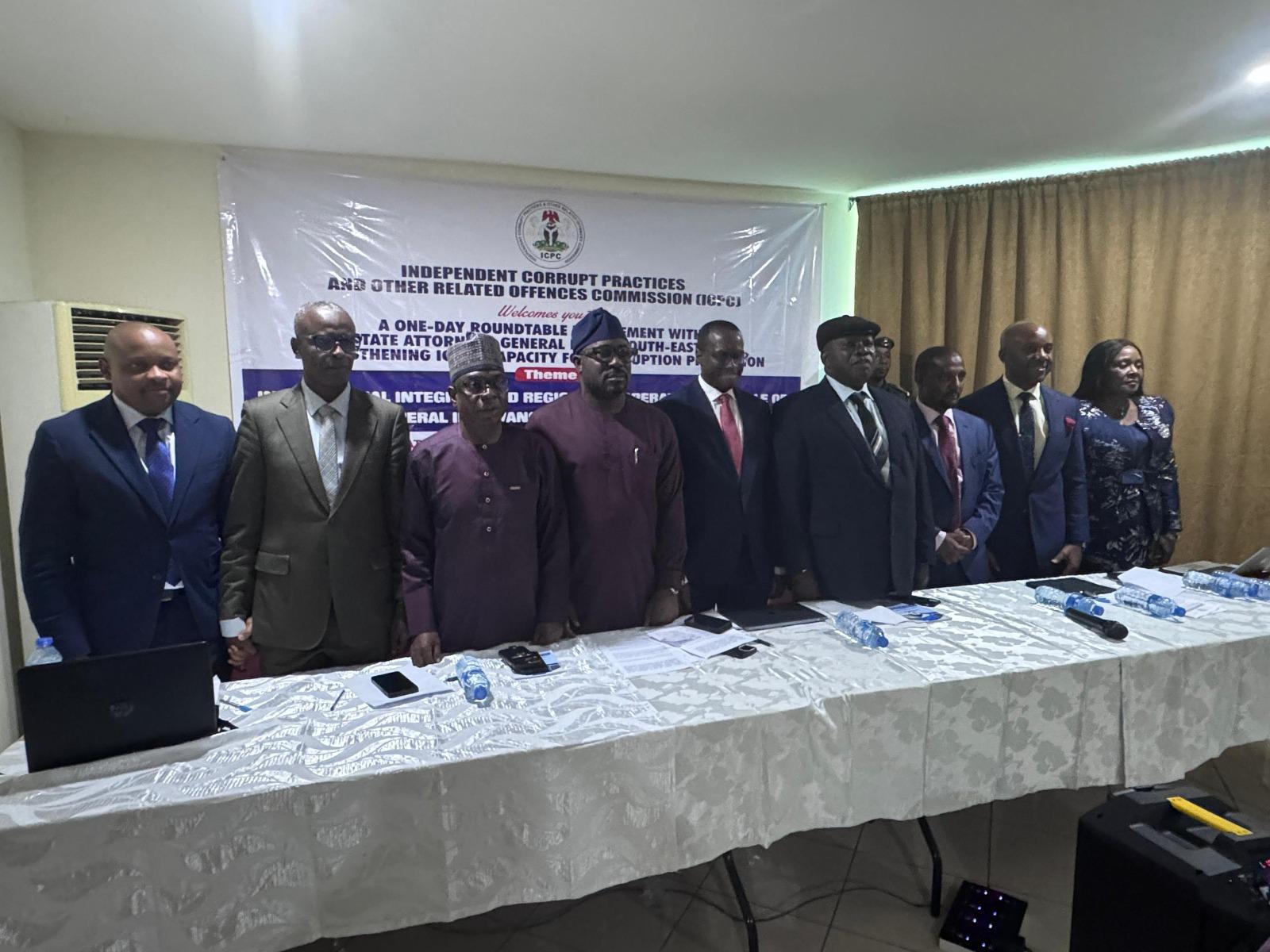
In a move to strengthen Nigeria’s anti-corruption framework, the Independent Corrupt Practices and Other Related Offences Commission (ICPC) has convened a landmark regional summit with State Attorneys-General from the South-East, aiming to unify efforts and strategies against public sector graft.
The high-level roundtable, held as part of the ICPC’s nationwide zonal engagements, spotlighted the need for collaboration between federal agencies and state-level legal institutions in tackling corruption, a longstanding impediment to Nigeria’s development.
“This engagement is designed to deepen collaboration, enhance intelligence sharing, and align strategies with both regional peculiarities and national priorities,” said ICPC Chairman Dr. Musa Aliyu, stated.
Opening the session with a tribute to former President Muhammadu Buhari, who was buried a day prior, Dr. Aliyu praised Buhari as a “moral compass” whose legacy had shaped Nigeria’s contemporary anti-corruption agenda.
Central to the discussions was the persistent challenge of jurisdictional conflicts between federal and state anti-graft bodies. Dr. Aliyu invoked Supreme Court rulings, including AG Ondo v. AGF and the 2024 Kogi State v. AGF decision, to reaffirm ICPC’s constitutional authority to prosecute corruption cases nationwide.
“It is counterproductive when state legal officers challenge powers already affirmed by the highest court.
“As Chief Law Officers, you must uphold, not undermine, Supreme Court decisions,” he stated.
He emphasised the importance of proactive prevention strategies and encouraged state Attorneys-General to evolve from legal advisors into champions of justice and transparent governance.
Call for Sustainable Collaboration
Former Attorney-General of Kano State, Dr. Ibrahim Mukhtar, underscored corruption’s tangible consequences, linking it directly to poverty, insecurity, and stalled infrastructure.
“Corruption is not abstract. Its consequences are real and devastating.
Mukhtar proposed state-level anti-corruption think tanks, chaired by Attorneys-General and backed by ICPC, civil society, and key ministries, to drive local innovation and policy reform.
“We must create platforms that produce a combined effect greater than the sum of our separate efforts,” he concluded.
Offering a legislative perspective, Senator Emmanuel Udende, Chairman of the Senate Committee on Anti-Corruption, pledged full Senate backing for subnational initiatives.
“This roundtable is a strategic move to deepen federal-state synergy,” he said.
Echoing this, House Committee Chairman Hon. Kayode Moshood Akiolu labelled corruption as “the stone tied to our feet as we try to march toward development.”
He encouraged state law officers to wield their prosecutorial powers assertively and help drive institutional reform.
The roundtable is part of a broader ICPC initiative to localise anti-corruption efforts and harmonise legal systems in preparation for the Commission’s upcoming National Anti-Corruption Summit later this year.
With renewed commitment from the judiciary, executive, and legislature, the summit marks a significant step toward a future where public institutions across Nigeria are governed by transparency, integrity, and a shared sense of justice.