

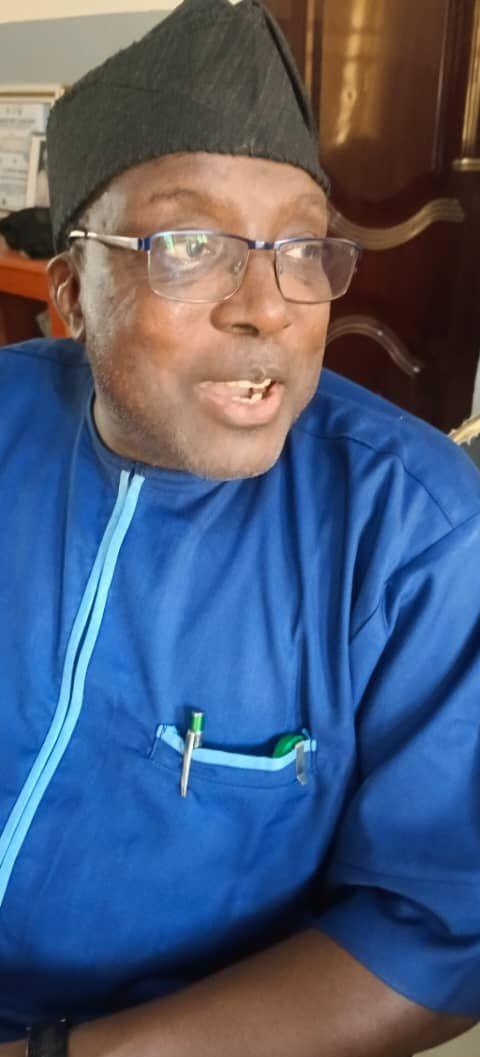
The newly redeployed Resident Electoral Commissioner (REC) in Kwara State, Mr Hale Gabriel Longpet, has disclosed plans by the Independent National Electoral Commission (INEC) to significantly increase the state’s voter population ahead of the 2027 general elections.
Mr Longpet made this known during a chat with newsmen in Ilorin, the capital of Kwara State, North Central Nigeria, where he explained that a major part of his mandate is to improve voter participation, both in registration and turnout.
He expressed concern that Kwara, despite its pivotal role in Nigeria’s political history, had only 1,695,927 registered voters as of the last general election, with 1,537,275 collecting their Permanent Voter Cards (PVCs), amounting to 90.6 per cent collection rate.
“I believe that with the population of Kwara and its strategic relevance, we should have more people registered. My target is to raise the voting population in the state beyond the current figure,” Longpet said.
To this end, INEC is set to kick off the Continuous Voter Registration (CVR) exercise on August 18, 2025 for the online registration while the in-person registration will commence on the 25th of this month across all 16 local government area headquarters in the state, in addition to the state office in Ilorin making 17 registration centres in total.
According to Longpet, the CVR will capture eligible Nigerians who recently turned 18, allow voters to transfer registration due to relocation, replace lost PVCs, and correct errors in names or other personal data. He emphasised that only Nigerians aged 18 and above who have not previously registered are eligible for fresh registration.
“The registration is not starting afresh; it is continuous, and that’s why it’s called Continuous Voter Registration. Many young people have become eligible since the last exercise in 2022,” he explained.
INEC, he added, would also make uncollected PVCs available at the registration centres, enabling those who missed out in previous distribution rounds to retrieve their cards.
The REC also revealed that he would embark on a tour of all 16 local governments in Kwara in the coming weeks as part of sensitisation efforts, particularly to reach hard-to-access areas such as riverine communities.
“We are starting at the local government headquarters, but if the Commission deems it necessary later, we may expand to ward levels as we did previously. We understand the terrain and are planning accordingly,” he said.
He stressed that INEC is working in collaboration with stakeholders including the National Orientation Agency (NOA), traditional institutions, civil society organizations, and the media to ensure widespread public enlightenment.
The Interagency Consultative Committee on Election Security (ICCES) is also on board to provide security support during the exercise.
Mr Longpet also addressed the issue of voter apathy, stating that many Nigerians still believe their votes don’t count, an assumption he described as false and dangerous to democratic development.
“People think their votes won’t count, but that’s not true. INEC has put in place credible systems like the Bimodal Voter Accreditation System (BVAS) to ensure only legitimate votes are cast and counted,” he stated.
He acknowledged that voter intimidation and violence in some areas discourage participation but assured that the Commission, with support from security agencies, is working to create safer voting environments.
On the issue of political cross-carpeting, Longpet clarified that INEC does not have the power to declare seats vacant following defections by elected officials.
He explained that it is the responsibility of the legislature, either the Speaker of the House of Assembly or Senate President—to notify INEC of any such developments before action can be taken.
Similarly, he reiterated that the conduct of local government elections lies solely with the State Independent Electoral Commissions (SIECs), and INEC’s only contribution is to provide the voter register upon request.
He disclosed that INEC has made submissions to the National Assembly concerning electoral reforms, including the possibility of diaspora voting and early voting for electoral officials.
“These proposals are currently under legislative consideration. We await the outcome,” he noted.
Responding to a question on the viability of electronic voting, Longpet admitted that while desirable, the current infrastructure across Nigeria cannot support it.
“There are areas in Plateau State, for instance, where there is no network coverage at all. Until such gaps are bridged, full electronic voting remains impractical,” he said.
Longpet, who served as REC in Kogi before his redeployment, said his priority is to ensure inclusiveness, transparency, and voter confidence throughout his tenure in Kwara.
“I want to leave Kwara State with a higher and more active voter base than I met. That would be my legacy,” he added.