

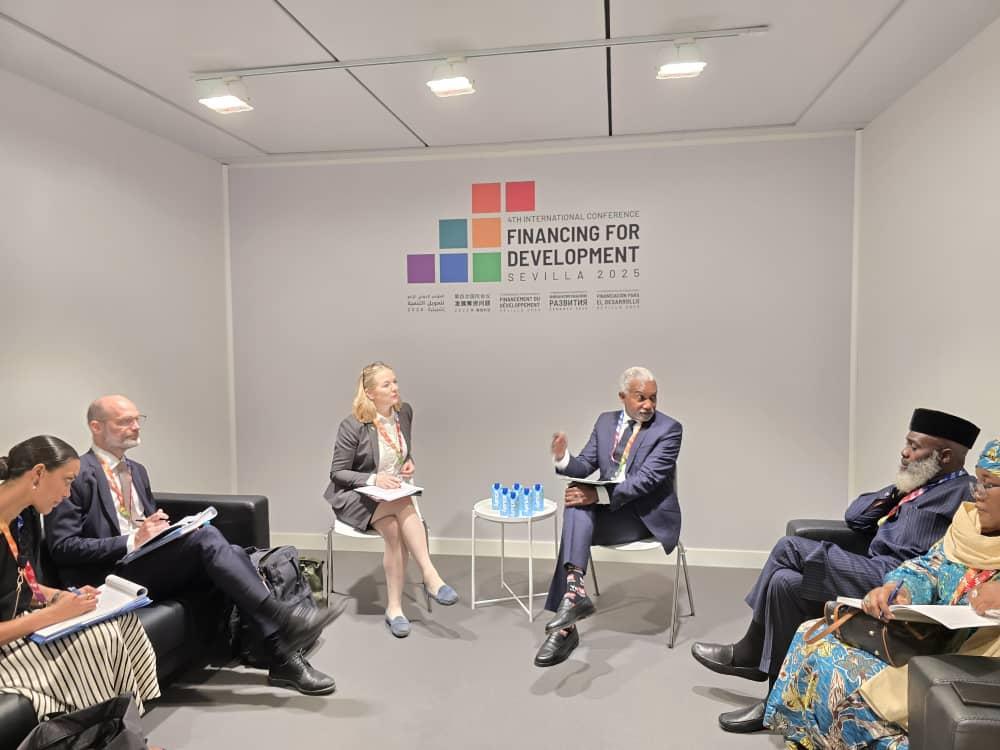
Nigeria’s Minister of Foreign Affairs, Ambassador Yusuf Tuggar, has reaffirmed the country’s commitment to financial inclusion, economic empowerment, and global financial transparency.
He stated this during the Fourth International Conference on Financing for Development (FFD4) in Spain.
According to a statement signed by the Minister’s Special Assistant on Media and Communications Strategy, Mr Alkasim Abdulkadir, Tuggar delivered Nigeria’s national statement on behalf of President Bola Ahmed Tinubu,
He highlighted Nigeria’s strategic efforts to scale up its development finance infrastructure, saying the country is focused on empowering women and youth through access to funding for micro, small, and medium-sized enterprises (MSMEs).
He noted that “Nigeria is scaling up the capacity of development finance institutions like the Bank of Industry and Bank of Agriculture to support micro, small, and medium-sized enterprises, especially women and youth-led businesses.”
The Minister decried the loss of over $88.6 billion annually from Africa due to illicit financial flows, stressing that domestic resource mobilisation alone is insufficient.
He stated that “In response, Nigeria has embraced digitalisation, overhauled its revenue systems, and launched a Beneficial Ownership Register to promote financial transparency and fight financial corruption. We call on all countries to adopt open beneficial ownership registers and support the establishment of a global registry.”
On fiscal reforms, the Minister said Nigeria is taking bold steps to increase its tax-to-GDP ratio and improve its economic outlook. He noted that President Tinubu recently signed comprehensive tax reform bills into law, which aim to raise the country’s tax-to-GDP ratio to 18 per cent by 2025, introduce a global minimum tax for multinationals, and increase VAT to 12.5 per cent by 2026.
According to him, “Our government has taken bold measures to improve fiscal responsibility and reallocate resources toward productive investments. One of the earliest reforms of President Tinubu’s administration was the removal of fuel subsidies—a tough but necessary decision. We also unified our exchange rate, increasing market transparency.”
Ambassador Tuggar added that “These reforms are already bearing fruit. Nigeria’s credit rating has improved, and in 2024, our economy recorded its fastest growth in a decade. Our tax-to-GDP ratio rose from 10 per cent to 13 per cent within a year.”
He reaffirmed Nigeria’s support for the United Nations Tax Convention and its preference for a more inclusive global tax framework, noting that “Nigeria played a vital role in delivering the UN Tax Convention. It is a much better, much fairer deal than the OECD Two-Pillar Tax Initiative.”
He added that “We have a common interest in giving a real voice in the global financial architecture. We urge a similar spirit of bold thinking to address the burden of debt repayments that undermine the prospects of so many poorer countries.”
On the sidelines of the FFD4 conference, Ambassador Tuggar served as keynote speaker at the launch of the Green Guarantee Group (GGG), where he reiterated Nigeria’s commitment to green financing and the Sustainable Development Goals.
The Minister also held high-level bilateral meetings aimed at strengthening Nigeria’s global partnerships. In a meeting with the Executive Secretary of the United Nations Capital Development Fund (UNCDF), both parties discussed enhanced cooperation for job creation and SME development in Nigeria, with plans to sign a Memorandum of Understanding to provide interest-free loans and broader support for small businesses.
In a separate meeting with Sweden’s Vice Minister for Foreign Affairs, Ambassador Tuggar sought Swedish technical assistance for implementing Nigeria’s tax reforms and lobbied for Sweden’s support of Nigeria’s bid for a non-permanent seat on the United Nations Security Council for the 2030–2031 term.
These engagements, according to the Foreign Ministry, highlight Nigeria’s proactive diplomacy and its continued commitment to building inclusive and sustainable economic growth for its citizens.
PIAK