

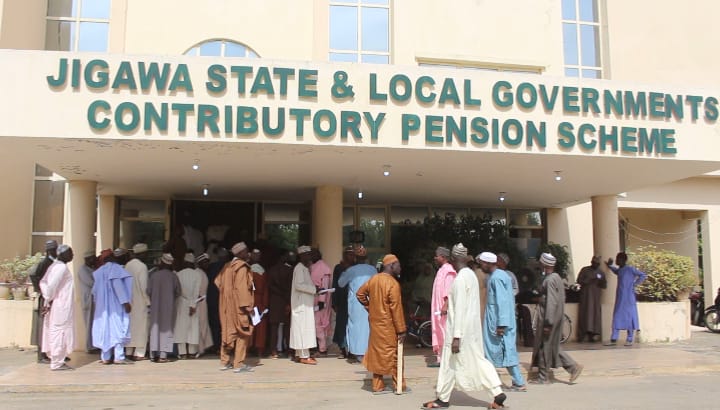
The Jigawa State and Local Governments Contributory Pension Scheme Board has disbursed over ₦1.4 billion to 564 retirees and beneficiaries as part of efforts to strengthen pension administration and workers’ welfare in the state.
The disbursement was announced at the Pension House in Dutse, where the State Accountant General, Alhaji Abdullahi Shehu, described Jigawa’s pension administration model as one of the most effective in the country, attracting interest from other states seeking to replicate its structure.
Shehu reaffirmed the commitment of Governor Umar Namadi to the welfare of civil servants and retirees, noting that since assuming office in May 2023, the administration has injected over N11 billion into strengthening the pension scheme.
According to him, “this sustained investment has ensured prompt payment of retirement benefits, including entitlements of officers who died in active service.*
He further highlighted that Jigawa State is among the few states to fully implement the new national minimum wage of N70,000, offering one of the most competitive salary packages for public servants in Nigeria, an achievement increasingly cited in national labour and governance discussions.
Providing a breakdown of the payments, the Executive Secretary of the Pension Board, Dr. Binyaminu Shitu Aminu, disclosed that a total of N1,429,201,208.92 was approved for the exercise.
He said N1,191,804,237.17 was paid to 485 civil servants who retired from active service, while N226,547,197.84 went to the families of 71 deceased officers.
An additional N10,849,773.91 was disbursed to families of eight pensioners as death pension balances.
Dr. Aminu reaffirmed the Board’s commitment to timely and transparent pension payments, stressing that monthly pensions are consistently paid on the first day of every month.
He added that “the Jigawa model demonstrates that effective pension management is achievable through political will, discipline, and prudent financial planning.”
As pension arrears and delayed gratuities continue to challenge many states across the federation, Jigawa’s approach is increasingly viewed as a national reference point in ensuring a secure and dignified post-service life for Nigerian workers.