

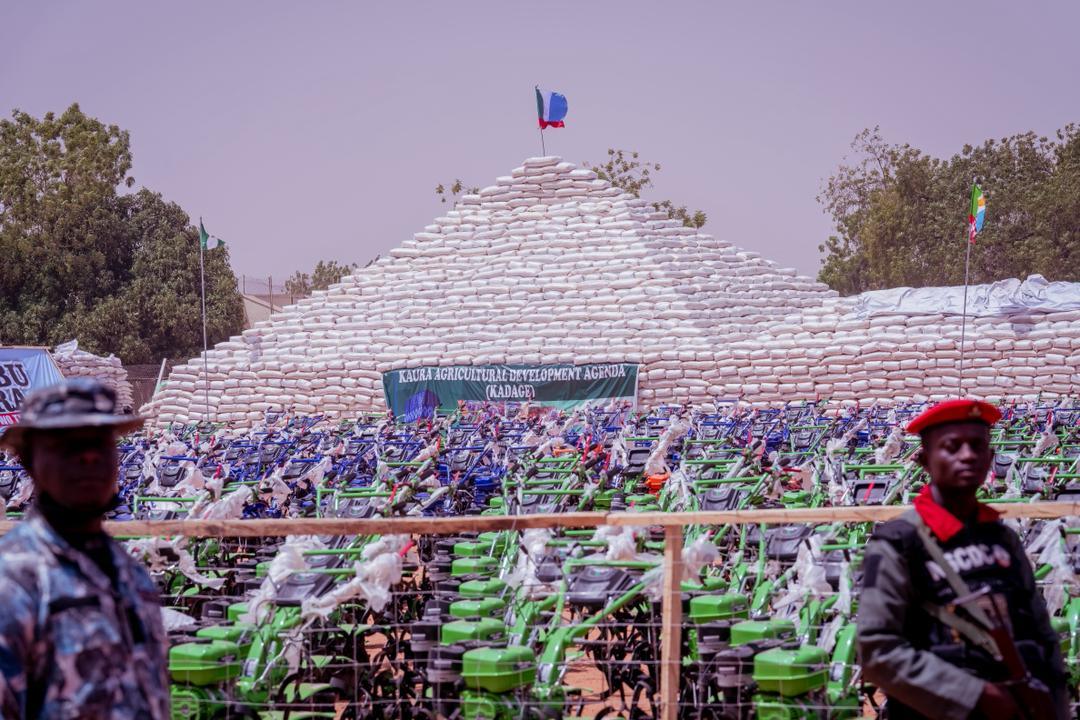
The Kebbi state government has flagged off the distribution of farming inputs and Ramadan palliatives across the state.
The Minister of Agriculture and Food Security, Abubakar Kyari, who was at the launch of the Kaura Agricultural Development Agenda (KADAGE) in Birnin Kebbi, the state capital commended Kebbi State’s commitment to agricultural development.
He described Kebbi as a state where agriculture shapes the economy and sustains livelihoods while noting that more than 80 percent of the population is engaged in farming and related activities, making agriculture central to the state’s identity and economic strength.
Kyari emphasised that food security remains fundamental to national sovereignty and economic resilience, adding that President Bola Ahmed Tinubu has elevated agriculture to a strategic national priority.
He lauded Governor Nasir Idris for aligning with the federal government’s mandate to strengthen domestic production and deliver measurable results in food security.
The Minister praised Kebbi’s long-standing leadership in rice production, noting that the state has progressed beyond primary cultivation to structured value addition and agro-industrial growth. He highlighted the role of major rice mills in processing paddy into high-quality finished products for national markets.

Kyari also referenced the commissioning of fortification and quality control equipment at the Takalau Rice Mill, describing it as one of the few facilities in Nigeria capable of producing fortified rice. According to him, the facility bridges smallholder farmers with commercial-scale processing while meeting premium standards.
He assured that the Federal Ministry of Agriculture and Food Security would continue to support Kebbi State’s agricultural transformation and urged farmers to embrace innovation and technology. He also called for greater inclusion of youth and women in agricultural enterprises to sustain productivity and growth.
In his address, Kebbi State Governor Nasir Idris described the occasion as a significant milestone in the state’s agricultural transformation drive.
He said the Kaura Agricultural Development Agenda (KADAGE) remains focused on empowering farmers, improving productivity, and strengthening food security.
According to the Governor, sustained investment in free farm inputs, machinery, and extension services demonstrates the administration’s commitment to boosting agricultural output and reinforcing both state and national economies.
Idris disclosed that Kebbi recorded steady growth in rice production, with annual output rising from 3.05 million tonnes in 2023 to 3.15 million tonnes in 2024. Projections for 2025, he added, remain strong.
He reaffirmed that “Kebbi continues to rank among Nigeria’s leading rice-producing states, noting that other major crops have also recorded consistent increases”.
The Governor also announced the launch of the 2026 dry season farming programme, explaining that Kebbi operates two production cycles within a single dry season to maximize output.
He revealed that the state is distributing 2,000 solar-powered pumps, 5,000 power tillers, 5,500 sprayers, 24,000 litres of herbicides, 70,000 litres of liquid organic fertilizer, and 5,000 tonnes of assorted fertilizers to farmers across the state.
In addition, 6,500 tonnes of assorted grains including rice, maize, and millet are being distributed as Ramadan palliatives to support vulnerable residents during the holy month.
Idris stated that beneficiaries were carefully selected in collaboration with traditional rulers and farmers’ groups, warning that no substitutions would be tolerated.
He directed the distribution committee to ensure fairness and transparency and cautioned political office holders against diverting items meant for grassroots beneficiaries.
“Security agencies, he added, have been instructed to arrest anyone found selling the distributed inputs”.
Earlier, the Commissioner for Agriculture, Alhaji Shehu Mu’azu, said the event marked the third edition of the large-scale distribution initiative under the current administration. He described the programme as fulfillment of the governor’s promise to directly support farmers and improve livelihoods through practical interventions.
Mu’azu highlighted the expansion of solar-powered pump distribution from an initial 1,000 units to nearly 15,000 units over time. He stressed that the machinery and inputs are provided free of charge to enhance production capacity.
Speaking on behalf of beneficiaries, Alhaji Hayatu Muhammad from Birnin Kebbi thanked the governor, noting that more than one million farmers are expected to benefit from the initiative. He assured that recipients would utilise the items responsibly to boost productivity and support food security.
Also speaking, the Vice President of the Rice Farmers Association of Nigeria (RIFAN) Malam Auwal commended the governor’s sustained support for farmers and efforts to strengthen rice production in the state.