

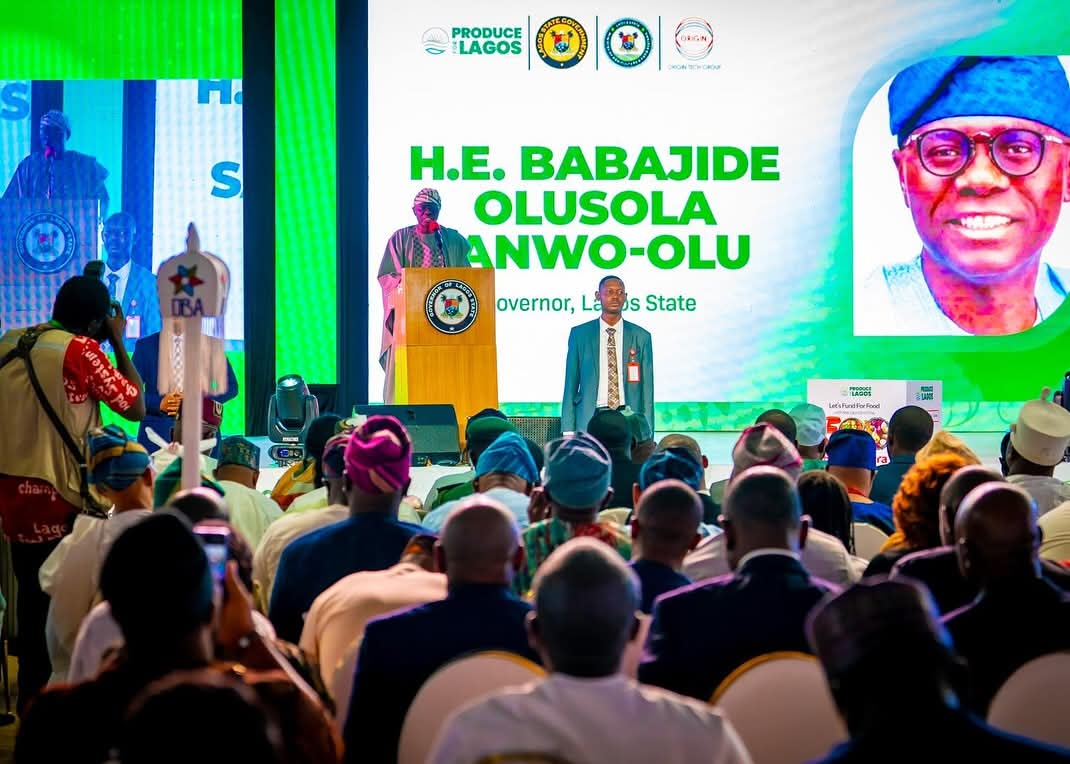
The Lagos State Government has launched a ₦500 Billion Food Offtaker Guarrantee Fund towards enhancing food security and agricultural productivity in the state.

The programme according to the government was designed to ensure stable food supply and development of a modern, efficient food value chain through public-private partnership.
Speaking during the launch of the initiative held at the Lagos House Ikeja, Lagos State Governor, Mr Babajide Sanwo-Olu said that the idea is to catalyse private sector investment in agriculture and food systems, boost agricultural output and improve food logistics and storage infrastructure.

Governor Sanwo-Olu who described the launch of the program as a watershed moment towards the drive to make Lagos food-secure and self-reliant, expressed optimism that the programme would provide guaranteed off-take contracts, access to financing, and connecting Lagosians directly with Lagos’s dynamic food economy.
He stressed further that the initiative will boost agricultural production and reduce reliance on informal and uncoordinated supply channels, create jobs for our youth and increase economic returns for all ecosystem stakeholders.

“It will be implemented through the Lagos Food Systems Infrastructure Company (LAFSINCO) and supported by key Special Purpose Vehicles like the Lagos Bulk Trading Company, Ekolog (Eko Logistics), and the Produce for Lagos Fund.
“This ₦500 Billion Offtake Guarantee Fund will provide working capital for bulk traders, finance for logistics operators, liquidity for aggregators, and credit support for food producers across Nigeria. It is a demonstration of our understanding that our food economy cannot thrive on policy alone – it requires financing.
“This fund is not a subsidy; it is an investment vehicle that will catalyse private capital, stabilise food prices, and de-risk agricultural operations across the value chain. What we are doing here is creating a whole new agricultural ecosystem, one that rises to meet the demands of today and of tomorrow—combining policy, financing, infrastructure, and data.” Sanwo-Olu said.

The Governor called on all state governors, financial institutions, development organisations, foreign missions and diplomatic representatives from our valued partner nations, regulatory bodies, multilateral organisations, captains of industries, our able farmers nationwide, and other relevant value chain actors to produce for Lagos.
According to him “Let us rise together to feed this nation sustainably. Let us collaborate across borders, build resilient infrastructure, support, and secure our food future not just for Lagos but for Nigeria. Let us lead, let us inspire, and let us grow for the prosperity of our people and the greatness of our country.”
State counterparts
Speaking during the event, Governors Dapo Abiodun of Ogun State, Mohammed Bago of Niger State, Agbu Kefas of Taraba and Usman Ododo of Kogi commended Governor Sanwo-Olu and the Lagos State Government for the bold initiative on food security.
The governors, whose states are expected to be major beneficiaries of the Produce for Lagos Programme and ₦500 billion Offtake Guarantee Fund, expressed readiness to partner with Lagos State in the areas of comparative advantages in boosting food security, not only in Lagos but in Nigeria.
Applauding partnership
Also speaking, the Minister for Digital Economy, Bosun Tijani; the Minister of Livestock, Idi Maiha; and the Minister of State for Finance, Doris Aniete, hailed the Lagos State government for the Produce for Lagos Programme, noting that it underscores the state’s commitment to food security and partnership with other states.
The Chief of Defence Staff, General Christopher Musa, expressed his confidence in the initiative, stating that it would work well in addressing food security challenges in the state, while expressing the readiness of the Armed Forces of Nigeria to support the Produce for Lagos Programme initiative, which, according to him, will tackle hunger in the country.
Sustaining Food Systems
In her remarks, Lagos State Commissioner for Agriculture and Food Systems, Ms. Bisola Olusanya, maintained that the State government is desirous of building and sustaining a truly sovereign food system that will provide for the future.
Olusanya stressed that the initiative is a bold and history-shaping intervention to rewire the food chain, reconnect rural abundance with urban demand, and reward those who farm, trade, transport, and nourish the Nigeria’s population.
“This is the justice demanded of us by the tomato farmer in Zaria whose harvest rots by the roadside, for the pepper trader in Mile 12 who pays double for logistics yet earns half for her labour, and for the millions who sleep hungry not because we lack food – but because we lack systems.
“Produce for Lagos is not just a policy but a promise, that Lagos, Africa’s largest urban consumer base, will no longer be fed by chance, but through coordination, commitment, and shared responsibility. And the ₦500 billion offtaker Guarantee Fund serves as the anchor that will give offtakers the confidence to buy, farmers the assurance to plant, financiers the boldness to invest, and Nigerians the certainty of daily nourishment.
“This is not the beginning of the journey but a summit that has been patiently and intentionally climbed since the start of this administration in 2019.
“It began with a vision cast in strategy with the unveiling of the Lagos State 5-Year Agricultural and Food Systems Roadmap, which laid the groundwork for everything we celebrate today.” she said
The Commissioner mentioned that the state has taken audacious steps with other initiatives such as the Lagos Fresh Food Hubs, Lagos Agrinnovation, Club, Eko Flavours, Lagos Food Festival, Lagos Agric Scholars’ and Lagos Agripreneurship programmes, Ounje Eko initiative among others, stressing that “Produce for Lagos” is not just about Lagos, but linking the city to every root, stalk, and grain grown across the federation.
She however emphasised that the programme is a blueprint for how the private sector and states can collaborate, not compete, in the work of feeding the people.
Oyenike Oyeniyi