

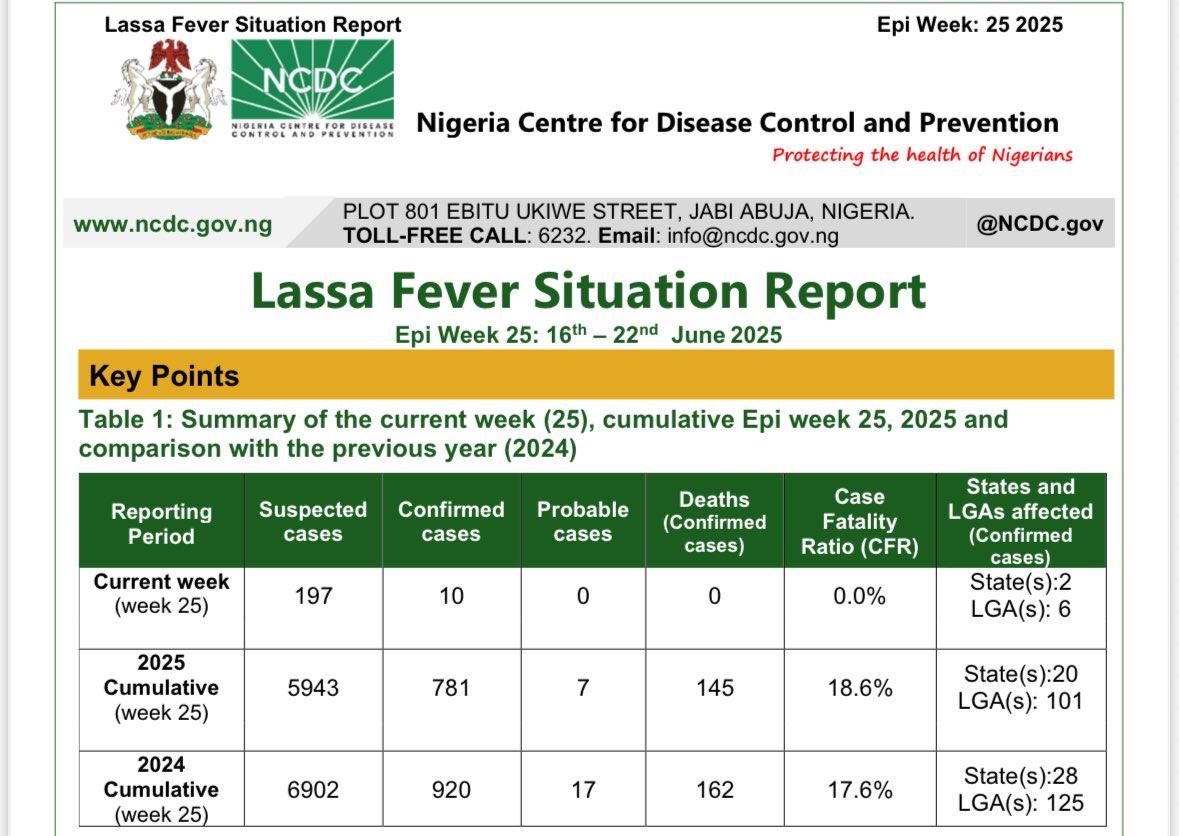
The Nigeria Centre for Disease Control and Prevention (NCDC) has confirmed that 145 Nigerians have died from Lassa fever complications as of the 25th epidemiological week of 2025, covering the period from 16th to 22nd June.
This translates to a Case Fatality Rate (CFR) of 18.6%, marking an increase from the 17.6% CFR recorded during the same period in 2024.
According to the NCDC’s weekly Lassa Fever Situation Report, a total of 5,943 suspected cases have been reported so far in 2025, of which 781 have been laboratory-confirmed.
“During the current reporting week, 197 suspected cases were recorded, with 10 confirmed positive—up from eight in the previous week.
“These new cases were reported from Ondo and Edo States,” the report stated.
Since the beginning of the year, 20 states and 101 Local Government Areas (LGAs) have recorded at least one confirmed case of Lassa fever.
📢 Lassa Fever Update – Week 25, 2025
10 new confirmed cases were reported in Ondo & Edo States.
So far this year:
🔸 781 confirmed cases
🔸 145 deaths
🔸 CFR: 18.6% (↑ from 17.6% same period in 2024)
🔸 91% of cases from 5 states: Ondo, Bauchi, Edo, Taraba & EbonyiStay… pic.twitter.com/0UsWPCZBpx
— NCDC (@NCDCgov) July 5, 2025
However, five states alone account for 91% of all confirmed cases, underscoring the concentration of the outbreak in specific regions. These include:
- Ondo State (31%)
- Bauchi State (24%)
- Edo State (17%)
- Taraba State (16%)
- Ebonyi State (3%)
The most affected demographic remains individuals aged 21 to 30 years, with a median age of 30.
The male-to-female ratio among confirmed cases is 1:0.8, indicating a slightly higher prevalence among males.
While no new healthcare workers were infected during the week under review, 23 healthcare workers have been affected so far in 2025.
Read Also: Pharmacist Association Announces 44th International Conference in Anambra
The NCDC attributed the persistently high death toll to factors such as late presentation of cases, poor health-seeking behaviour, and low public awareness, particularly in high-burden communities.
In response, the national Lassa fever multi-sectoral Technical Working Group continues to lead coordination efforts involving various stakeholders. Ongoing interventions include:
- Enhanced disease surveillance and case management
- Intensified contact tracing
- Distribution of essential medical supplies
- Public health awareness and risk communication campaigns
Additionally, clinician sensitisation activities have been conducted in high-risk LGAs, alongside capacity-building webinars and stakeholder engagements to strengthen preparedness and response.
To bolster infection control, the NCDC has launched an Infection Prevention and Control (IPC) e-learning platform, and continues to collaborate with partners such as WHO, ALIMA, IHVN, UNICEF, and Georgetown University.
Despite ongoing efforts, the agency reiterated the urgent need for improved environmental sanitation, timely health-seeking, and wider community education to mitigate the spread of Lassa fever, which remains a serious public health threat in Nigeria.