

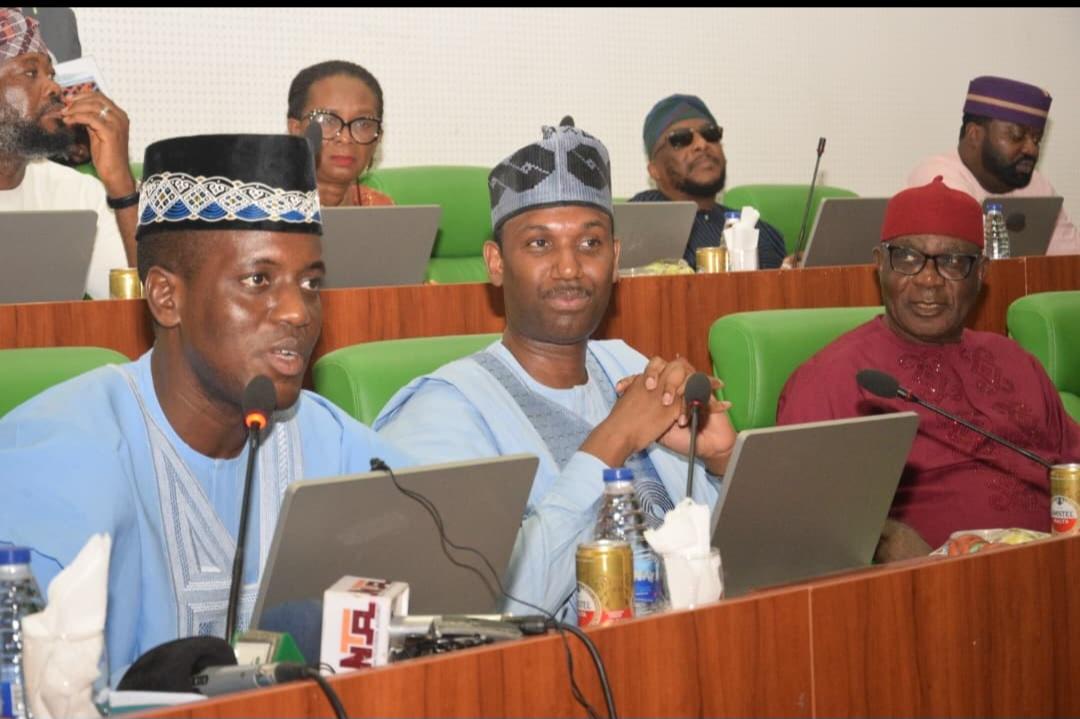
The House of Representatives says Nigeria must move from a nation of consumers to a powerhouse of producers.
The chairman of the House committee on Commerce, Mr. Ahmed Munir Lere, made the disclosure during the joint 2026 budget defence session for Ministries, Departments and Agencies under the committee, in Abuja.
He said that the committee’s priorities for the budget session are anchored on three pillars:
“Domestic Production: We must move from being a nation of consumers to a powerhouse of producers. We will scrutinise how this budget supports local content and “Made in Nigeria initiatives.
SME Empowerment: Small and Medium Enterprises are the heartbeat of our economy. This budget must prove it has the “oxygen” to keep that heart beating through accessible credit and reduced ease-of-doing-business bottlenecks.
Trade Expansion: With the African Continental Free Trade Area in full swing, Nigeria cannot afford to be a spectator. We must invest in the infrastructure of commerce—standardisation, certification, and digital trade.”
He urged the MDAs present to be transparent, “We expect data-backed projections. But more importantly, we expect human compassion behind the numbers. When you defend your capital expenditure, tell us how many jobs it creates. When you propose a new trade policy, tell us how it lowers the cost of goods for the average Nigerian.
“We are here as partners in progress, but we are also here as the eyes and ears of the Nigerian people. We will be firm where there is waste, and we will be supportive where there is vision,” Mr. Lere said.
He noted that the entire Budget must be built around the ministry with an advisory on which projects create optimal economic impact from key roads, agriculture policy, to advancing water inland waterways to reach ports in Boro and Makurdi, and so much more.
“Together, let us build a budget that doesn’t just “spend” but “invests” in the future of every Nigerian,” he added.
In her presentation , the Minister of Industry, Trade and Investment, Dr. Jumoke Oduwole, said that Nigeria’s total capital importation rose to approximately $21 billion in the first 10 months of 2025, marking a sharp increase from about $12 billion in 2024 and less than $4 billion in 2023.
She described the growth as evidence of renewed investor confidence and the impact of targeted reforms under President Bola Tinubu’s Renewed Hope Agenda.
She also attributed the recovery to deliberate ministry interventions, including the curation of over $5 billion in bankable projects, the establishment of sector-specific deal rooms, and the hosting of Nigeria’s inaugural Domestic Investors’ Summit. According to her, these initiatives re-engaged domestic capital, unlocked financing pipelines, and resolved about 50 long-standing investor bottlenecks, thereby accelerating the transition of projects from proposal stage to implementation.
The minister disclosed that the ministry also undertook more than 100 bilateral investment engagements across key global markets, including the United Arab Emirates, Brazil, Japan, the United States, and the United Kingdom.
She noted that sustained engagement under the Nigeria–UK Economic and Trade Partnership, which commenced in the second quarter of 2024, yielded tangible results, with UK investors accounting for approximately 65 per cent of Nigeria’s foreign capital inflows in 2025.
She also pointed out that the ministry intensified efforts to promote non-oil exports, improve market access for Nigerian goods, and strengthen quality infrastructure to meet international standards. She added that Special Economic Zones contributed significantly to industrial diversification, generating over $500 million in export revenues and creating more than 20,000 direct jobs.
Despite the positive trajectory, the minister appealed for an upward review of the ministry’s proposed ₦2.72 billion capital allocation for 2026, warning that the amount would be insufficient to sustain momentum and execute priority programmes at scale.
She recalled that in 2024, the ministry had a total appropriation of ₦14.39 billion, with Personnel and Overhead allocations fully utilised, while 93.2 per cent of the ₦8.36 billion capital allocation was released and fully expended. Revenue performance that year exceeded target by approximately ₦154 million, with full remittance to the Consolidated Revenue Fund.
She stressed that the 2026 budget framework prioritises implementation advancing industrial policy through value chain development, industrial clusters, and the expansion of Special Economic Zones, as well as strengthening trade facilitation and investment promotion.
“The emphasis remains ‘Nigeria First’, prioritising local production, supporting non-oil exports, and deepening domestic investment,” she said.
“Domestic investors will remain the anchor and strongest signal of confidence in the economy, while global investors will continue to be engaged through reverse trade missions and in-country investment visits,” she added.