

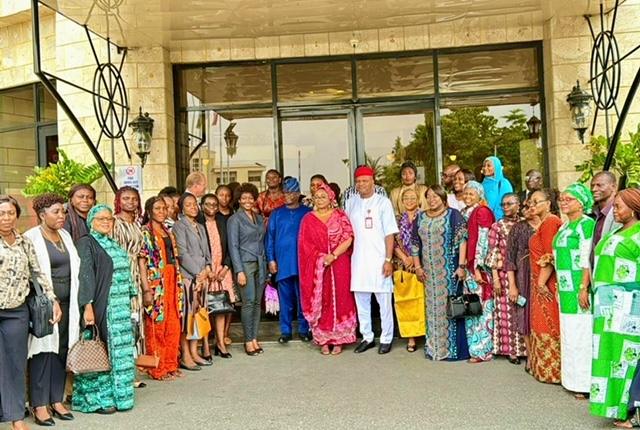
Women Affairs Minister, Hajiya Imaan Sulaiman-Ibrahim has supported the policy need for a clear national categorisation for women-owned businesses, that focuses on Nigerian realities and embodies nationally backed collective resolve to place women at the very centre of Nigeria’s economic architecture.
Addressing a Business Breakfast Dialogue in Abuja, the Minister said Nigerian Women are building the economy from the ground up, yet they remain largely invisible due to the absence of a national definition which recognises and empowers their enterprises.
She said “despite the well-documented contributions of women entrepreneurs in every sector – from agriculture and retail to manufacturing and digital innovation we still do not have a nationally recognised definition of a women-owned business; that absence creates a blind spot. It leads to policy gaps. It excludes women from financing, procurement, and investment. It weakens our gender-disaggregated data systems. Most importantly, it limits our ability to close the gender gap in enterprise,”
The Minister noted that no country can build inclusive prosperity, if it leaves half of its population out of economic ownership, as such the economic empowerment of women is a smart investment and a necessity for national competitiveness.
“We cannot empower what we do not define, and we cannot design effective policy.
Under the Renewed Hope Agenda of President Bola Ahmed Tinubu, GCFR, there is a clear recognition of the role of women in building the 1 Trillion dollars economy.”
While stratifying business ownership layers in Nigeria as sometimes informal, sometimes shared within families, and often shaped by cultural norms that limit formal shareholding by women, Sulaiman-Ibrahim called for flexible tiered definitions, to account for ownership, leadership, signatory power, and control.
“… as we expand the definition, we must also protect its integrity. We must avoid tokenism and fronting. Certification, verification, and even community-based validation mechanisms must be put in place, because a definition that cannot be enforced is as dangerous as having no definition at all…,” she added.
The Minister called for the removal of structural and procedural hurdles that block women from accessing capital, markets, and opportunity; and this starts with a clear and inclusive definitions, reaffirming that when women thrive economically, families eat better, children go to school, and communities are safer, .
Making submissions on the way forward, Sulaiman-Ibrahim called for affirmation of a working national definition, grounded in 51% ownership, while keeping room for future refinement; integrating the definition into Nigeria’s national economic and investment frameworks; across procurement, tax policy, regulatory reform, and MSME strategy, and the co-development of a certification and verification framework that is credible, inclusive, affordable, and accessible to women in every corner of Nigeria.
“…this conversation is not only about defining a business category, but it is about defining our values. It’s about saying to every Nigerian woman: we see you, we recognise your enterprise, and we are creating space for you to grow.Let us leave with a shared commitment and a pathway to action. Let us ensure that our daughters inherit an economy where they are not just operators, but owners. Not just contributors, but leaders,” she opined.
The Businesses Dialogue was hosted by the Abuja Chamber of Commerce and Industry (ACCI) and Investment Climate Reform (ICR) Facility.
Hauwa Abu