


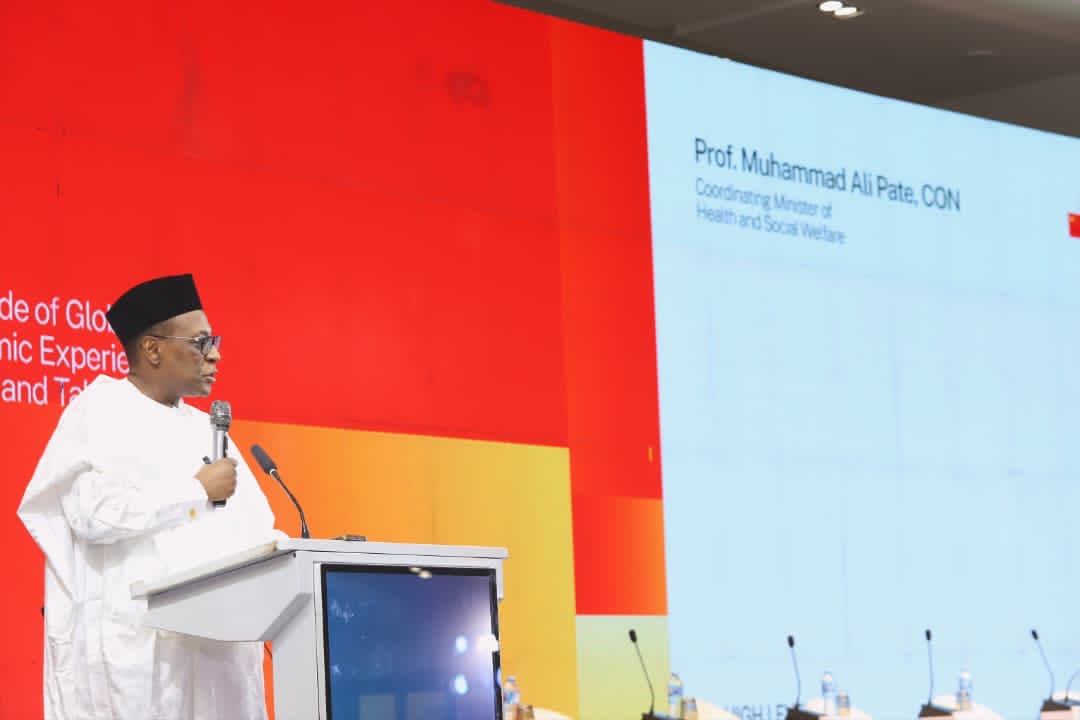
The Coordinating Minister of Health and Social Welfare, Professor Muhammad Ali Pate, has called for sustained investment in pandemic preparedness, warning that future global health crises are inevitable and require proactive measures rather than reactive responses.
Professor Pate made the call during a high-level public health symposium on pandemic preparedness and response, with insights from China and Nigeria, held in Abuja.
The Coordinating Minister highlighted the constant threat posed by infectious diseases like influenza, Ebola and coronaviruses.
“That brought home the risk that we constantly face,” he said, stressing the strong link between human health, the environment and animal populations.
“Pandemics do not start overnight; they start from an outbreak and grow until they cover the entire world,” he stated, saying that history, from the Spanish flu to COVID-19, shows how infectious diseases have consistently disrupted human civilisation.
“It is not just a purely public health issue; it is an economic security issue and also a national security issue,” he emphasised, pointing to the massive global economic losses during COVID-19 and the disruption of economic activities in Nigeria during the 2014 Ebola outbreak.
On lessons learned, the Minister stressed the need for continuous and proactive preparedness through investment in resilient health systems, strong public health institutions and a well-trained workforce.
He commended the role of the Nigeria Centre for Disease Control in coordinating national responses.
“Preparedness must be continuous, must be proactive, and we must invest in it,” he stated.
“Frontline health workers are the lifeblood of a response,” he said, revealing that nearly 79,000 health workers have been retrained in recent years to strengthen emergency response capacity.
Strengthening Research
He further advocated strengthening research, innovation and digital health systems, noting that Nigeria must transition from being a contributor to global health knowledge.
“We do not have to be net consumers of global knowledge; Nigeria can be a contributor,” he said, while stressing that global collaboration remains critical, drawing lessons from China’s response to COVID-19.
The Minister urged stakeholders to act decisively on lessons learnt. “It is not a matter of if, but when,” he warned.
Earlier, the Minister of State for Health and Social Welfare, Dr Iziaq Adekunle Salako, described pandemics as major threats to humanity, calling for urgent global preparedness.
“Pandemics are one of the most disruptive and most brutal killers in human history the next outbreak is not if but when.
“It reminded us that infectious diseases know no borders and revealed that even the wealthiest nations could be brought to their knees,” Salako said.
“Nigeria fared reasonably well… despite its weak health system,” he said, attributing the outcome to coordinated national efforts, strong leadership and support from partners.
Salako emphasised that Nigeria and China have valuable lessons to share in managing future health emergencies.
“Our two countries therefore have a lot to learn from each other and to teach the world,” he added.