


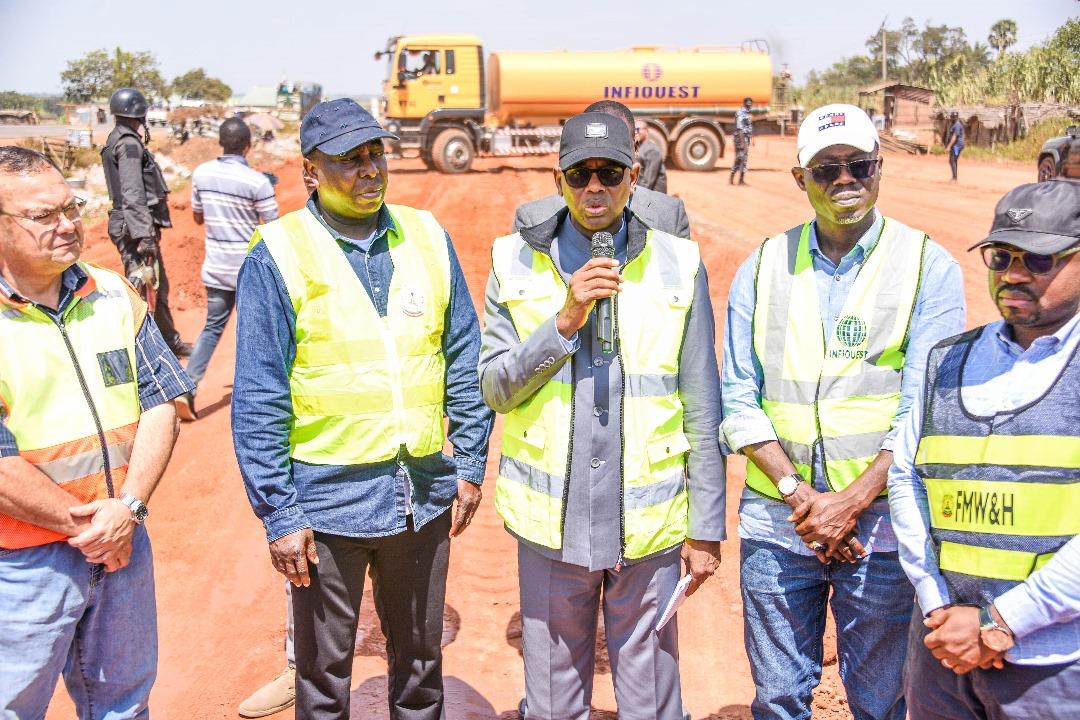
The Nigerian government has called on community leaders, traditional rulers and citizens to take ownership of road infrastructure and protect them from misuse and vandalism.
The Minister of State for Works, Mr Bello Goronyo made the call when he inspected sections of the Abuja–Kaduna–Zaria–Kano Expressway project in Northern Nigeria.
Goronyo expressed concern over rising cases of vandalism and misuse of newly constructed and ongoing road projects across the country, warning that “such acts threaten the lifespan and safety of the infrastructure.”
He particularly pointed instances where individuals removed safety railings, damaged concrete pavements, or converted portions of the highway into refuse dumps and drying grounds—especially around the Jaji Bridge corridor in Kaduna State.

“Maintenance begins with discipline and public responsibility. We have observed people cutting through newly completed road sections or tampering with vital components. These acts of vandalism must stop immediately.
“The Renewed Hope Administration of His Excellency, Asiwaju Bola Ahmed Tinubu is committing enormous resources to the building of durable roads across the country. Every act of vandalism or road abuse undermines national progress and the deployment of taxpayers’ money to other critical national priorities,” the Minister said.
He further disclosed that the Section I (Abuja-Kaduna) of the project, spanning 144 kilometres, is progressing steadily across several active sections – from Tungan Maje and Jere to Katari, Kakau, Gonigora, and Agogo Junction—with significant work already completed in drainage, reinforcement, and the construction of the shoulders.
“So far, about 26 kilometres of continuous rigid concrete pavement and 15 kilometres of binder and wearing course have been completed. The President has made it clear that funding will not be a constraint. It is now a matter of work and getting paid,” he said.
Shedding more light on the durability of the road, the Acting Director, Highways, Bridges and Design at the Works Ministry, Mr. Musa Sa’idu explained that “the project design was upgraded from flexible (asphalt) to rigid (concrete) pavement, capable of lasting for about a century and withstanding the stress of heavy-duty and overloaded vehicles.”
The Senior Project Manager of the contracting company, Messrs Infiouest International Limited, Mr. Robert Turner, reaffirmed their commitment to engineering excellence, stressing that work is progressing seven days a week, with plans to introduce night shifts to accelerate completion.
“We are determined to deliver this project ahead of schedule. The government has demonstrated exceptional consistency in funding, and we are matching that commitment with performance,” Turner said.