

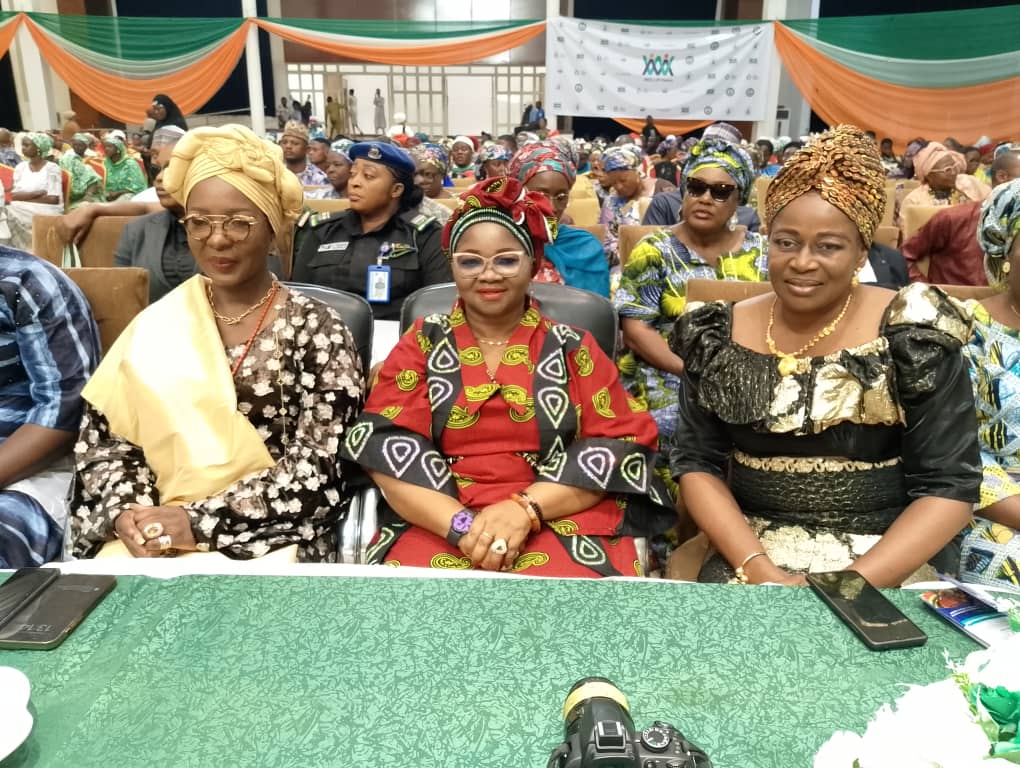
Kwara State has officially adopted the National Women’s Economic Empowerment (WEE) Policy, in a landmark event lauded by the Federal Government as a crucial step towards inclusive governance and national development.
Speaking at the launch ceremony, the Honourable Minister of Women Affairs and Social Development, Hon. Imaan Sulaiman-Ibrahim, who was represented at the event by her Special Assistant, Technical, Princess Jummai Idonije, praised Kwara State’s leadership for championing gender equality and setting a powerful example for the rest of the country.
“This domestication of the WEE Policy is not just a policy action; it is a declaration of collective will to build a gender-inclusive Kwara and a resilient Nigeria,” the Minister said.
Sulaiman-Ibrahim commended President Bola Ahmed Tinubu’s Renewed Hope Agenda, which she described as ushering in a new era of inclusive governance and economic empowerment.
She also acknowledged the First Lady, Senator Oluremi Tinubu, for her unwavering advocacy for women and families across Nigeria.
The minister equally commended the unwavering support of the First Lady of the Federal Republic of Nigeria, Senator Oluremi Tinubu, whose passion for advancing the well-being of women, children, and families is evident in her national interventions, policy advocacies, and motherly guidance to the women of Nigeria.
The Kwara State Governor Abdulrahman Abdulrazaq was hailed as a “true HeForShe champion” and a national leader in gender equity adding that as Chairman of the Nigeria Governors’ Forum, his administration has drawn attention for surpassing gender inclusion targets, making Kwara a beacon of progressive governance.
Special recognition was given to the First Lady of Kwara State, Ambassador Professor Olufolake Abdulrazaq, for her pivotal role in driving the policy’s domestication. The Minister described her efforts as “catalysing a broader wave of reform and innovation across the country.”
Traditional rulers, including the Emir of Shonga, HRH Dr. Haliru Yahaya, were also applauded for their active support in promoting women’s inclusion in governance and economic activities.
The WEE Policy aligns with Nigeria’s National Development Plan, the Sustainable Development Goals (particularly SDGs 1, 5, 8, and 10), and the African Union Agenda 2063 which aims to improve women’s access to finance, markets, decent work, land, technology, and leadership roles — particularly in both formal and informal sectors.
“With over 104 million women and girls in Nigeria — more than half our population — we cannot afford to sideline this demographic in our pursuit of national prosperity,” Sulaiman-Ibrahim emphasised.
“Empowering women strengthens families, reduces poverty, and enhances national stability,” he explained.
The Minister used the occasion to call for greater investment in the training and capacity-building of institutions responsible for implementing the policy. She stressed the need for stronger frameworks and increased budgetary allocations to ensure the policy translates into tangible outcomes for women across the state.
According to her, “To consolidate the gains we are making today, it is essential that we invest in the training and retraining of officers and institutions responsible for implementing the WEE Policy.
“Building capacity at all levels ensures not only policy coherence and sustainability but also positions Kwara State to become a model for other states. This effort will undoubtedly stand as part of the lasting legacy of the administration of Governor Abdulrahman Abdulrazaq.”
Highlighting Nigeria’s low levels of female political representation, just 4.3% at the federal level and 5.1% across state assemblies, the Minister urged Kwara lawmakers to support constitutional reforms, including the adoption of the Special Seats Bill for Women.
She praised Kwara for already having women in its House of Assembly, describing the state as a model of inclusive governance.
“This is not about tokenism,” she said. “It’s about correcting a representational imbalance that has held us back as a nation. When women are absent from decision-making tables, critical issues like maternal health, education, and gender-responsive budgeting are often inadequately addressed.”
She reaffirmed the commitment of the Federal Ministry of Women Affairs to support all states in the implementation of the WEE Policy, which she described as a core component of the national development agenda.
The domestication of the WEE Policy in Kwara marks a significant milestone in Nigeria’s journey toward gender equality, setting a precedent that other states are expected to follow in the coming months.