

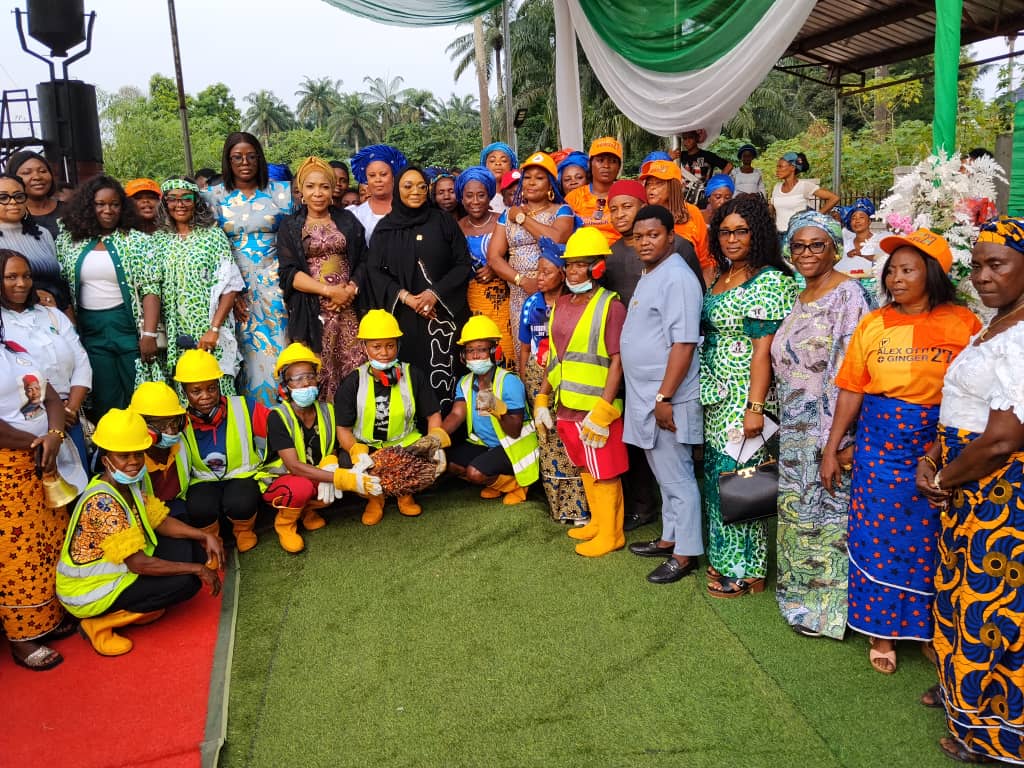
Nigeria’s Minister of Women Affairs and Social Development, Hajiya Iman Sulaiman-Ibrahim has commissioned two landmark projects in Abia State to advance women’s economic empowerment and strengthen protection systems for survivors of gender-based violence (GBV).
The Minister inaugurated the Nigeria for Women Programmes, “Osusu Abaala Women Palm-Oil Collective” in Isialangwa North Local Government Area and later launched the state’s Sexual Assault Referral Centre (SARC).
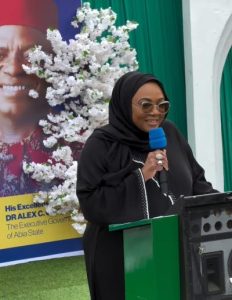
She described both initiatives as significant milestones in deepening women’s economic inclusion and reinforcing Nigeria’s protection architecture.
At the commissioning ceremony, attended by Governor Alex Otti and other dignitaries, Sulaiman-Ibrahim reflected on the progress made in advancing women’s economic inclusion under the administration of President Bola Tinubu.
“What we are witnessing today is not accidental; it is the result of deliberate policy, sustained partnerships, and the resilience of Nigerian women, while we are not there yet in terms of our ambition, the Nigeria for Women Project continues to push us closer to that reality,” she said.
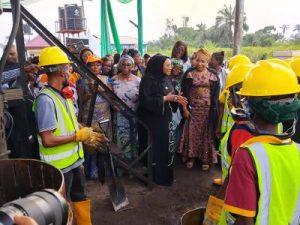
She described the palm-oil collective as a practical demonstration of organised women transitioning from fragmented informal activity to coordinated, market-oriented production that strengthens household incomes and local economies.
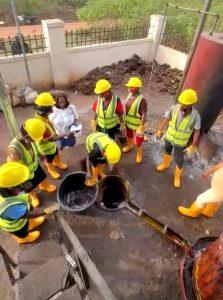
According to the Minister, “The Nigeria for Women Programme was designed to address longstanding structural barriers limiting women’s access to finance, markets, skills, and social capital.”
Scale up Phase
She noted that the programme’s Scale-Up phase, recently launched by President Tinubu, is targeting at least five million women nationwide as part of a coordinated national strategy on livelihoods, food security, and inclusive growth.
The Minister emphasised that the expansion is being implemented under the Renewed Hope Social Impact Interventions – 774 framework, integrating women’s economic empowerment, food security, social protection, and family resilience.
“To the women of Osusu Abaala, this facility is an economic asset and a collective responsibility. It must be governed transparently, managed efficiently, and sustained through accountability, reinvestment, and disciplined group leadership,” she charged.
Commending President Tinubu, subnationals, development partners and other stakeholders for their commitment to women’s empowerment, the minister formally commissioned the collective, expressing hope that it would stand as a replicable model of organised women’s enterprise, local value addition, and inclusive agribusiness development.
At the launch of the Sexual Assault Referral Centre in Abia State, the Minister stated that under the Renewed Hope Social Development Agenda, the Ministry is repositioning protection services as a core pillar of national stability, human capital development, and social justice for women and girls.
“Gender-Based Violence is a pervasive and deeply underreported threat to human security, public health, and social stability,” she said, adding that the centre provides a safe, confidential, and integrated platform for medical care, psychosocial support, legal referral, and justice services for survivors.
She appreciated the Abia State Government for prioritising the protection of women and children and for creating the enabling environment for the Centre’s establishment, noting that it demonstrates strong sub-national leadership and a clear understanding that safe communities are foundational to sustainable development.
The Minister also thanked President Tinubu for declaring 2026 as the year for Social Development and Families, disclosing that as of November 2025, Nigeria had fifty Sexual Assault Referral Centres across twenty-four states, collectively assisting over 58,134 survivors.
“Silence, stigma, and impunity must no longer define the experience of survivors. Access to justice, care, and protection must become the national standard,” she declared.
She reaffirmed the government’s commitment to strengthening the national GBV response architecture, expressing hope that the Abia SARC would serve as a safe space for healing, a gateway to justice, and a model for replication across other States of the Federation.
World Bank Senior Social Development Specialist and Task Team Leader Nigeria for Women Programme, Mr. Michael Ilesanmi, said, “The collective is an opportunity for women entrepreneurs to come together and address the issue of scale and aggregation while linking them to expanded market opportunities which results in increased income.”