

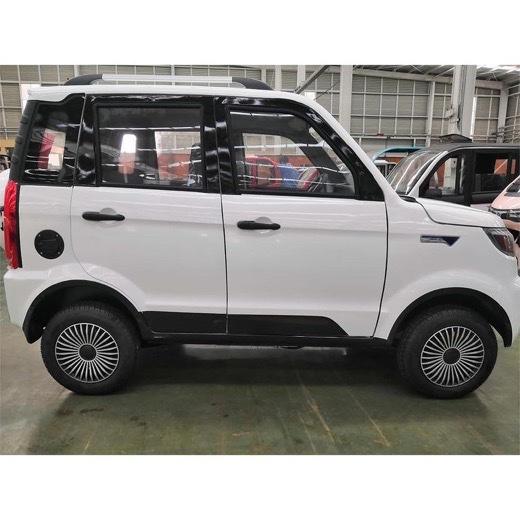
The Nasarawa State Government has partnered with Electric Motor Vehicle Company (EMVC), a pioneering firm in Nigeria’s electric vehicle industry, aimed at promoting clean energy and sustainable transportation for its citizens.
The company launched its first electric vehicle charging station in the state during President Bola Ahmed Tinubu’s visit to the state on Wednesday in Lafia, the state capital.
Speaking in an exclusive interview with Voice of Nigeria, the Chief Executive Officer (CEO) of EMVC, Prince Mustapha Audu, said the collaboration would boost the transportation system, produce clean energy, and reduce emissions.

He said the EMVC was one of the largest electric vehicle companies in Nigeria and had been expanding in different states.
“This is the first electric vehicle-charging station in the state. We’re starting with a minimum of five, and then we’ll increase the quantity as the demand for electric vehicles grows. But it’s clear: this is the future of transportation,” he said.
Prince Audu explained that setting up the charging station was also to create job opportunities for the citizens of the state.

“Some of our engineers, as you can see, are from the state. The youths would gain more by learning a lot in technology.
It will be a lot of technology transfer, knowledge transfer to young people, how to fix EVs, how to assemble them, and these charging infrastructures,” he added.
The EMVC’s CEO further said the Renewed Hope Agenda of President Bola Tinubu on sustainable transportation had made the State Governor Abdullahi Sule key into CNG and electric vehicles projects.
“We believe that this is an opportunity that is here for all of us. And as young Nigerians, who are ready to capitalize on the future, the future of transportation is electric. That’s just a fact,” he asserted, as global energy landscape is shifting towards cleaner alternatives.

Highlighting the benefit of setting up the charging station in Nasarawa State, he said, “You don’t need NEPA or generator or diesel. Say bye-bye to fuel subsidy issues, as the charging cost is ₦5,000 per watt of charge, which can fully charge an electric vehicle.”
“We have SUVs that can travel 1,200 km per charge and sedan models suitable for ride-hailing services with a 400 km range. We also have locally made tricycles and motorcycles popularly known as ‘Igwe’ that are affordable and built for Nigerian roads,” he added.
Benefits of the Electric Vehicles
The EMVC’s CEO enumerated the benefits of the electric vehicles to include reduction in carbon footprint, cleaner air, and lower operating costs.

“This is because vehicles have fewer parts, making them easier to maintain and repair. There’s nothing in the bonnet here. There are less than 300 parts in an electric vehicle. The actual operation of the vehicle itself is less than 40 parts, which means that the chances of things going wrong are much reduced,” he added.
“The cars are quite affordable. The smaller mini sedans are the most affordable brand new cars in Nigeria, which range from 14 million naira. The tricycles too are very competitive, costing 4.1 million naira with two years warranty, which can be extended to five years,” said Prince Mustapha Audu, speaking on the affordability of the Electric Vehicles.
Challenges
Prince Audu acknowledged challenges, such as poor road conditions and climate change but assured that the vehicles were designed with Nigerian realities in mind.

He expressed confidence in the durability of the locally manufactured electric vehicles, tricycles, and motorcycles, urging Nigerians to embrace the cleaner, cheaper alternative to transportation.
Also speaking in an interview, the technical officer at the EMVC, Engr Hassan Ibrahim, said the charging station has multiple charging bays that can accommodate three cars charging simultaneously within three hours, making it a convenient option for EV owners.
He mentioned that the charging station supports various electric vehicle models with different battery capacities, including 40-amp, 120-amp, and 160-amp lithium batteries.