

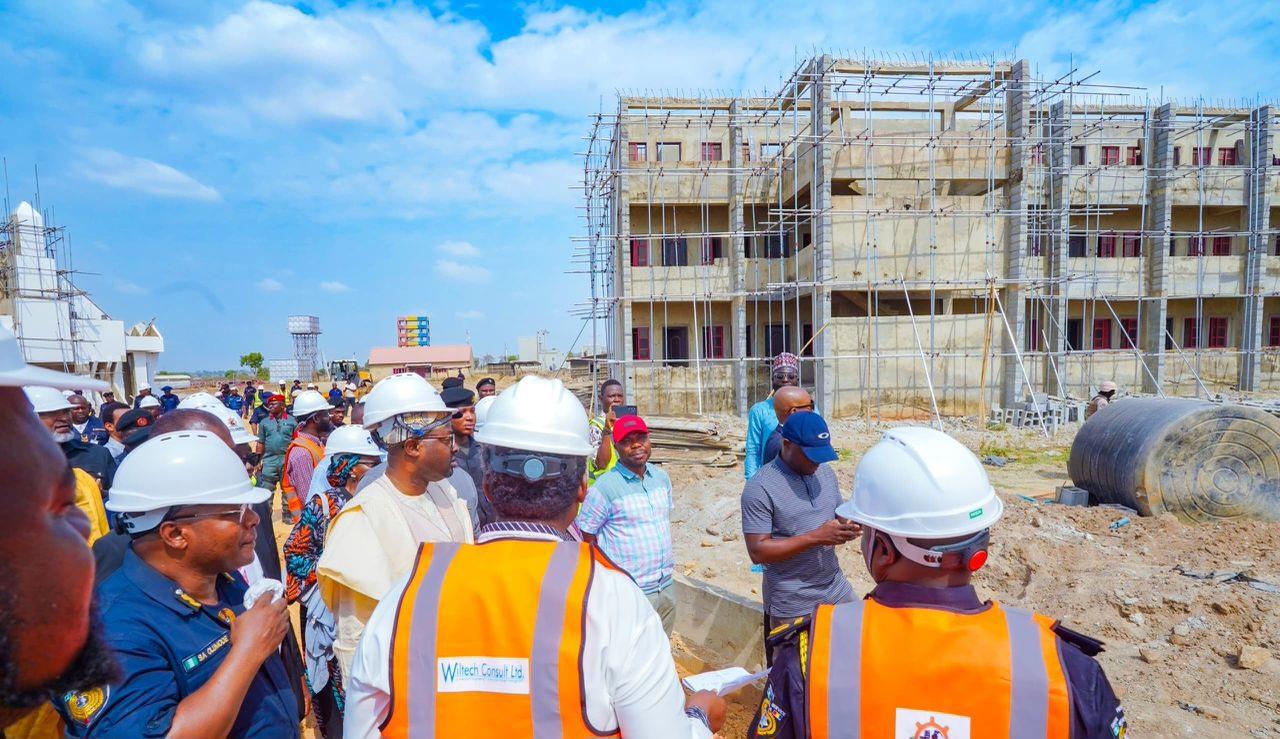
The Nigerian Government has disclosed that the National Fire Academy in Sheda, Kwali, in the Federal Capital Territory FCT, is on track for completion by May 2026.
Minister of Interior, Dr Olubunmi Tunji-Ojo, announced this following a comprehensive inspection of the site.
According to him, the academy is expected to empower Nigerian youth and provide high-level training for both the public and private sectors.
The minister noted that while consultants place the progress at 70 percent, current structural developments, by his estimation, indicate a solid completion rate of at least 60 to 65 percent.
Accompanied by the Permanent Secretary of the Ministry, Dr Magdalene Ajani, and the Controller General of the Federal Fire Service FFS, Mr. Olumode Samuel Adeyemi, the Minister detailed a strategic expansion of the project’s original scope.
Through an arrangement with the Kwali Area Council and local traditional institutions, the facility has secured an additional 13 hectares of land, expanding the total site to 23 hectares to serve as a premier hub for capacity building.
The vision for the academy has evolved to include professional and career developmental courses for various paramilitary services.
International Standard
Dr Tunji-Ojo emphasised that the facility is designed to meet international standards, providing a local alternative for rescue management training that was previously sought abroad, thereby reducing national capital flight.
The minister stressed that modern fire services must transcend traditional firefighting, focusing instead on comprehensive emergency response and rescue services.
Controller General of the Federal Fire Service, Mr Olumode Samuel Adeyemi, noted the unique infrastructure at the site, specifically the “firehouse” designed for search and rescue operations, which he described as the first of its kind in West Africa.
He noted that the academy’s accommodation facilities are built to house 3,000 participants at once, ensuring the Service’s 11,000-strong workforce has the necessary environment for advanced human capital development.