

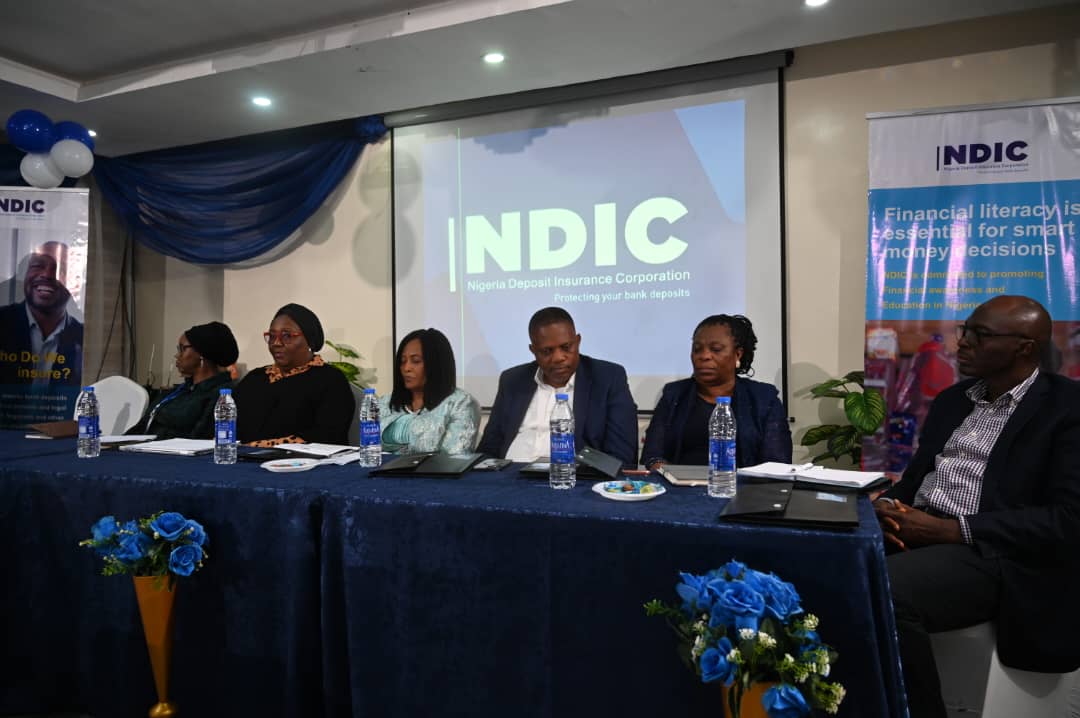
The Nigerian Deposit Insurance Company, (NDIC), has reassured Nigerians that it will not relent in ensuring the safety of depositors funds and assets in line with its mandate of guaranteeing deposits; adequate banking supervision; failure resolution and bank liquidation.
At a recently held Stakeholders meeting in Lagos, the Director, Claims Resolution Department NDIC, Kazeem Olawale said that the NDIC as a deposit insurer, guarantees the payment of deposits up to the maximum limit in accordance with its law in the event of failure of an insured financial institution (bank).

He said, “Currently, the Deposit Insurance System (DIS) in Nigeria covers all deposit taking financial institutions licensed by the Central Bank of Nigeria (CBN) which include Deposit Money Banks (DMBs), Non-Interest Banks (NIBs), Microfinance Banks (MFBs), Primary Mortgage Banks (PMBs), Payment Service Banks (PSB) and Mobile Money Operators (MMOs).
“All types of deposits are covered except for: Insider deposits, Interbank placements (Exempted in 2007), Deposits held as collateral for loans and Such other deposits as may be specified from time to time by the Board of NDIC,” he said.
In relation to the Corporation’s supervisory role in the financial ecosystem, Olawale said that the NDIC collaborates with the CBN to protect depositors; foster monetary stability; promote an effective and efficient payment system; and promote competition and innovation in the banking system.
He said that the corporation also ensures that issues pertaining to failing and failed institutions are resolved timely and efficiently.
This, Olawale said, is done among other things through either giving financial assistance to these banks in the form of loans, guarantee for loans, or accommodation bills, or by offering technical assistance via takeover of management and control of a bank, changes in management, assisted merger or through the acquisition of the ailing bank by another bank deemed more capable.
Olawale explained that the NDIC was however expected to ensure that liquidation is done in an orderly and efficient manner in a situation where all other forms of assistance as earlier mentioned have been exhausted with no immediate positive results in view.
He said, “Liquidation commences after the revocation of operating license by the CBN. It involves: Revocation of operating license; Orderly closure; Settlement of claims, with depositors being the priority, followed by creditors and shareholders where possible; and Cost effective realization of assets.”
Director, Consumer Protection and Financial Inclusion Department at the CBN, Mr Ibrahim Tuggar, who spoke on the topic: ‘Understanding Bank Charges, Electronic Banking and Financial Prudence’ said that as more people increasingly engage with financial institutions, and with the rapid growth seen in the digital financial landscape, consumers and businesses interact more frequently with financial institutions now than they ever did before.

According to him, these interactions often carry implicit or explicit costs such as bank charges, service fees, and electronic transactions.
Tuggar said, “As financial consumers, we hold both rights and responsibilities that are crucial for our financial well-being. By understanding and exercising our rights while fulfilling our responsibilities, we can navigate the financial landscape.”
He added that a proper understanding of charges by consumers would therefore help regulators enforce compliance, prevent exploitation, and maintain trust in the financial system.
On some major risks associated with digital banking, Tuggar said that while the shift to a “digital life” offers countless advantages, it presents the risk of identity theft which financial consumers must pay attention to, stressing also that understanding these issues help users adopt safer digital banking practices.
Some of these risks are: Cybersecurity threats such as phishing and identity theft; System downtimes that delay transactions; Fraudulent transactions if security is compromised; and Dependence on digital literacy and connectivity.
He then admonished customers to be financially responsible and to be mindful in their management of available financial resources by living within their means, avoiding unnecessary debt, making budget-based decisions as well as saving and investing wisely.
While Customers have a duty to provide Accurate and Up-to-date Information, give clear mandate to financial institutions and promptly report changes, they were also encouraged to regularly review transaction records and account statements to promptly raise any concerns with their financial institutions.