

The Nigerian Ministry of Works is adopting advanced technologies such as digital project monitoring, geotechnical mapping, drone-assisted planning, and climate-resilient materials to meet the nation’s evolving infrastructure needs.
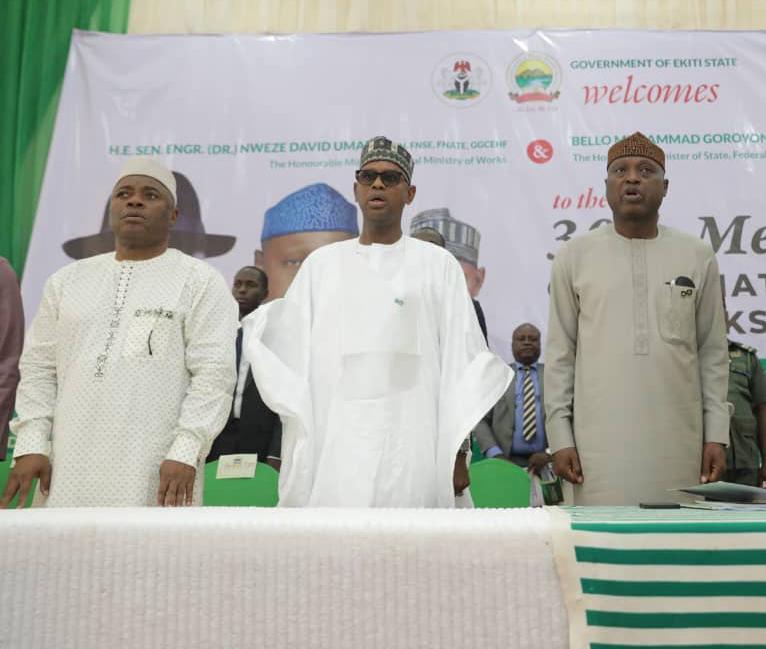
The Minister of Works, David Umahi, represented by the Minister of State for Works, Bello Goronyo, disclosed this at the 30th meeting of the National Council on Works (NCW) held in Ado-Ekiti, Ekiti State, Southern Nigeria.
Speaking on the theme, “Discipline, Transparency and Innovation in Engineering Practice,” Umahi emphasized that public servants must see infrastructure delivery beyond physical structures, viewing it instead as the backbone of the national economy.
He urged stakeholders to uphold discipline, to build trust, maintain transparency for accountability, and embrace innovation to achieve sustainability.
“Infrastructure is more than concrete and steel or asphalt, it is the backbone of our economy and a bridge to opportunities. Through discipline, transparency, and innovation, we will deliver roads that reflect our people’s aspirations,” he said.
Read Also: Minister of Works hails Kwara’s strategic infrastructure progress
A press statement by the Ministry’s Director of Press and Public Relations, Mohammed Ahmed, outlined key resolutions reached at the Council meeting, including:
- Adoption of a National Monitoring, Evaluation and Control (MEC) Framework to ensure value-for-money and accountability.
- A directive for MDAs to publish project details and progress updates on official websites for greater transparency.
- Approval for the establishment of a National Road Infrastructure Coordination Committee (NRICC) to harmonize inter-agency efforts and prevent contract duplication.
- Recommendation for increased adoption of Public-Private Partnership (PPP) models in road and bridge infrastructure.
- Endorsement of solar street lighting and climate-resilient materials in line with national sustainability goals.
- A call for inter-ministerial collaboration among the Federal Ministries of Works, Transportation, and Innovation, Science, and Technology to promote digital innovation and smart transport systems.
- Support for FERMA’s Direct Labour Unit to strengthen rapid road maintenance nationwide.
Road Revolution
Hosting the meeting, Ekiti State Governor, Biodun Oyebanji, highlighted the state’s progress in infrastructure development, describing it as a “road revolution” that has opened up communities and boosted access to markets, schools, and healthcare facilities.
“Since inception, our administration has made deliberate efforts to invest in infrastructure as a key driver of economic growth and social development. We appreciate President Bola Ahmed Tinubu for his interventions on Federal roads in our State, which we have complemented through the repair of the Ado–Iworoko–Ifaki dual carriageway,” the Governor said.
The Council reviewed 67 memoranda, of which 62 were adopted, following extensive deliberations during the three-day technical sessions that preceded the main event. These sessions involved directors, stakeholders, and permanent secretaries, and focused on policy coordination, institutional strengthening, innovation-driven engineering, and transparent project delivery.
The meeting was attended by Commissioners of Works and Permanent Secretaries from all 36 States of the Federation.