


The Federal Government has formally adopted the One Humanitarian–One Poverty Response System (OHOPRS) as a unified national framework to coordinate humanitarian action, social protection, and poverty reduction across the country.
The decision followed a four-day National Technical Workshop convened by the Federal Ministry of Humanitarian Affairs and Poverty Reduction, with support from International Alert and other development partners, held at the UN House in Abuja.
Addressing participants, the Minister, Humanitarian Affairs and Poverty Reduction, Dr. Bernard M. Doro, described the reform as a decisive shift in Nigeria’s approach to poverty alleviation.
“Today marks a defining moment in our journey towards reforming humanitarian interventions and reducing poverty at scale,” he said.
He underscored systemic gaps in existing interventions, stating: “It is not that support is not reaching people. It is that our systems are not designed to move people from survival to self-reliance.”
The Minister emphasised that OHOPRS “is not another programme” but “a national operating system” designed to eliminate fragmentation, duplication, and disconnection across institutions, data, and financing structures.
Participants at the workshop endorsed the framework as “a unified, data-driven platform that integrates humanitarian response, social protection, and development interventions,” aiming to deliver “a structured pathway for individuals and households to sustainably exit poverty.”
Key features of the system include a Unified National Beneficiary Register, lifecycle-based intervention tracking, coordinated governance mechanisms, and a structured poverty exit framework.
The communiqué highlighted a strong emphasis on digital transformation, with agreements to establish “a centralised national data center” and deploy “a unified management information system” (OneMIS) to ensure interoperability and real-time monitoring.
Deliberations also stressed sustainable financing through public-private partnerships and pooled donor funding, alongside strengthened accountability mechanisms.
Participants further agreed on adopting the Multidimensional Poverty Index to better capture “who is poor, how they are poor, and where they are located”.
The workshop concluded with a formal flag-off of the OHOPRS initiative and broad stakeholder commitment to implementation.
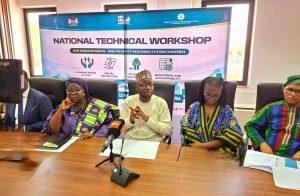
Reaffirming the government’s resolve, Dr Doro stated: ‘We are no longer content with “managing” poverty. Our goal is to end it. We are moving from helping Nigerians survive to enabling them to thrive.”
The Ministry expressed appreciation to all partners, including International Alert, for their contributions to advancing a coordinated national response.