

Nigeria has reaffirmed its commitment to ending Tuberculosis (TB), as key stakeholders highlight progress, persistent gaps and renewed strategies ahead of World TB Day 2026.
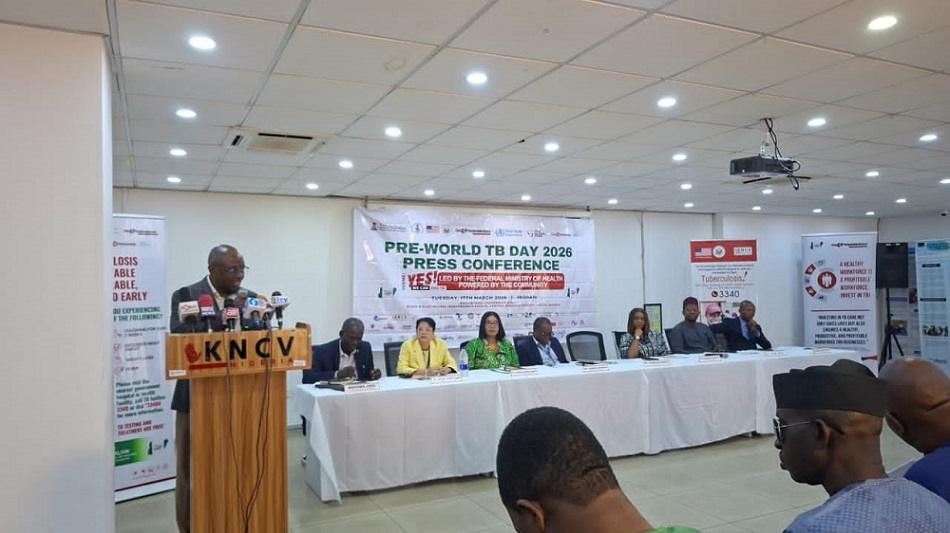
At a pre-World TB Day press conference in Abuja, the Director of Public Health at the Federal Ministry of Health and Social Welfare, Dr Charles Nzelu, said the country is strengthening innovation and community-driven approaches to close gaps in TB detection and treatment.
He described the 2026 theme, “Yes, We Can End TB: Led by Government, Powered by Communities,” as a reflection of renewed national leadership and grassroots resilience.
“This theme is not just a slogan; it is a testament to the renewed leadership we are seeing at the national level and the resilience of our communities,” he said.
Dr Nzelu noted that under the leadership of the Coordinating Minister of Health and Social Welfare, Muhammad Ali Pate, and the Minister of State, Iziaq Adekunle Salako, TB control has become a priority within Nigeria’s health agenda.
He revealed that Nigeria has recorded significant improvements in TB case notification as the current National Strategic Plan (2021–2026) nears completion, although challenges remain.
“We have made significant increase in our TB notification, but it is not yet uhuru, there is still a lot of work to be done,” he stated.
The Director further disclosed that the Federal Government is leading the rollout of new diagnostic technologies, including point-of-care molecular testing platforms, to expand access in underserved areas.
“This new diagnostic platform is a game changer, allowing us to bring molecular testing closer to the people and ensuring no Nigerian is left behind due to geography,” he added.
According to him, over 1,000 diagnostic machines are being deployed nationwide, supported by strengthened electronic reporting systems to enhance real-time data tracking and prevent stockouts of life-saving drugs.
 Dr Nzelu also called on journalists to intensify public awareness, stressing that TB services are free in government-approved facilities.
“No Nigerian should pay for TB services; diagnosis and treatment are free, and nobody should die from a disease that is curable,” he emphasized.
He urged members of the public to seek medical attention for a persistent cough lasting more than two weeks, noting that early detection remains critical in stopping transmission.
In his presentation, the Acting National Coordinator of the National Tuberculosis, Leprosy and Buruli Ulcer Control Programme, Dr Clement Adesigbin, described Nigeria as one of the high-burden countries for TB globally.
“The incidence rate of tuberculosis in Nigeria is about 219 per 100,000 population, translating to over 500,000 cases annually,” he said.
Dr Adesigbin explained that TB is not just a medical issue but is closely linked to socio-economic factors such as poverty, malnutrition, and overcrowding.
“Whenever you see poverty, undernutrition, and overcrowding, you will see a high burden of tuberculosis. Ending TB requires addressing these underlying factors,” he noted.
He highlighted progress made in recent years, including a significant increase in treatment coverage from about 20 percent in 2018 to over 80 percent currently.
The National Coordinator also disclosed that over 25,000 health facilities across Nigeria now provide TB services, with increasing involvement of private healthcare providers.
“We no longer sit in facilities and wait for patients; we go to the communities, to the hard-to-reach areas, to find cases early and put them on treatment,” he said.
He added that Nigeria is leveraging modern technologies such as GeneXpert machines, portable digital X-rays, and artificial intelligence tools to detect TB cases and identify hotspots more efficiently.
Despite these gains, Dr Adesigbin identified stigma, funding constraints, and shifting global health priorities as major challenges.
“People still stigmatize TB because of a lack of information. This is where the media plays a critical role in educating the public,” he stressed.
Earlier in her welcome address, the Board Chair of Stop TB Partnership Nigeria, Dr Queen Ogbuji-Ladipo, emphasized the importance of sustained collaboration and increased domestic financing to end TB in Nigeria.
“Ending TB requires strong leadership from government, while communities remain the driving force for awareness, prevention, treatment adherence, and accountability,” she said.
She acknowledged the progress made through partnerships involving government, development partners, civil society, and the media, which have helped expand TB detection and improve access to care.
“While we celebrate these achievements, we must acknowledge that more still needs to be done, especially as global health financing becomes increasingly constrained,” she added.
Dr Ogbuji-Ladipo called for renewed commitment from all stakeholders, including government institutions, the private sector, and community leaders, to sustain momentum in the fight against TB.
“When government leads with strong policies and adequate financing, and communities are empowered, ending TB becomes an achievable reality,” she stated.
World TB Day is commemorated annually on March 24 to raise awareness about the devastating health, social, and economic impact of tuberculosis and to accelerate global efforts to eliminate the disease.