

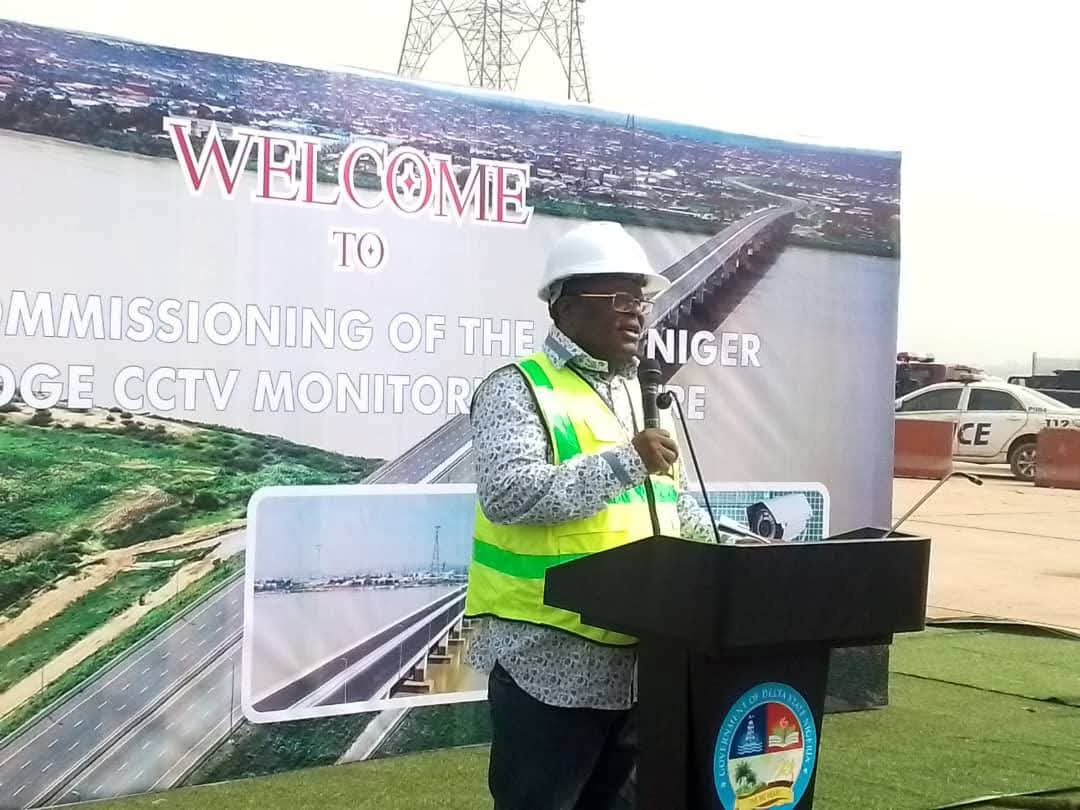
The Nigerian Government has announced a ban on sand mining within a 10-kilometre radius of the River Niger as part of measures to protect the First and Second Niger Bridges and other critical federal infrastructure nationwide.
The Minister of Works, Senator David Umahi, disclosed this in Asaba, Delta State, during the commissioning of the Second Niger Bridge CCTV Surveillance and Monitoring Centre.
He said the decision was approved by the Federal Executive Council (FEC) and would be strictly enforced to safeguard the structural integrity of major bridges across the country.
Umahi directed the Delta State Police Command and other security agencies to arrest anyone found engaging in sand mining within the restricted zone.
He said the Federal Government would provide a patrol boat and two patrol vehicles to enhance enforcement around the bridge environment.
The Minister also announced that tolling on the Second Niger Bridge would not commence until all access and bypass roads on both the Anambra and Delta State axis are fully completed.
According to him, although the toll plaza is ready, government will ensure that motorists have unhindered alternative routes before tolling begins.
CCTV Monitoring
He explained that the newly commissioned CCTV monitoring centre is designed to provide round-the-clock security on the federal highway, stressing that there would be no physical security checkpoints along the road.
Instead, security operatives would monitor activities remotely through the surveillance system and respond to emergencies within five minutes.
“The idea is to have a free-flowing highway without checkpoints. Security agencies will operate from the CCTV monitoring centre and ensure rapid response to any incident along the corridor,” Umahi said.
On road infrastructure, the Minister revealed that the 17.5-kilometre Asaba bypass of the Second Niger Bridge, valued at ₦279 billion and designed to divert traffic away from Asaba township, is scheduled for commissioning in April.
He stated that the two access roads to the bridge have been redesigned and are being constructed with reinforced concrete pavement for durability.
He further disclosed that similar construction is ongoing on the Anambra axis, covering 17.7 kilometres at a cost of ₦140 billion, with five bridges and two flyovers.
Umahi commended the Delta and Anambra State governments for their commitment to the payment of compensation to affected communities.
Presidential Approval
The Minister also announced presidential approval for the reconstruction of the 11.5-kilometre Summit Junction, Niger Bridge road in Asaba, a Type 2 highway project costing ₦48 billion.
He said ₦15 billion has already been released for the commencement of the project, which will include extensive drainage infrastructure to permanently address traffic congestion along the corridor.
During an inspection of the Anambra axis access road, Umahi charged contractors to accelerate work and adhere strictly to project specifications, while expressing dissatisfaction with the slow pace of construction in some sections.
In their remarks, the Asagba of Asaba, Professor Epiphany Azinge, commended the Federal Government for the completion of the Second Niger Bridge, highlighting its significant socio-economic benefits to the region and the country.
Similarly, the Chairman of the Anambra State Council of Traditional Rulers and Igwe of Obosi, Igwe Chidubem Iweka, said the opening of the bridge has eased traffic congestion on the old Niger Bridge, particularly during the Christmas and New Year festivities.
He noted that the installation of CCTV cameras would further boost the confidence of commuters and called for the speedy completion of all access roads to the bridge.