

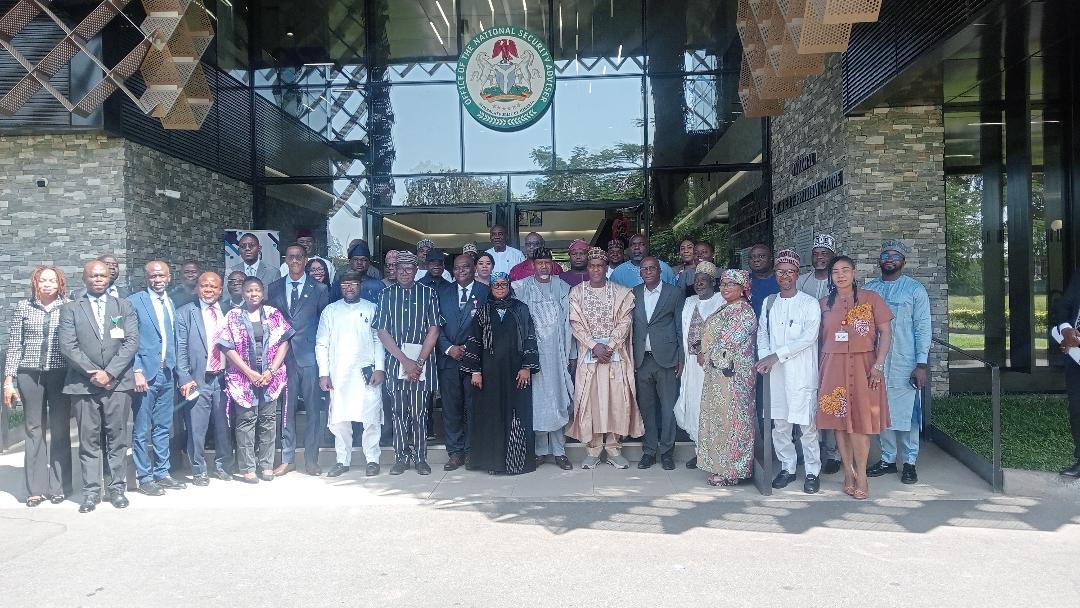
Nigeria has commenced the final validation process of its draft National Framework and Strategy for Disarmament, Demobilisation and Reintegration (DDR), marking a strategic move to address security fragility and support former combatants and communities transitioning from conflict.
At the validation exercise in Abuja, the National Coordinator, National Counter Terrorism Centre (NCTC), Office of the National Security Adviser, Major General Adamu Laka said “the exercise is both timely and strategic, coming at a period when all geopolitical zones are faced with persistent and evolving security threats.”
Represented by the Director of Intelligence, Brigadier General Peter Gbor, the Coordinator stated that insecurity in various forms, including terrorism, banditry, secessionist agitations, farmers–herders conflicts, militancy, and rising incidents of abduction for ransom, continues to undermine national stability, economic growth and social cohesion. New and emerging crimes, he added, require urgent, coordinated and holistic responses.
He emphasised that the Office of the National Security Adviser, through the National Counter Terrorism Centre, in collaboration with the United Kingdom’s Strengthening Peace and Resilience in Nigeria (UK-SPRING) programme, has prioritised the harmonisation of a people-centred and sustainable DDR framework.
To this effect, he noted, a clear roadmap was developed, including regional consultations conducted across all six geopolitical zones to engage stakeholders such as security agencies, traditional rulers, religious leaders, civil society organisations, socio-cultural groups, women and youth representatives, persons living with disabilities, as well as selected state and federal ministries and agencies.
Following these consultations, he stated that the framework now under validation signals a significant milestone in counter-terrorism efforts, providing structured and sustainable pathways for individuals transitioning away from armed violence and back into productive civilian life.
He clarified that DDR is not only about disarmament but also offers “hope of healing from trauma, dignity through economic empowerment, and justice through accountability and reconciliation.”
He explained that the purpose of the validation is to review the draft document, identify strengths and gaps, and offer expert recommendations to ensure alignment with national priorities, international standards and proven practices.
He reaffirmed that the National Counter Terrorism Centre’s mandate is rooted in the Terrorism Prevention and Prohibition Act 2022 and anchored on national policy frameworks including NACTEST 2016, the National Action Plan for Preventing and Countering Violent Extremism 2017, and the National Security Strategy 2019, among others currently under review.
He commended the contributions of government agencies, civil society actors and community leaders, and offered special recognition to UK-SPRING for its sustained support to the project.
Also Read: AU Endorses Regional DDR Talks, Strengthens Ties with Nigeria
Meanwhile, the United Kingdom’s Strengthening Peace and Resilience in Nigeria (UK-SPRING) programme has reaffirmed its support for the development of Nigeria’s national DDR framework, describing the process as a critical step in promoting sustainable peace.
According to the Team Lead, Dr Ukoha Ukiwo, who spoke on behalf of UK-SPRING at the Stakeholders’ Validation and Review Exercise of the Draft National Policy Framework and Strategy for Disarmament, Demobilisation and Reintegration (DDR) 2025, the intervention forms part of the organisation’s long-term commitment to partnering with Nigerian institutions and communities to drive stability and strengthen resilience.
He noted that the programme had worked over the past year with national, state and local agencies to build capacity and deepen peace and security efforts.
“This framework is designed to offer alternative and positive pathways to individuals engaged in violence, based on comprehensive global experiences that show such approaches to be sustainable,” Dr Ukiwo stated.
He explained that while cooperation remains essential, “persuasion and engagement provide a more lasting route to transforming lives and enabling meaningful decisions.”
The UK-SPRING lead commended the nationwide consultations facilitated through the Office of the National Security Adviser, noting that the process successfully aggregated the views of Nigerians across all geopolitical zones on what shape the transition pathway should take.
He praised the coordination and technical leadership that resulted in a credible draft framework.
“We are hopeful that this validation will allow stakeholders to revisit key issues and ensure that the document, once adopted and signed by the President and Commander-in-Chief, delivers results and stands the test of time,” he added, acknowledging the support of the UK Foreign, Commonwealth and Development Office.
Earlier, the Director, Preventing and Countering Violent Extremism, at the Counter Terrorism Centre, Ambassador Musa Mairo Abbas, said “the framework is the result of extensive regional consultations across all six geopolitical zones between May and October 2025.”
“This framework is designed to support individuals who have renounced violence and seek meaningful reintegration into their communities,” Ambassador Abbas said, noting that its development reflects the joint commitment of government agencies, development partners, civil society actors and local communities.
Ambassador Abbas stressed that the complexities of violent extremism require sustained collaboration and multi-stakeholder engagement.
He explained that “the validation marks the beginning of a new phase focused on strengthening peace, rebuilding trust and stabilising conflict-affected areas.”
She acknowledged the funding and technical support of UK-SPRING and other partners, describing it as continued evidence of international commitment to peace across Nigeria and the wider Lake Chad Basin region.