

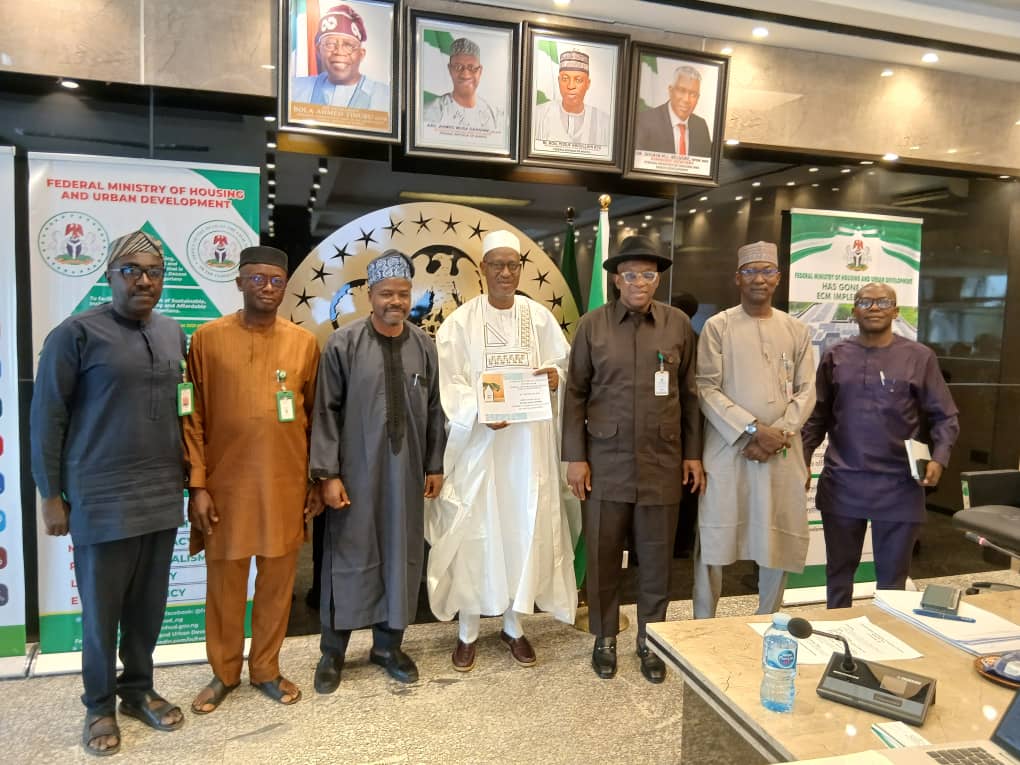
The Nigerian government says more than 15.2 million existing housing units nationwide are structurally inadequate, exposing a critical housing quality crisis that goes beyond the construction of new homes.
The Minister of Housing and Urban Development, Ahmed Musa Dangiwa made this known during the presentation of findings from the National Housing Data Initiative (NHDI), a landmark effort to institutionalise credible, harmonised housing data in Africa’s most populous nation.
Dangiwa said; “Beyond headline deficit figures, the application of harmonised and internationally recognised methodologies now allows us to state with clarity and confidence that Nigeria currently faces a housing inadequacy problem affecting approximately 15.2 million housing units nationwide.”
According to the Minister, the affected homes exist physically but fall below acceptable standards of safety, habitability, durability, access to basic services, and infrastructure.
Dangiwa stressed that Nigeria’s housing challenge is both quantitative and qualitative, requiring urgent upgrading of existing housing stock alongside new construction.
The Minister said; “Nigeria’s housing challenge is not only about building new houses..but equally about upgrading existing housing stock, regenerating deteriorated neighbourhoods, improving basic services and infrastructure, and ensuring dignity and safety in housing outcomes.”
The findings were derived using globally recognised tools, including the Household Crowding Index, Adequate Housing Index, and a Composite Index Methodology, supported by data from the National Population Commission, National Bureau of Statistics, Central Bank of Nigeria, and other sector institutions.
The National Housing Data Technical Committee, established in August 2024, collaborated with the World Bank to ensure international consistency and standardisation of the data.
Committee Chairman, Taofeeq Olatinwo revealed that, as of 2025, Kano State records the highest level of housing inadequacy, while Bayelsa State records the lowest, based on the Adequate Housing Index.
In a major policy shift, the Minister announced that the Nigerian Government has begun steps to establish a National Housing Data Centre, to be domiciled initially within the Ministry and later institutionalised through a statutory framework or Special Purpose Vehicle.
He described the initiative as “a major intellectual, technical, and institutional milestone in Nigeria’s housing and urban development reform journey.”
The proposed Centre is expected to strengthen housing policy formulation, guide investment decisions, expand access to housing finance, and improve accountability in housing delivery.
The Minister said the initiative aligns with the Renewed Hope Agenda of President Bola Ahmed Tinubu, positioning Nigeria to attract investment, stabilise housing markets, and deliver affordable and social housing more effectively.
“With the National Housing Data Initiative, Nigeria is better positioned to plan more accurately, invest more confidently, and deliver housing more equitably,” he stated.
Permanent Secretary of the Ministry, Dr Shuab Belgore, announced that the report would be formally published and circulated to all relevant agencies, while directing that the Housing Data Centre be operational by January 2026.
Lateefah Ibrahim