

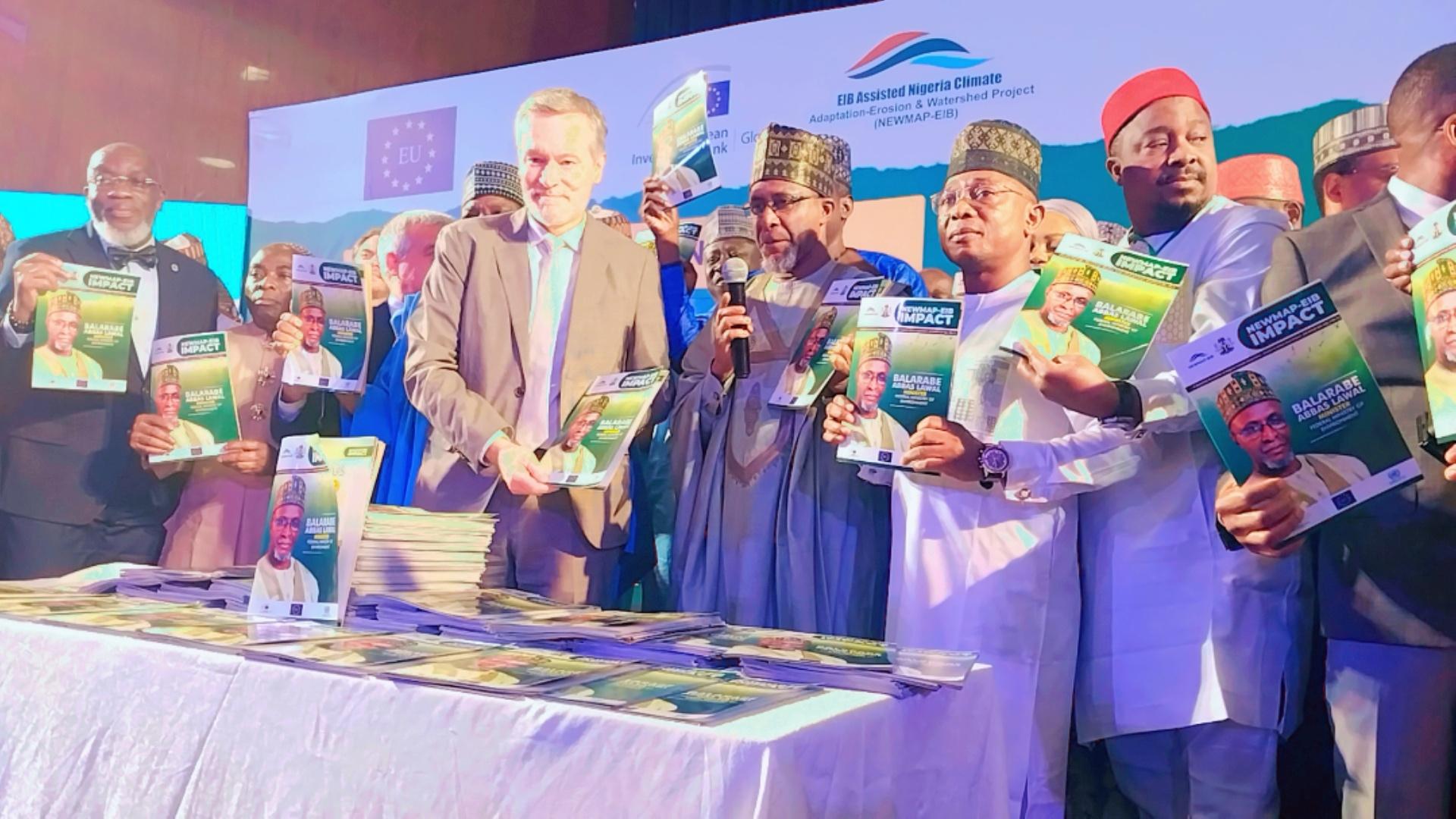
The Nigerian Government, in partnership with the European Investment Bank (EIB), has launched the Nigeria Climate Adaptation-Erosion and Watershed Project (NEWMAP-EIB) to reduce vulnerability to soil erosion and strengthen resilience against climate change impacts.
The €175 million project, funded by the EIB, will run for five years across 23 states and is structured around key components of watershed management, infrastructure investment, institutional strengthening, climate change response, and effective project management.
Speaking at the launch in Abuja, Minister of Environment, Mr. Balarabe Lawal, said the Federal Government had released ₦750 million as the first tranche of counterpart funding.
“At the same time, participating states have demonstrated commitment by providing counterpart funds to their State Project Implementing Units, thereby strengthening the prospects for the success and sustainability of NEWMAP-EIB. May I emphasise that the success of this project depends on the commitment of stakeholders at all levels,” he said.
He urged state governors to continue supporting the initiative through counterpart contributions, noting that the Federal Government was processing another tranche of funding through the Ministry of Finance.
The Minister emphasised that the Renewed Hope Agenda of President Bola Ahmed Tinubu prioritises climate-smart and resilient cities.
“Mr President’s commitments to sustainability has been key to this project’s success. We commend him for his steadfast leadership and reaffirm our dedication to advancing his administration’s environmental policies,” he added.
Mr. Lawal explained that the updated project secured additional financing of €175 million from the EIB in 2020, shortly before the closure of the World Bank-supported NEWMAP-IDA.
“It will be implemented over a five-year period across twenty-three (23) states, namely: Abia, Akwa Ibom, Anambra, Borno, Cross River, Delta, Ebonyi, Edo, Enugu, Ekiti, Gombe, Imo, Kaduna, Kano, Katsina, Kogi, Nasarawa, Niger, Ogun, Ondo, Oyo, Plateau, and Sokoto,” he said.
Head of the EIB Regional Hub for West and Central Africa, Mr. Roger Stuart, described the project as a landmark step in reversing environmental damage.
“Today marks the first phase of implementation of this landmark project for the EIB and Sheridan and marks a significant milestone in the journey that reflects long-term preparation and shared commitment to climate resilience,” he said.
He explained that the project would support flood prevention, restore 3,100 hectares of land and habitats, and create 25,000 jobs in forestry, afforestation, and fisheries.
“There will be a positive impact on the lives and property of 750,000 Nigerians by 2030. The project will improve resilience, restore livelihoods, and economic opportunities. But at its heart, this project is about reversing the damage caused by soil erosion and human activity throughout Nigeria,” Stuart noted.
Representing the Minister of Finance, Deputy Director of International Development Assistance, Mr. Alkali Mustapha Bello, said the project’s goal was to reduce communities’ vulnerability to soil erosion.
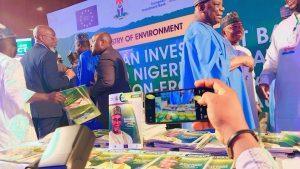
“Today marks a milestone in our collective effort to safeguard Nigeria’s environmental communities and economy from the adverse effects of climate change, particularly soil erosion and watershed degradation. This project, valued at €175 million, represents a strong demonstration of the partnership between the European Investment Bank and the government of Nigeria,” he said.
He added that the project, effective from May 2025, had already received a first disbursement of €17.5 million in August 2025 and would be implemented through four components: erosion and watershed management, institutional strengthening, climate change response, and project management.
Project Coordinator, NEWMAP-EIB, Engr. Anda Ayuba Yalaks, said the initiative was designed to address climate change challenges through strong federal and state collaboration.
“The NEWMAP-EIB project was to ensure that more attention is focused on mitigation, whereby we will be able to meet these issues of land degradation at the initial stage and to ensure that handle it as topic for further discussion. While in areas where erosion has become manifested and is aggravated, we bring a lasting solution,” he said.
He added that the project would adopt an environmental resuscitation approach with rigorous community engagement.
The first phase of NEWMAP (2013–2022), supported by the World Bank and the Federal Government, recorded significant achievements in tackling gully erosion and watershed mismanagement. With the launch of NEWMAP-EIB, Nigeria and its partners aim to consolidate and scale up these gains for sustainable development.