


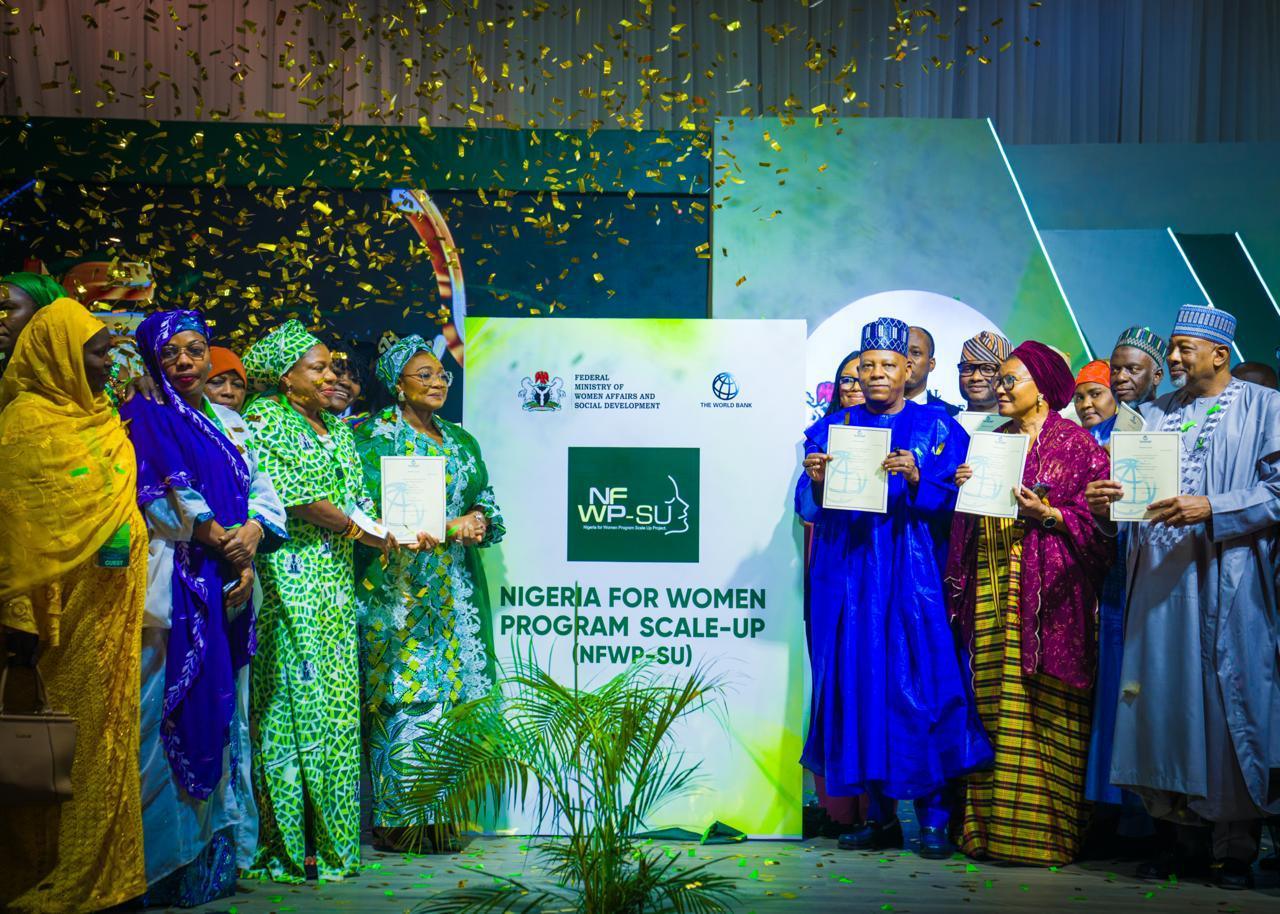
The launch of the Nigeria for Women Scale-Up Programme has sent an unmistakable message from Nigeria to the world: women are no longer at the margins of development; they are now at the very centre of the nation’s economic architecture.
President Bola Ahmed Tinubu validated this at the Presidential launch of the Nigeria for Women Programme Scale-Up (NFWP-SU), asserting that women driving development is a strategic economic imperative and not a social gesture.
“Today marks a decisive moment in our National development journey and a clear affirmation of this administration’s priorities. With this launch of the Nigeria for Women Programme Scale-Up, we are reinforcing our deliberate choice to place women’s economic empowerment, child protection, family strengthening, and social development at the very centre of Nigeria’s growth strategy” the President declared.
From Evidence to Expansion
President Tinubu emphasised that the programme’s expansion is rooted in measurable impact.
“In just six states under phase one, over one million beneficiaries were reached. This confirms an important principle of this administration: we act on evidence, not assumptions. What works will be strengthened, expanded, and institutionalised.”
He was unequivocal about women’s place as engine rooms and bulwarks of reengineering Nigeria’s economic future.
“Nigeria cannot achieve sustainable growth if half of its population remains structurally constrained. Women are not peripheral to National Development. They are central drivers of productivity, custodians of family stability, and indispensable partners in our ambition to build a resilient, competitive, and prosperous nation.”
With Nigeria’s ambition to build a one-trillion-dollar economy, the President reaffirmed women’s participation as non-negotiable.
“Unlocking their full potential is therefore not optional; it is essential for national growth, diversification, and resilience.”
The 540-million-dollar Scale-Up Phase represents one of the largest investments in the agency of women on the continent. It is co-financed by the World Bank and the Federal and State Governments and designed to directly reach at least five million women across Nigeria’s States and the Federal Capital Territory- Abuja.
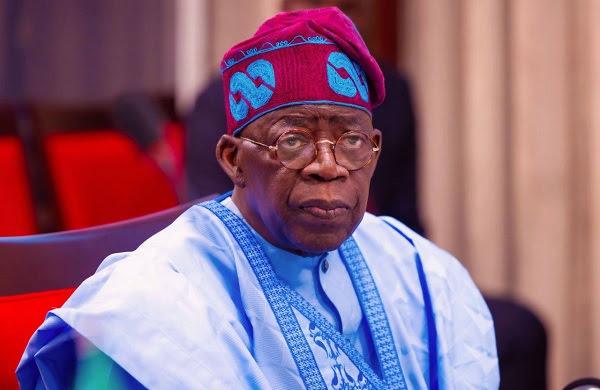
President Tinubu has raised the bar; setting an even broader target to engender his administration’s Renewed Hope inclusion vision:
“We will continue to invest in women-led enterprises. We will expand access to clean cooking and household energy. We will strengthen social protection systems. We will scale digital inclusion. And we will build platforms that convert potential into productivity, dignity into income, and inclusion into national stability” he pronounced.
With this, the President formally declared 2026 as the Year of Social Development and Families, directing coordinated action across all arms and levels of government.
Governance with a Human and Women’s Face
The Minister of Women Affairs and Social Development, Hajia Iman Sulaiman-Ibrahim, described the scale-up launch as historic.
“It confirms, unmistakably, that the Renewed Hope Agenda has given governance both a human face and a women’s face, and that it is now embedded in national systems, and not just promises.”
She provided some facts and figures from Phase One’s documented success stories:
“In just the 6 states in which Phase 1 was implemented, 26,577 Women Affinity Groups were formed with over 560,000 members… they collectively saved over ₦4.9 billion of their own money and have inter-loaned significantly to expand their businesses, cover health costs, and pay school fees.”

She highlighted an unexpected Renewed Hope democratic dividend in Niger State.
“Many women, for the first time in their lives, obtained formal identification in order to participate… These newly registered women did not stop at programme participation; they became politically visible. In one local government area, women beneficiaries organized and voted collectively, and influenced the outcome of a local election… this is what happens when social policy meets civic identity. Empowerment becomes democratic strength” she disclosed.
The Minister of Agriculture and Food Security, Senator Abubakar Kyari noted that it aligns with President Tinubu’s eight-point Renewed Hope Agenda and pledged the cooperation of the Ministerial steering committee.
Commending the Minister of Women Affairs and Social Development for the impacts of the Nigeria for Women Scale-Up Programme, especially in the Agriculture sector, Senator Kyari said:
“When the nation is secure with food, everybody rises and of course, women are the ones that are driving both the production and processing.”
Subnationals Align Behind the Programme
The Nigeria Governors’ Forum through the Katsina State Deputy Governor Alhaji Faruk Lawal Jobe, pledged full support for success of programme:
“As Governors, we see this programme not as a social outlook, but as an economic strategy, one that recognises women as producers, entrepreneurs, and stabilisers of our local economy.”
Citing impacts in Katsina State, Jobe detailed the state’s financial commitment:
“We started with only three local governments… we made our counterpart funding of 500 million available… so far, we made an additional 4 billion Naira available last year, and we made an additional contribution of 4 billion in this year’s budget.”
The National Assembly has also aligned itself with the initiative. Speaking through the Chairman, Senate Committee on Women Affairs, Senator Ireti Kingibe, Senate President Godswill Akpabio said:
“It aligns strongly with the legislative priorities of the National Assembly and reinforces our commitment to inclusive growth, gender-responsive governance and sustainable national development.”
He further assured stakeholders of legislative backing to entrench policy reforms:
“I assure all partners and stakeholders of the continued support of the National Assembly in readying the legal and institutional framework that expands opportunities for women and protects their contributions to national progress.”
World Bank: Power in the Collective
World Bank Senior Social Development Specialist and Task Team Leader, Mr. Michael Ilesanmi, described the programme as transformative.
“This programme aims to reach 5 million women and their households with access to finance and access to markets and ultimately it’s to improve livelihoods of these women.”
While reflecting on lessons from Phase One, he noted:
“One of the biggest lessons from the first phase is that there’s power in collective… nearly 600,000 women were supported… these women became driving force of economic change in their respective communities.”
He added that layering interventions such as health insurance had reshaped household dynamics.
“It’s helped them to create the space for joint household decision-making and this has transformed lives.”
Read Also: President Tinubu Launches $540M Women Empowerment Programme, Targets 25M Nigerians
Nigeria Centres Women in National Development Strategy
Uche Amawu of the Gates Foundation further situated the importance of the scale-up poignantly.
“Women represent about half of Nigeria’s population and a majority of the informal workforce in Nigeria. They drive food systems, microenterprise, caregiving, and community stability.”
Amawu emphasised that expanding women’s access to finance, markets, skills, and digital tools through the Nigeria for Women programme scale-up is not only the right thing to do, but one of the smartest economic investments Nigeria can make today.
“Because every time a woman increases her household income, that means the mother and father are likely to seek better health care, it means a child gets routine immunisation, it means a family eats better, a child stays at school, and the community at large.”
Across the States: Stories of Transformation
Documented reports of the success of Phase One from the beneficiary States, were backed by exhibited products including shea butter, groundnut cakes, Adire Fabrics, Palm oil, Palm kernel oil, rice and others
Kebbi State
Rifkatu Maigida, Livelihood Advisor in Kebbi, credits the scale-up impact as causing a social shift:
“Initially, before the coming of this program in Kebbi, so many of our people, they don’t even allow their women to go out. Some of them, initially, they were not having National Identity Number, the N-I-N number. Because of this project, so many people have obtained their N-I-N. They have opened their own personal bank accounts. They have businesses that have been strengthened.
“With these small, small loans they gave themselves, they were able to scale up their businesses. Some of them now are employers of labour. We have some beneficiaries that have up to seven, eight staff working for them.”
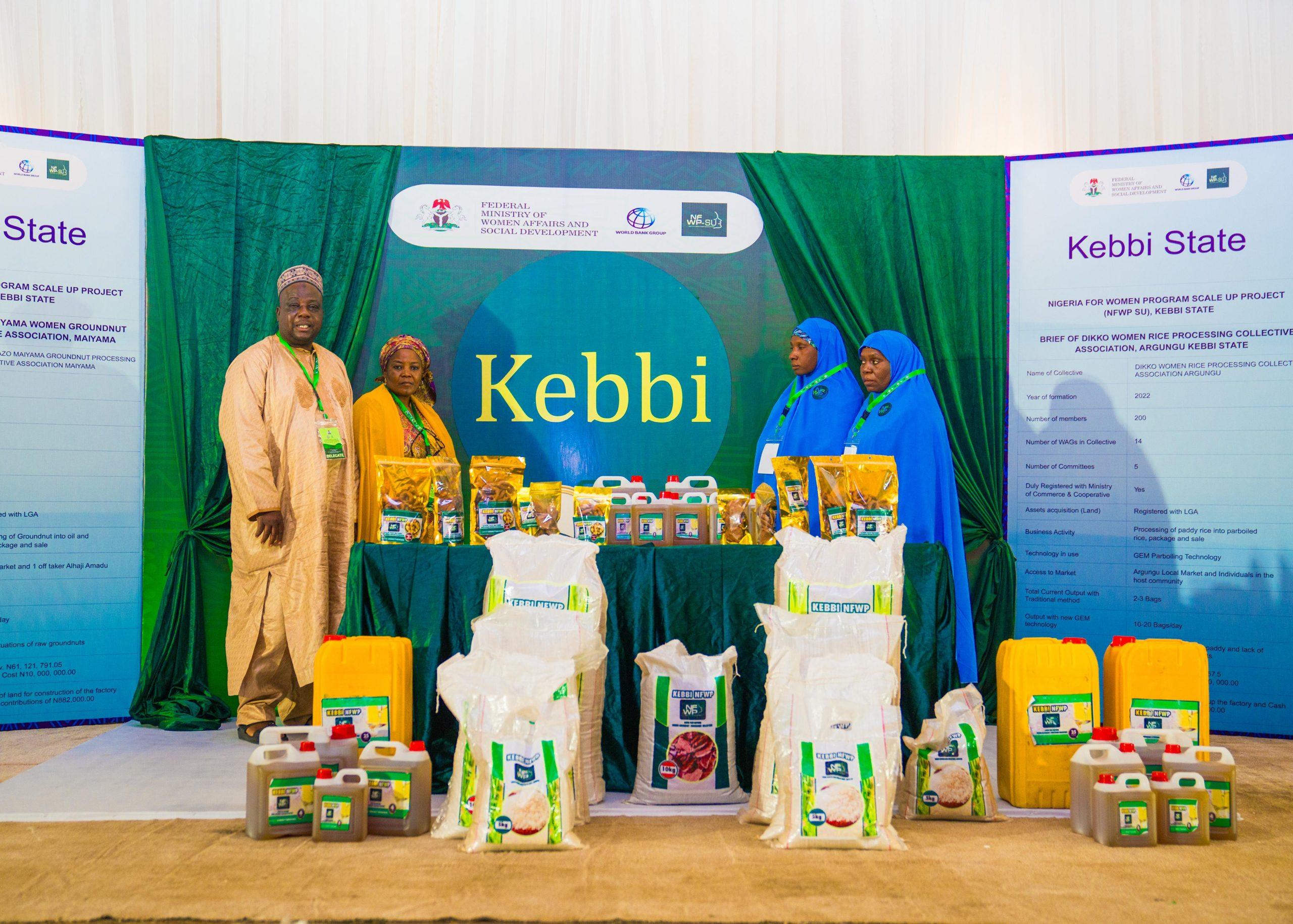
According to her, Kebbi women are now exporting rice to Niger Republic, Ibadan and Lagos.
Kebbi has 1,200 Women Affinity Groups under the parent project, with a target of 5,000 under the scale-up. The state showcased rice value chains and groundnut products, including groundnut oil, kulikuli and animal feed cake.
Ogun State
State Project Coordinator, Bolanle Fadairo, described the initiative as different from past interventions.
“When we talk about Nigerian for Women Project, we talk about training… this brings the sustainability of the project.”
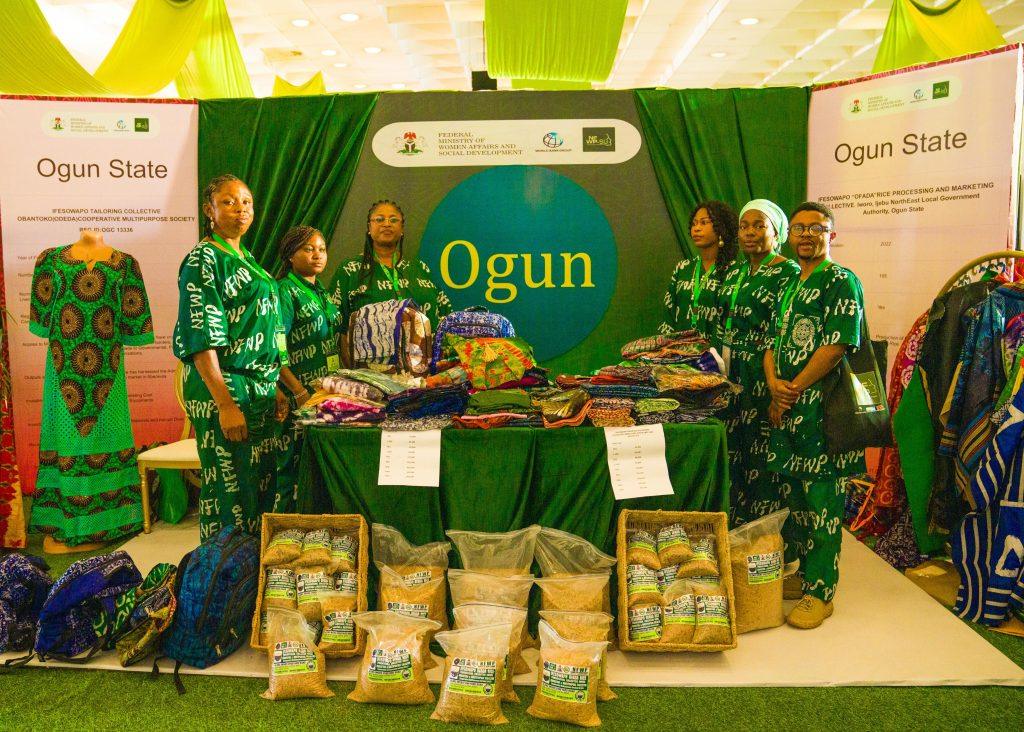
Ogun surpassed its target of 54,000 women, empowering over 70,000 in four local governments.
“Women voices were not heard. But with Nigeria for Women Project… these women now contribute meaningfully to the upkeep in the family and at the same time, to the community decision making.”
From Ofada rice processing in Ijebu North East to Adire collectives producing for Dye Lab in the U.S., she said:
“It’s a platform, already established platform.”
Akwa Ibom State
The State Coordinator for Akwa Ibom, Ofonime Iniobong Etuknwa said
“We had 3,939 women groups… and 73,000 women registered on the program passing the benchmark of the 54,000 women.
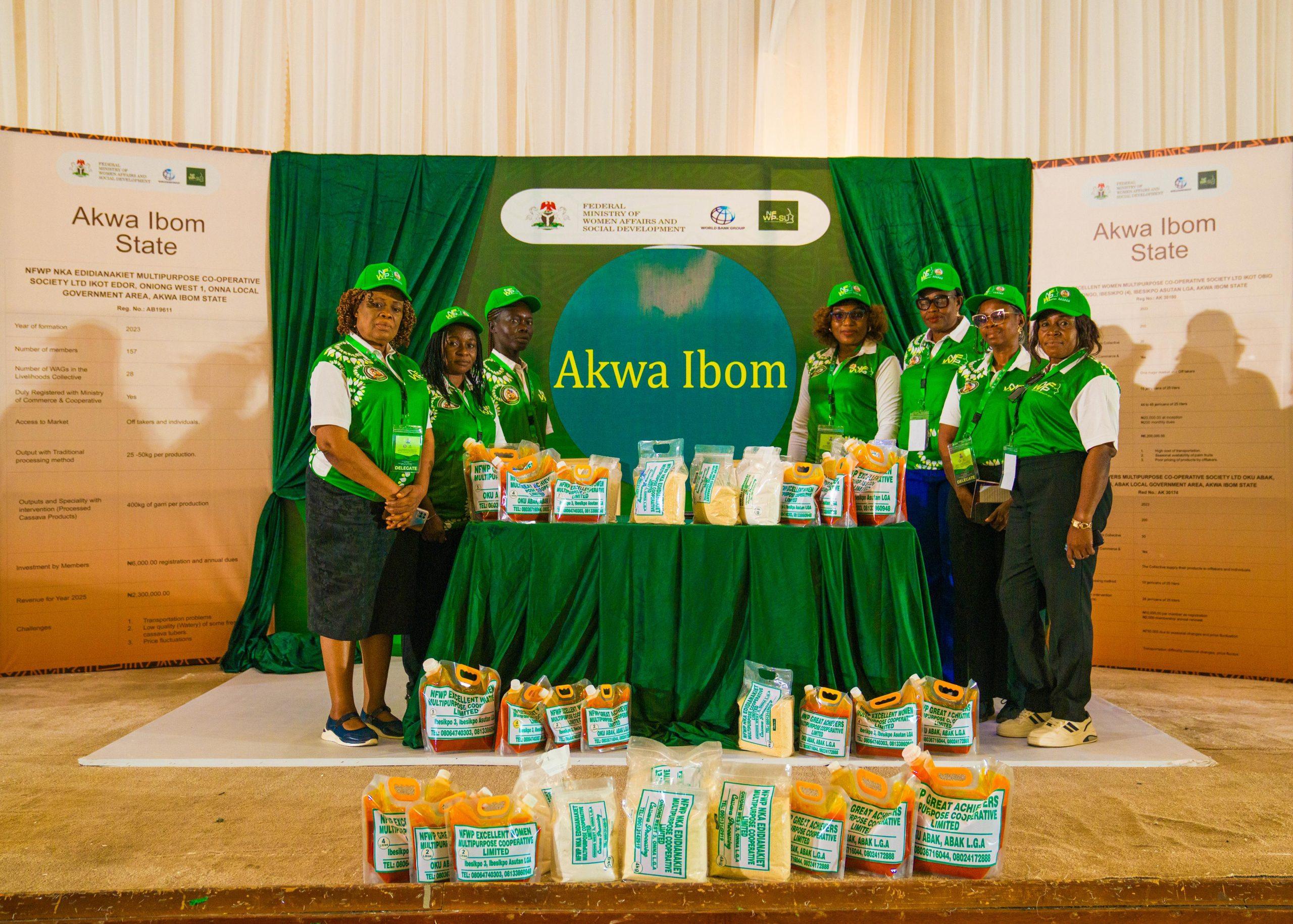
“With palm oil and cassava processing collectives, the state is eyeing export markets.
“We’re excited and looking forward to making our women more economically engaged… and then because I agree we will ensure financial inclusion.”
Niger State
The Coordinator for Niger State, Sarki Bello said;
“In the pilot phase we had a total of 75,545 women… each of these women benefited from a 60,000 non-refundable grants.”
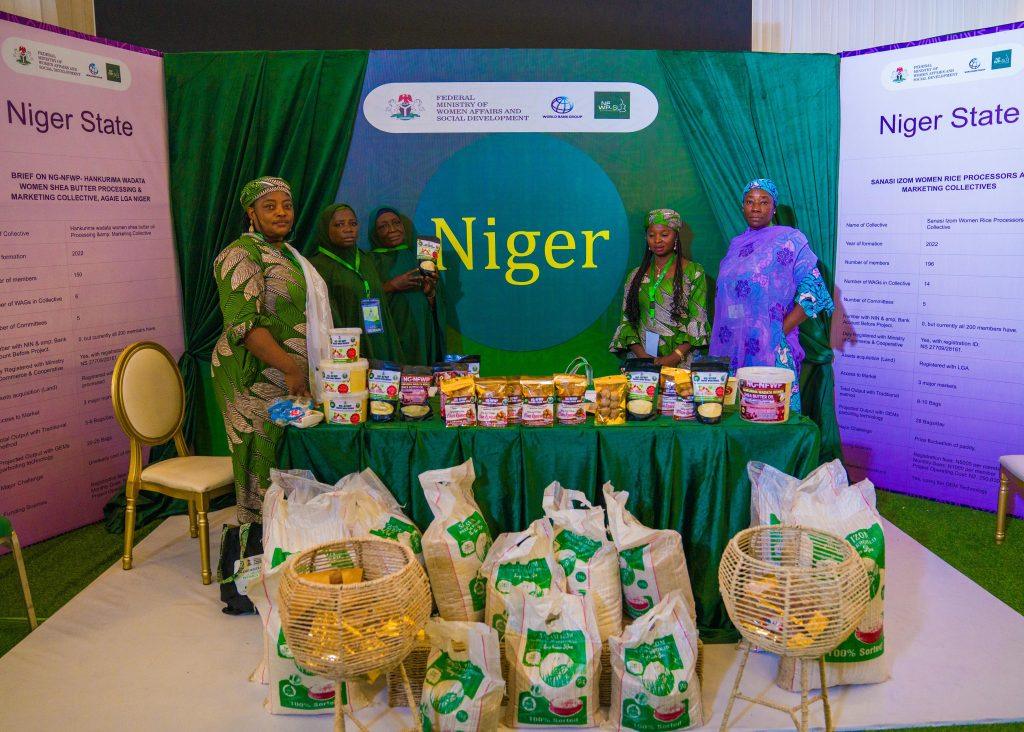
Shea butter from Agai, rice from Gurara, and groundnut snacks such as ‘dankuwa’ reflect expanding business enterprises.
“We intend to double this as we go to scale-up.”
Taraba State
In Taraba, Bether Kwatishe said the project brought knowledge and savings culture.
“The Nigeria for Women project impacted women in Taraba State by bringing us the knowledge of understanding how we are going to save and enhance our livelihoods.”
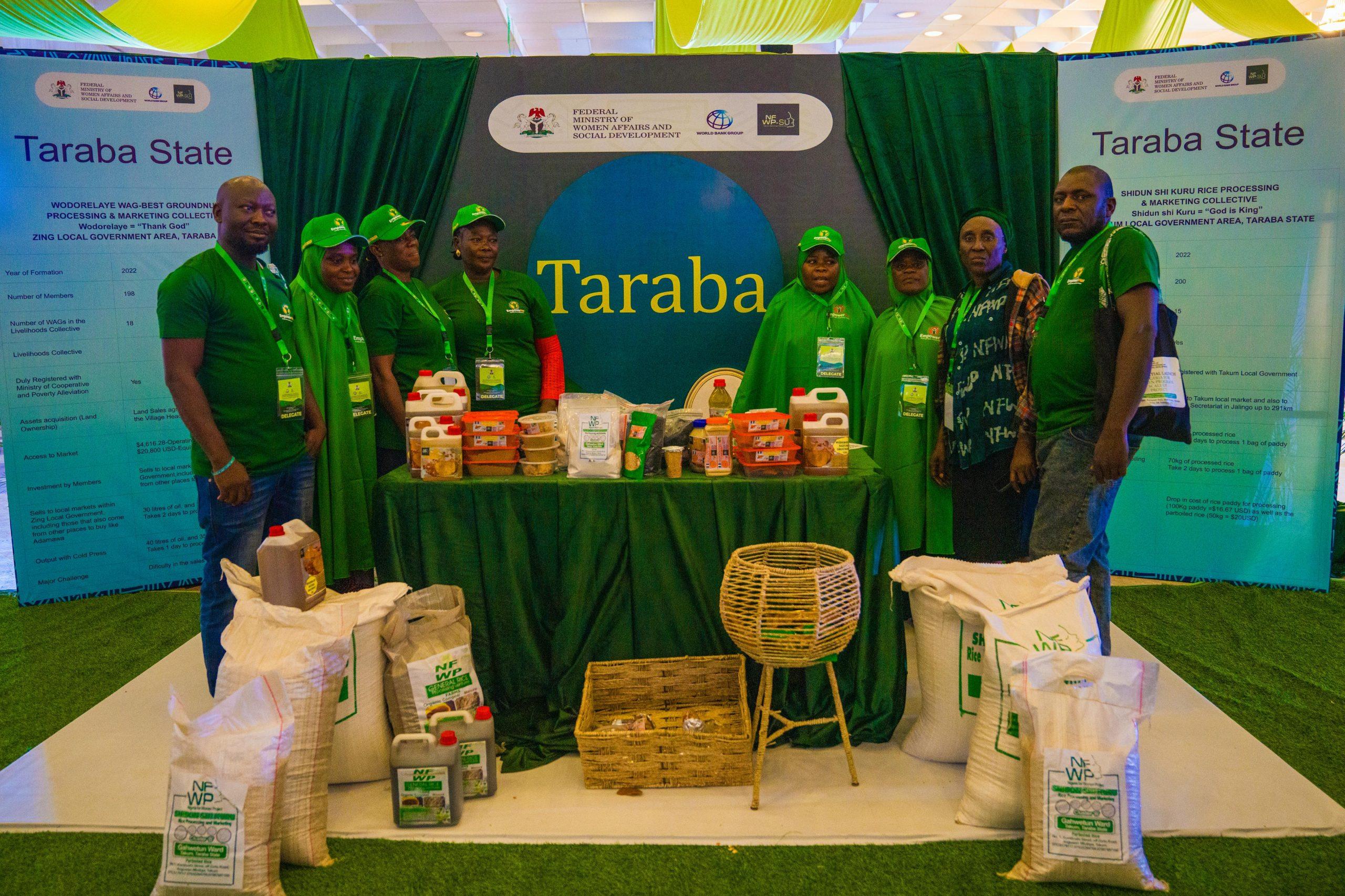
Thirteen collectives produce rice, palm oil and a range of groundnut products.
Kwatishe envisions more up-scaling.
“I want them to come up with upscaling in yam, cassava, fabrics and tailoring in Taraba State.”
Abia State
In Abia, Chinenye Amos Uhegbu, shared the state’s performance:
“We formed 3,657 WAGs… and we have 60 collectives standing in Abia.”
With 38 cassava and 22 palm oil processing sites, she called the pilot phase “really a success story.”
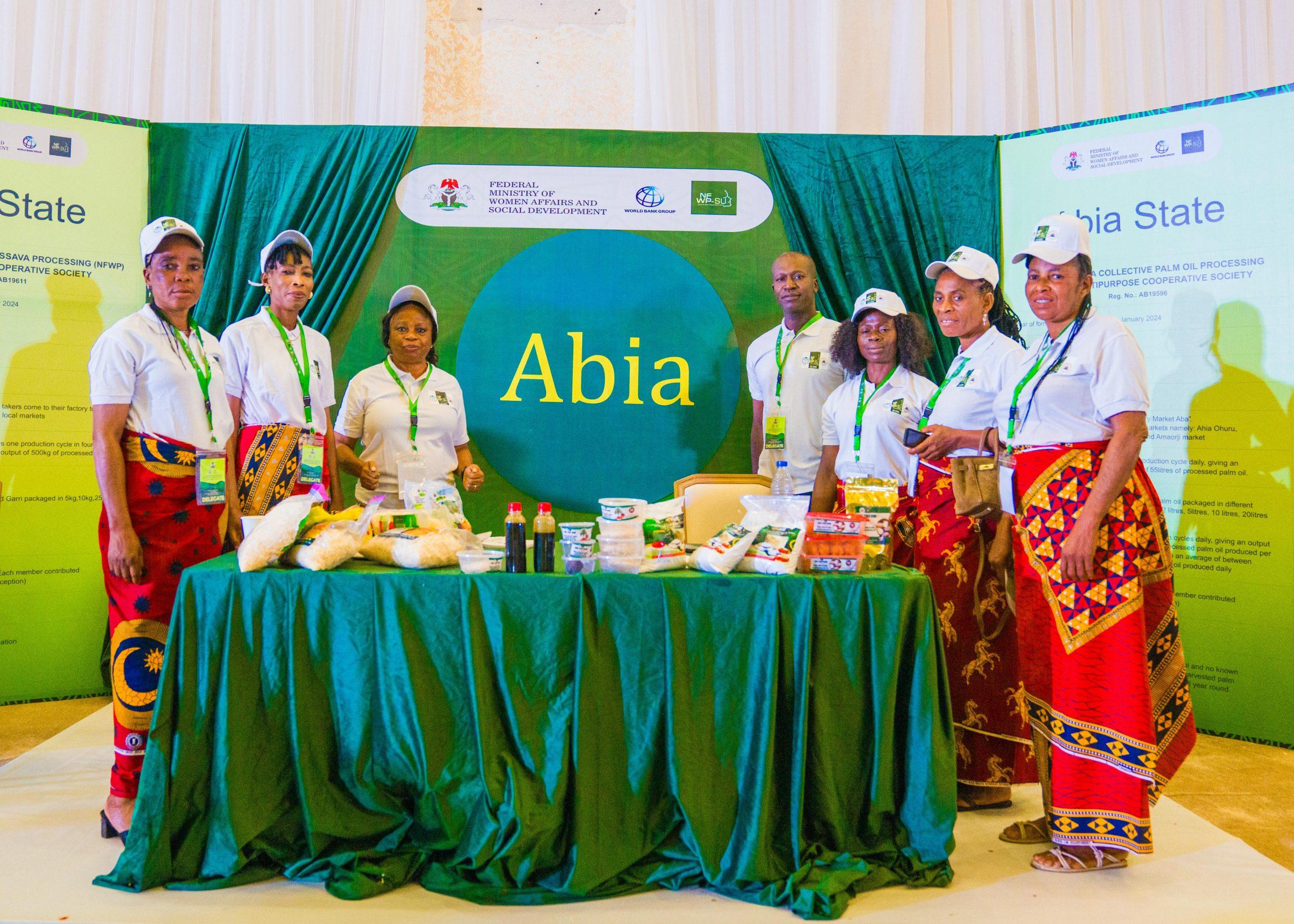
Abia State embodies another success story of how the economies have improved from little to much.
“Some of them have grown to become employers of labour from the little they had. And they got the individual livelihood grants of 60,000, borrowed from their WAGs, and financed their trade. And now most of them have grown so much that the stories abound everywhere.”
She acknowledged early skepticism:
“The initial problem or challenge of unbelief was surpassed when they saw that it was free.”
She however appealed for increase in the number of benefitting Local Government Areas.
“Other local governments are saying why are you doing it with three local governments per time? Why can’t you come at once? So everybody will benefit at the same time. If that can be done, it will be fine.”
Looking Ahead
From Kebbi’s rice exporters to Ogun’s Adire producers, from Akwa Ibom’s palm oil hubs to Abia’s cassava processors, from Niger’s shea butter collectives to Taraba’s groundnut enterprises, the Nigeria for Women Scale-Up Programme has moved beyond policy rhetorics into measurable economic and social transformation.
President Tinubu summed up the vision:
“To the women of Nigeria: this government sees you, values your contribution, and is investing in your success; not as charity, but as a deliberate national strategy for growth, stability, and prosperity.”
With federal leadership, State ownership, legislative backing, strengthened legal frameworks, and World Bank partnership aligned, the Nigeria for Women Scale-Up Programme stands today, not merely as a social intervention but as a strategic investment in the critical bloc of Nigeria’s future.