

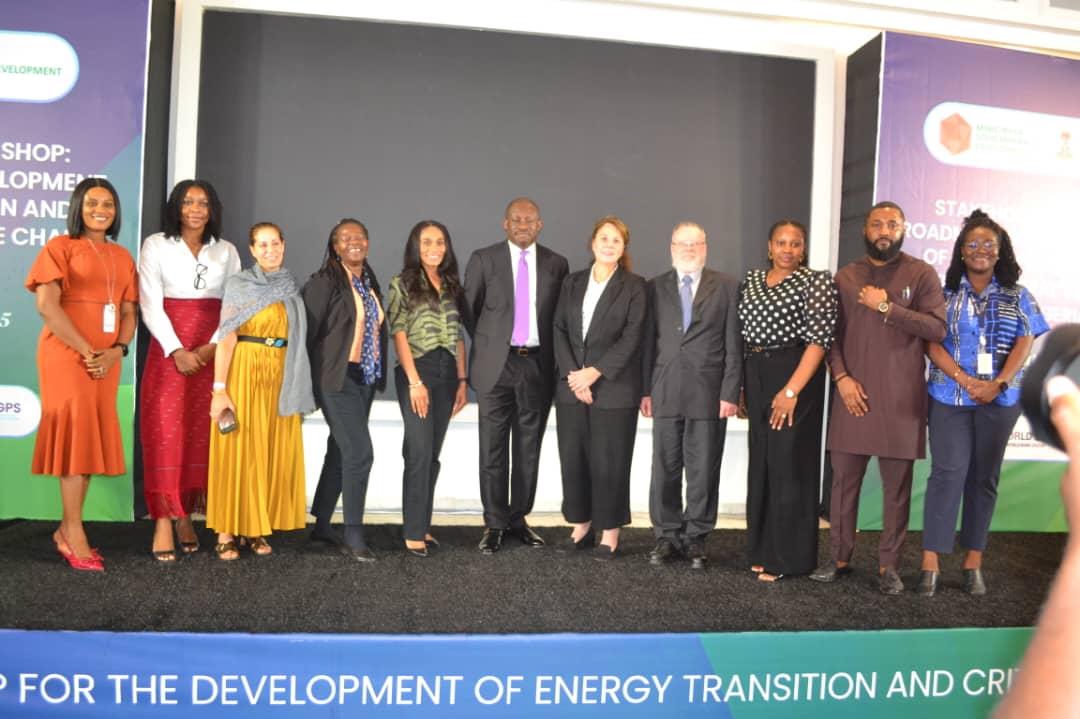
The Nigerian Government has restated its commitment to implementing the Energy Transition and Critical Minerals (ETCM) Roadmap, a key strategy designed to position the country as a major player in the global clean energy economy.
This was disclosed by the Head, Press and Public Relations Department
Ministry of Solid Minerals Development, Kania Andeyaba.
Speaking at the opening of a two-day stakeholders’ workshop supported by the world bank in Abuja, the nation’s capital, the Minister of Solid Minerals Development, Dr. Dele Alake, represented by the Ministry’s Permanent Secretary, Engr. Faruk Yabo described the event as a “strategic milestone” in Nigeria’s journey toward harnessing its vast mineral resources in a sustainable and globally competitive manner.
“Today’s gathering is not just another technical meeting. It is a strategic milestone in our journey to harness the immense potential of our mineral resources, drive industrialisation, and position Nigeria as a key player in the global energy transition,” he said.
Global Demand
Dr. Alake noted that the urgency of the energy transition is heightened by the increasing global demand for rare earth elements essential for solar panels, electric vehicles, and battery storage systems.
“Technology is evolving at an unprecedented pace. Nations that develop competitive and sustainable mineral value chains will lead in the new clean energy economy. Nigeria, with its rich deposits, must seize this moment,” he stated.
Industrial operations
The Minister highlighted the roadmap’s key pillars as attracting investment across the entire mineral value chain; building energy infrastructure and human capital; strengthening governance, security, and environmental compliance.
It also supports artisanal and small-scale miners alongside industrial operations and ensure that mining benefits are shared fairly with communities and all levels of government.
He said that the roadmap aligns with the ministry’s seven-point agenda and broader African frameworks, such as the Africa Rare Earth Strategy and the African Mining Vision.
Collaborative policymaking
Dr. Alake emphasised that the workshop marks a shift towards collaborative policymaking, bringing together stakeholders across all sectors to shape Nigeria’s clean energy future.
“We must be open-minded, practical, and focused on actionable solutions that make Nigeria competitive in the global ETCM value chain. This is about jobs, industrial linkages, investment, and a sustainable, low-carbon future.”
In a keynote presentation, the Director General of the Nigerian Mining Cadastre Office, Engr. Obadiah Nkom, reviewed the implementation of the 2016 Minerals Roadmap, tracing milestones from 1902 to the recent 2024 Mineral Value Chain Regulations.
He highlighted past challenges such as poor policies, lack of geoscience data, and low investor confidence, but noted major progress including increased domestic processing, new regulatory frameworks, and significant investments:
. $100M Avatar Energy lithium battery plant in Nasarawa (4,000 daily capacity, 4,000 jobs)
· $600M lithium plant near Kaduna-Niger border (soon to commission)
· $200M refinery near Abuja (advanced stages)
· $150M NASENI-REA lithium-ion battery factory deal
Engr. Nkom also outlined phased roadmap implementation covering immediate to long-term reforms, infrastructure, and community engagement.
Critical minerals
The World Bank highlighted a projected 500% global rise in demand for critical minerals like lithium and cobalt by 2050, urging urgent policy action to leverage Nigeria’s rich reserves.
The workshop united key government officials, industry leaders, development partners, academics, and mining communities to discuss Nigeria’s critical minerals potential.
Lateefah Ibrahim