



The Nigerian government on Monday launched the “Cross-Border Digital Payments and Identity in Nigeria under the AfCFTA” report, urging stakeholders to unlock trade opportunities for Micro, Small and Medium Enterprises (MSMEs) to access the $3.5 trillion African Continental Free Trade Area (AfCFTA) market.
The high-level report, hosted by the Office of the Vice President in collaboration with ODI Global under the Supporting Investment and Trade in Africa (SITA) programme, was unveiled by the Deputy Chief of Staff to the President, Ibrahim Hassan-Hadejia, in Abuja.
Hassan-Hadejia described the research as both timely and strategic, noting the strong coordination by the Office of the Vice President and the leadership of the Federal Ministry of Industry, Trade and Investment.
He revealed that the cross-border payments report followed earlier milestones, including the development and launch of Nigeria’s Digital Trade Strategy and a capacity-building programme for subnational leaders.
Leading Role
Furthermore, he said Nigeria is increasingly assuming a leading role in shaping the digital trade agenda across the African continent, necessitating that the country remains at the forefront of AfCFTA implementation.
He noted that deepening engagement with AfCFTA and enabling businesses, particularly SMEs, to conduct seamless cross-border transactions will be critical to unlocking trade, fostering growth, and creating jobs.
He further stated that efficient cross-border payments, supported by trusted digital identity systems as recommended in the report, will be key to realising President Bola Ahmed Tinubu’s Renewed Hope vision for Nigerian MSMEs.
The Deputy Chief of Staff also observed that while the report identifies the Pan-African Payment and Settlement System as a critical platform for cross-border digital payments, Nigerian fintech firms such as PalmPay and Moniepoint, which have some of the largest and most active user bases, will play a pivotal role in driving adoption.
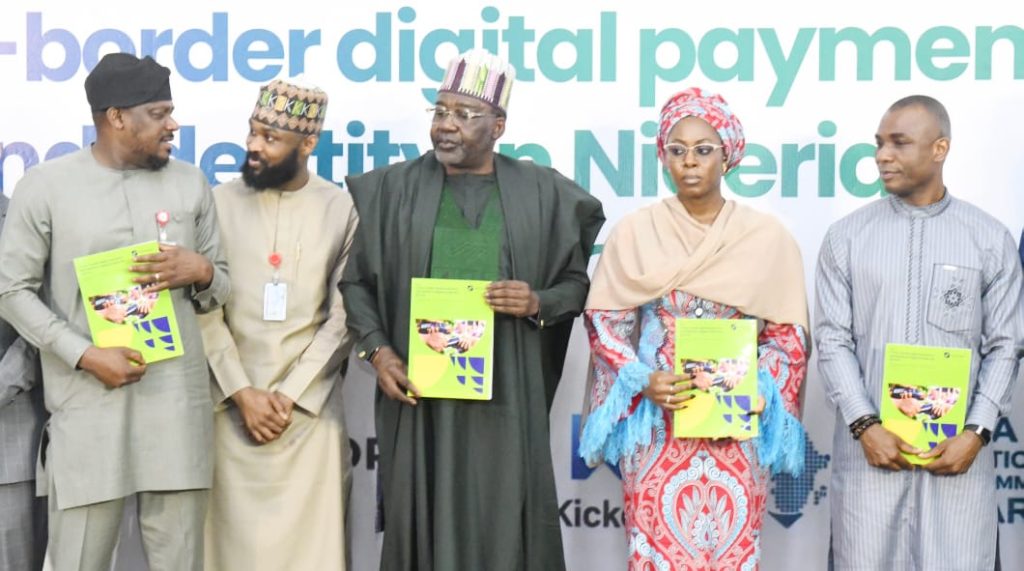
He assured that the Federal Government remains committed to strengthening critical infrastructure, regulatory frameworks, and partnerships to ensure Nigeria is not only ready for digital trade but continues to lead.
“I appreciate the efforts of all stakeholders and urge us to move AfCFTA beyond a continental agreement to a $3.5 trillion trade juggernaut that will reinvigorate our industries, unlock intra-African trade, and domesticate African prosperity,” he added.
He said “intra-African trade will be driven not only by large corporations but by small businesses empowered through digital trade and e-commerce, while noting that issues of trust, identity, and logistics, as highlighted in the report, must be addressed”.
Enabling Seamless Access To Continental Markets
Commenting on the report, the Special Adviser to the President on Job Creation and MSMEs, Temitola Adekunle-Johnson, said the report – developed under the purview of the Office of the Vice President-would significantly strengthen the MSME ecosystem.
He expressed optimism that the report’s findings and recommendations would enable Nigerian SMEs to achieve seamless access to continental markets.
The Special Assistant to the President on ICT Policy, Office of the Vice President, Salihu Dasuki, disclosed that the office, in partnership with development partners, has developed a framework to fast-track seamless cross-border payments for MSMEs.
He added that “a key pillar of President Tinubu’s Renewed Hope Agenda is enabling Nigerians to access digital trade, which informed the capacity-building programme conducted for subnational governments last year”.
The Special Assistant to the President on Project Support, Office of the Vice President, Shuda Ahmed, commended ODI Global for leading the research underpinning the report.
She noted that without seamless and affordable cross-border payment systems, MSMEs across the continent would be unable to scale beyond their domestic markets.
The event was attended by officials of ODI Global, representatives of AfCFTA, the National Information Technology Development Agency (NITDA), National Identity Management Commission (NIMC), Nigerian Petroleum Development Company (NPDC), Federal Competition and Consumer Protection Commission (FCCPC), and MSMEs, among other key stakeholders.