

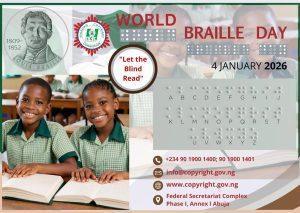
The Director-General of the Nigerian Copyright Commission (NCC), Dr John Asein, has expressed concern over the severe shortage of books in accessible formats for persons with visual impairments in Nigeria.
Dr Asein made this known in a statement to mark the 2026 World Braille Day, observed annually on January 4. He disclosed that less than one per cent of published materials in Nigeria are available in accessible formats such as Braille, audio books or screen-reader-compatible digital text, describing the situation as a “deeply troubling book famine.”
According to him, the scarcity of accessible reading materials constitutes a major barrier to education, employment and social inclusion for persons who are blind or visually impaired.
World Braille Day commemorates the birth of Louis Braille, the inventor of the Braille reading and writing system. Dr Asein noted that the global observance underscores the need to ensure that technological advancement does not further marginalise persons with print disabilities.
The NCC Director-General said Nigeria’s response to the challenge is anchored on the Copyright Act of 2022, which domesticates the Marrakesh Treaty, an international agreement aimed at removing copyright barriers for the print-disabled.
He explained that the law represents a shift from a charity-based approach to a rights-based framework, guaranteeing access to knowledge for persons with visual impairments.
Dr Asein said Section 26 of the Act permits the production, distribution and cross-border exchange of books in accessible formats without prior authorisation from copyright holders.
He added that the Act also provides safe-harbour protections for authorised entities such as libraries and non-governmental organisations to lawfully convert and share accessible materials.
He further disclosed that the NCC has issued guidelines to ensure clarity, transparency and safeguards in the production of accessible works, in order to promote confidence among publishers and disability advocacy groups.
Dr Asein warned that the persistent book famine continues to fuel poverty and illiteracy among visually impaired persons across Africa, limiting their access to higher education and participation in the workforce.
He stressed that addressing the challenge is critical to Nigeria’s development objectives.
“Inclusion is not an act of generosity; it is a legal obligation, a moral imperative and a development necessity,” he said.
The NCC Director-General assured that the Commission would intensify advocacy and capacity-building programmes for publishers, libraries and educational institutions, with a view to promoting inclusive access to knowledge while safeguarding authors’ rights.