

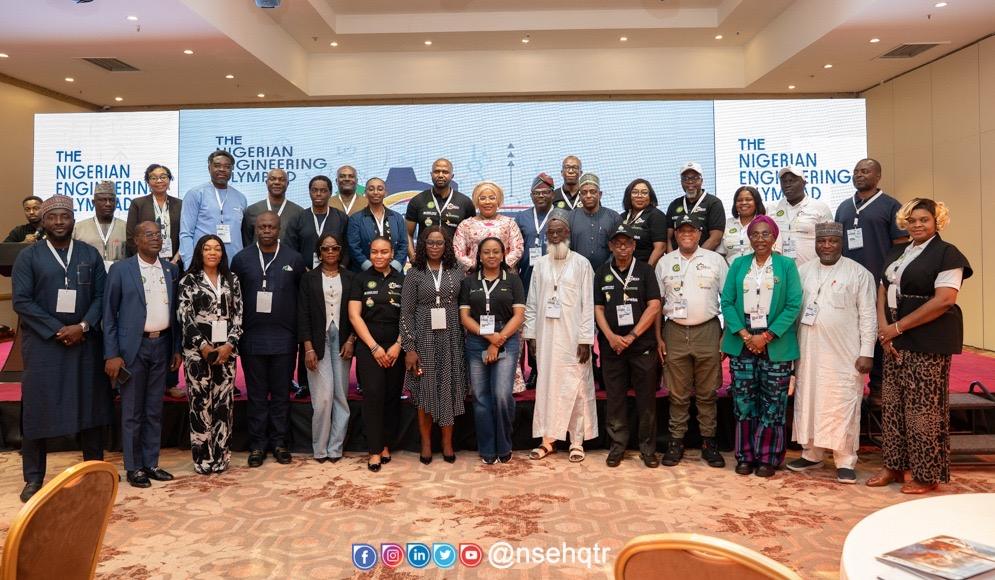
Nigeria has reiterated its commitment to strengthening its global engineering competitiveness with the launch of the maiden Nigerian Engineering Olympiad (NEO).
The NEO is an initiative aimed at identifying, nurturing, and transforming engineering inventions by university students into market-ready technologies capable of advancing national development.
The Olympiad aims to tackle pressing needs in infrastructure, manufacturing, energy transition, sustainability, and digital technology, and to produce a generation of job-creating engineers, problem solvers, and globally competitive innovators.
Speaking at the launch, the President of the Nigerian Society of Engineers (NSE), Margaret Oguntala, said the Olympiad was “a watershed moment” in the history of engineering education in Nigeria.
Oguntala explained that “the Nigerian Engineering Olympiad programme, a competition that would span about seven months, aims to transform students’ engineering ideas into real-life solutions.”
According to her, the Olympiad will create a structured pipeline, regional contests, prototype bootcamps, iterative design, product validation, intellectual property support, and a national finale in April 2026, designed to take ideas from concept to commercialization.
“Ideas do shape the world. Every great invention in history began with a single idea… and Nigeria is brimming with such creative minds in our universities today,”Oguntala said.
She described the Olympiad as “a national innovation incubator that will provide mentorship, seed funding, and technical guidance to the top teams.’
Oguntala also highlighted NSE’s recent $17.4 million partnership with MIDAS IT of India to supply advanced engineering design software to 15 universities, a step she said would “strengthen academic excellence and prepare young engineers for global competitiveness.”
Oguntala reiterated Nigeria’s determination to elevate its technological capacity and compete on a global scale.
She said; “Today, we ignite a spark that will light the way for Nigeria’s engineering future. The innovations born from this Olympiad could become the solutions that drive our industries, improve our infrastructure and uplift our communities.”
On his part, the Enactus Nigeria Country Director, Michael Ajayi said the Olympiad was conceived with Nigeria’s demographic realities in mind, noting that “Nigeria’s population sits at about 200 to 250 million people, with about 70 percent being young.
“Meanwhile, unemployment is exceeding 30%. The question is: how do we leverage the strength, innovation, and drive of young people to support national development?”
Ajayi said Olympiad would help young engineers tackle real-life challenges and build businesses that create jobs.
“If we inspire these innovations and enable them to thrive, you have young people driving entrepreneurial ventures and opening doors for others,” he said.
Ajayi emphasised that technical mentorship would be central to success, stressing that professionals in engineering and business development will literally hold the hands of participants to ensure they have the technical, financial, and business development support they need.
He said; “Olympiad is open to all engineering fields in accredited institutions, with potential future expansion to science-based students.”
Ajayi stressed that national-scale impact can only be achieved through collaboration across government, the private sector, and civil society.
He said; “This partnership proves that when we combine policy support, private-sector systems, and nonprofit expertise, we can deliver transformational impact not just for individuals, but for entire industries.
“Olympiad’s objectives include encouraging students to apply classroom knowledge to real-life problem-solving and enabling them to build engineering-driven businesses that generate jobs and wealth.”
Also speaking, the Executive Secretary of the Nigerian Content Development and Monitoring Board (NCDMB), Felix Omatsola Ogbe, said the Olympiad aligns directly with national productivity goals, warning that Nigeria’s engineering capability has been undermined by a severe skills gap.
A Board Director, Mr. Abayomi Bamidele, who represented the Executive Secretary, cited a 2023 survey disclosing that only about 5 percent of Nigerian engineering graduates are industry-ready at the point of graduation, while over 70 percent lack hands-on technical skills needed for modern industry.
He noted the implications of the skills gap: “It contributes to a shortage of competent local engineers, heightens reliance on expatriates, and fuels the brain drain as talented Nigerian engineers seek opportunities abroad.”
Ogbe said the initiative supports the NCDMB’s mission to promote human-capital development and indigenous innovation.
He said; “Our aspiration is to position Nigeria as an engineering innovation hub. Through this Olympiad, we aim to institutionalize a national platform that identifies, nurtures and supports exceptional talent across tertiary institutions.”
Ogbe called for stronger collaboration among academia, government, and industry to ensure applied research produces tangible solutions.
First E&P’s General Manager for Integrated Gas Development, Yetunde Taiwo, said the company’s involvement stems from a commitment to innovation and talent development.
Taiwo said; “Our core values are around fostering talent, innovation and entrepreneurship. Some of the perennial challenges we see in the industry can actually be solved by these very bright young minds.”
She added that engaging students early with real industry problems could help reduce brain drain by creating clear pathways into the workforce.
Representing Renaissance Africa Energy Company, Nigerian Content Manager, Olanrewaju Olawunyi, said; “their support reflects a longstanding commitment to developing human capital.”
On behalf of the Minister of Youth Development, the Technical Adviser, Ebiho Agun, said; “the Olympiad aligns fully with government priorities and the nation’s long-term workforce needs.”
The event was organised by Enactus Nigeria in partnership with NSE, Nigerian Content Development and Monitoring Board (NCDMB), Renaissance Africa Energy Company (RAEC), and the First Exploration and Petroleum Development Company (FIRST E&P).