

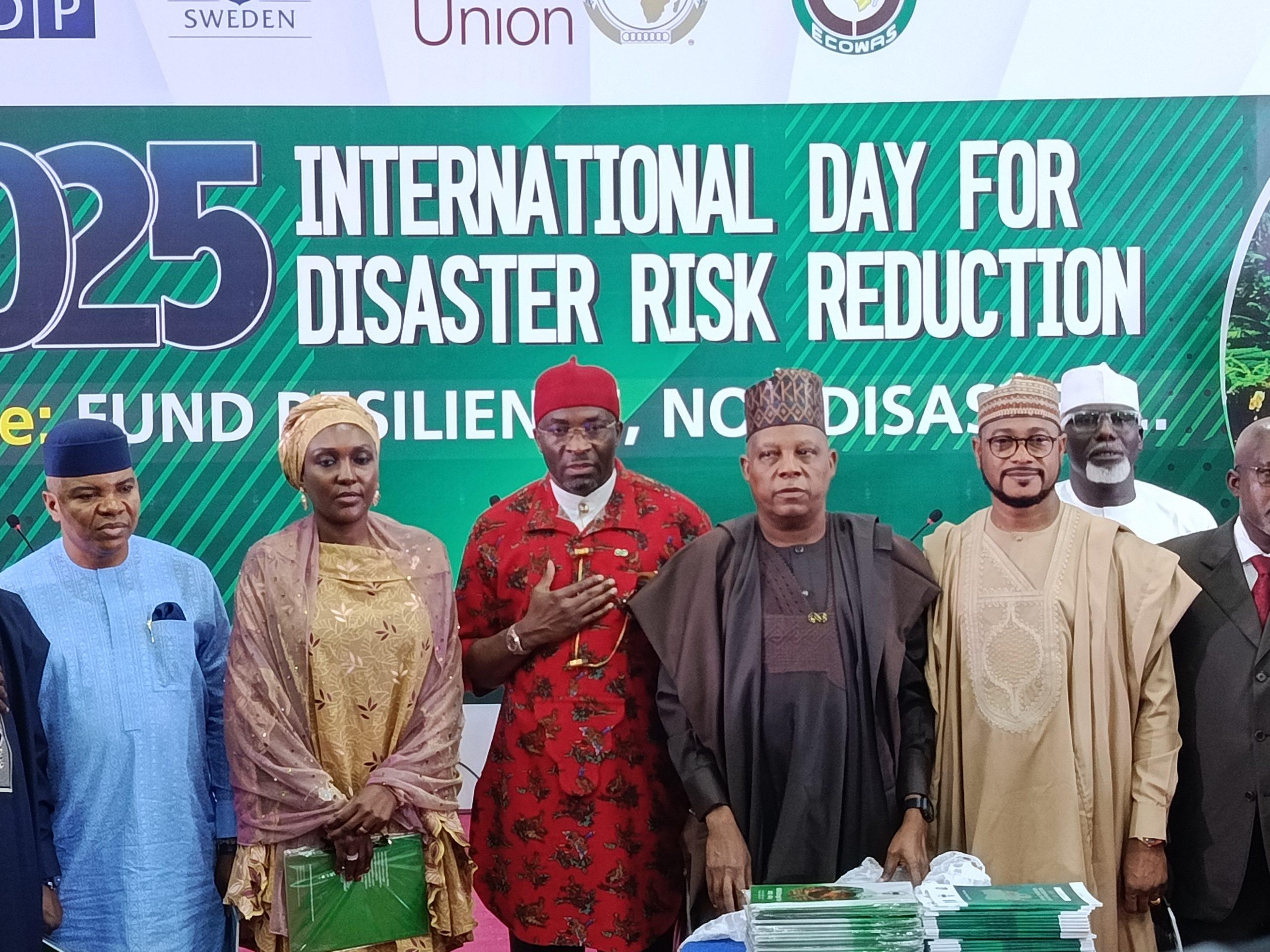
The Nigerian Government is integrating disaster risk reduction plans into every sector towards the scaling up of investment amidst funding cut.
Vice President Kashim Shettima said this at the 2025 International Disaster Risk Reduction day, organised by the National Emergency Management Agency, (NEMA), in Abuja, the nation’s capital.
He said government will also expand early warning systems to ensure that communities receive timely alerts before any outbreak occurs.
The Vice President said disaster readiness is the true measure of every nation’s maturity, noting that, the strength of a people is not proven in the chaos that follows calamity, but in the wisdom of preparation that prevents
“Beyond demonstrating our utmost respect for the sanctity of human life, it reveals our commitment to building a system that rests on order, foresight, and stability.
“The theme of this year’s commemoration, “Fund Resilience, Not Disasters,” speaks to a truth we often overlook: it is far wiser, far cheaper, and far more humane to prepare for disasters before they strike than to rebuild after they destroy. Every naira we spend today on preparedness saves many more tomorrow on response and recovery. Every investment in resilience is, in truth, an investment in the lives and futures of our people”.
He reiterated the need to strengthen state and local emergency management agencies through training, technology, and coordination support through a National Disaster Risk Financing Framework to guarantee that funding for prevention and preparedness is available when and where it is needed.
Government will also deepen partnerships with development partners, the private sector, and research institutions to drive innovation and resilience building, at all levels.
“But, distinguished ladies and gentlemen, commitment alone is not enough. We must match our words with action and our policies with funding. To fund resilience is to invest in drainage systems, not relief camps; to build stronger schools and hospitals, not temporary shelters; to support farmers with climate-smart tools, not just food aid after floods; and to train and equip our first responders before the sirens start to wail. This is the shift we must make—from reacting to crises to anticipating and preventing them”.
He therefore emphasised that, all hands must be on deck, to ensure resilience is guaranteed as it reflects in how cities are planned, in how businesses protect their workers, and in how communities share information and look out for one another.
“Our academia and research institutions also bear the responsibility of helping us generate the data, innovation, and practical research we need to prepare for a safer future. We count on them to shape the knowledge that guides our decisions. And we expect our civil society to hold us accountable, to raise awareness, and to mobilise citizens around the shared responsibility of preparedness”.
The vice President, therefore pointed out that unless communities are empowered and supported to take ownership of their safety, none of these efforts will yield results.
They are the foundation of whatever strategy we adopt and the heartbeat of our national resilience.
Addressing the gathering , the Director General, NEMA, Zubaida Umar said Nigeria, like many nations, continues to experience increasing frequency and intensity of disasters driven by climate change, conflicts, pandemics, and technological risks.
These events, she said, are testing the limits of traditional emergency response systems and demanding a more proactive, preventive, and well-financed disaster risk management framework.
This is why today’s dialogue is critical, to collectively rethink how we fund resilience; to move from reactive, ad-hoc funding of disasters to a multi-stakeholder financing architecture that supports prevention, preparedness, and sustainable recovery.
According to her, the event also presented an opportunity for the official launch of two landmark policy instruments that will guide the collective efforts in the years ahead:
The NEMA Strategy Plan (2025–2029) and
The National Disaster Risk Reduction Strategy (2025–2030) which are anchored on risk-informed development, innovation in financing, and stronger institutional collaboration, ensuring that disaster risk management becomes an integral part of planning across all sectors.
“In this regard, NEMA is already working with key stakeholders to develop a National Risk Monitoring and Information Platform that will serve as a cross-sectoral system for early warning, vulnerability mapping, and risk-informed investment decisions.
“Equally important is the dialogue around innovative financing, exploring instruments such as catastrophe bonds, insurance pools, climate funds, and blended finance models that can sustain risk reduction efforts at scale”. Director General said.
The Director General, NEMA, also disclosed that plans by the Agency to convene the National Disaster Risk Management Summit, is underway.