


Nigeria is set to strengthen the integrity and credibility of its emerging carbon market through the deployment of robust Measurement, Reporting and Verification (MRV) systems, as the Federal Government seeks to attract large-scale private investment into climate action.
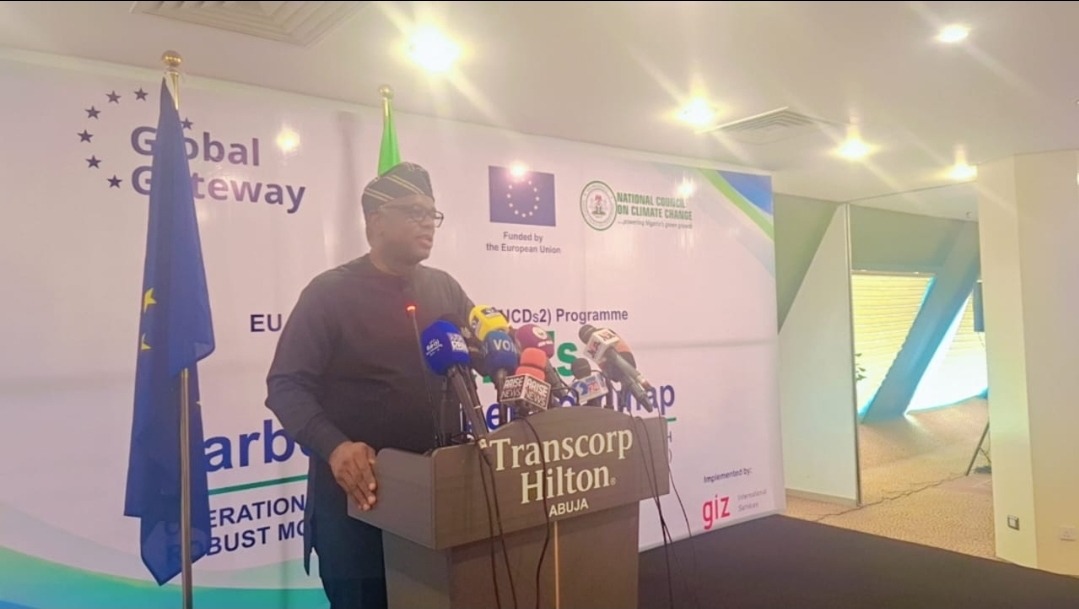
The Director-General of the National Council on Climate Change (NCCC), Mrs. Omotenioye Majekodunmi, disclosed this at a high-level roundtable on “Operationalising Nigeria’s Carbon Markets through Robust Measurement, Reporting, and Verification (MRV) Protocols,” convened under the European Union Climate Dialogues programme in Abuja, Nigeria’s capital.
Represented by the Director, Energy, Transportation & Infrastructure of NCCC, Mr. Michael Ivenso, the Director-General said Nigeria was determined to ensure that carbon markets translate the country’s climate commitments into tangible economic opportunities while preventing greenwashing and protecting the interests of communities, investors and project developers.

According to the Director-General, “carbon markets are only as strong as the integrity of the underlying credits,” stressing that Nigeria would not accommodate a carbon market that lacked transparency, credibility and environmental integrity.
Mrs. Majekodunmi said the country’s objective was to ensure that carbon projects delivered real, additional and permanent mitigation outcomes, while contributing to community development, environmental protection and fair returns for project developers and investors.
READ ALSO: Nigerian President Approves Carbon Market Framework
The Director-General said carbon markets were not a panacea for Nigeria’s climate and development challenges, but argued that, when supported by transparency, credible MRV systems and effective stakeholder collaboration, they could become a major catalyst for sustainable development.

The NCCC Boss, therefore, urged participants at the roundtable to move beyond discussion and develop an actionable and time-bound roadmap capable of positioning Nigeria as a leading destination for high-integrity carbon investment in Africa.
“A major component of the new approach is the operationalisation of a unified and interoperable national carbon registry.
“The registry is expected to provide a digital record of carbon credits generated, issued, transferred and retired in Nigeria, thereby helping to prevent double-counting and strengthening the integrity of carbon transactions.” She explained.

The NCCC also plans to accelerate the adoption of digital Measurement, Reporting and Verification (dMRV) technologies, including remote sensing, Internet of Things (IoT) sensors, geospatial data and distributed ledger technologies.
The technologies are expected to reduce the cost and time required to verify carbon projects while improving the accuracy and reliability of emissions data.
The Director-General explained that without effective MRV systems, buyers would be unable to determine whether claimed emissions reductions were genuine, regulators would face difficulties tracking emissions and safeguarding against double-counting, while communities could struggle to monitor benefit-sharing arrangements.
The NCCC called for stronger collaboration among federal ministries, state governments, private-sector operators, development partners, financial institutions, civil society organisations and academic institutions.
Head of section, Green and Digital Economy, EU Delegation to Nigeria and ECOWAS, Ms. Yolanda San Jose, said carbon markets are playing an increasingly important role in supporting emissions reductions, mobilising finance, and encouraging investment.
According to her, this is why Nigeria took a very important step last year by adopting its National Carbon Markets Framework. It established a structured legal and institutional system for domestic and international carbon trading under the Climate Change Act (2021) and Article 6 of the Paris Agreement. The Framework is the foundation for confidence, trust, and effectiveness in Nigeria’s emerging carbon market system.

Ms. Jose noted that, for Nigeria, the development of a strong national carbon market system is both imperative and a significant opportunity, and would help align climate targets with development priorities, support investment, and create an enabling environment for a low-carbon future.
“Today’s event is intended to help shape that pathway. In particular, we aim to align stakeholder views around Nigeria’s National Carbon Markets Framework and to discuss a preliminary roadmap for its operationalisation. We will do so by emphasising the robustness of so-called Measurement, Reporting and Verification (MRV) practices, to ensure that this market mechanism delivers credible results for both the Nigerian people and the environment.”
She added that the European Union is pleased to support this process in partnership with Nigeria.
Representing the Ministry of Environment, Mrs Halima Bawa-Buhari said the ministry is working towards a partnership that will lead to a robust Measurement, Reporting and Verification (MRV) system and a high-integrity carbon market, contributing significantly to the Securing Nigeria’s Forest Future (SNFF) financing roadmap.
One of the development partners, UKPACT Officer, Ms Folakemi Aletan, said a well-functioning carbon market in Nigeria represents more than a climate policy instrument.
She said it provides an opportunity to mobilise investment, support sustainable development, strengthen competitiveness and ultimately mobilise climate finance.
The representative of the Food and Agriculture Organisation (FAO), Mrs Nifesimi Ogunkua, said; “the organisation is supporting the National Council on Climate Change through a partnership agreement to strengthen the operationalisation of Nigeria’s carbon market framework.”
She said the support includes the design and deployment of a digital portal for managing the lifecycle of carbon credit projects.
The development of the MRV system builds on Nigeria’s National Carbon Markets Framework (NCMF), which established an institutional and regulatory architecture for carbon market activities across the country.

