

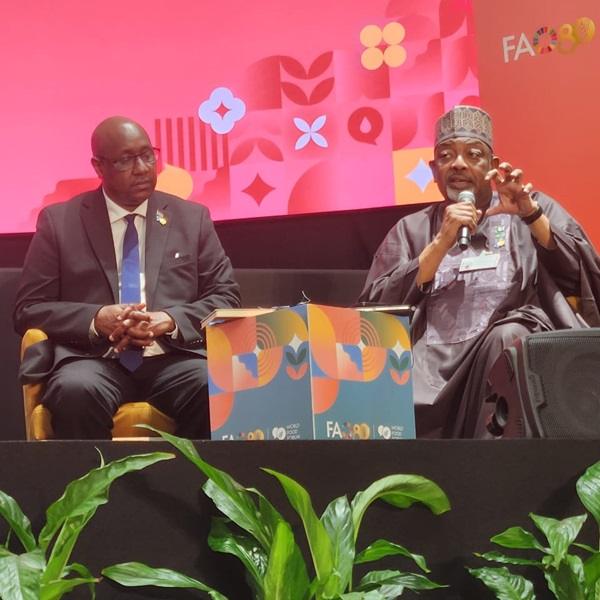
Nigeria has reiterated its strong commitment to South–South and Triangular Cooperation (SSTC) as a key driver for agrifood transformation and sustainable development through the exchange of knowledge, expertise, and resources among developing nations.
Speaking during the Ministerial Dialogue on SSTC at the 2025 World Food Forum (WFF)—an event marking the 80th anniversary of the Food and Agriculture Organization (FAO) in Rome, Italy—the Minister of Agriculture and Food Security, Senator Abubakar Kyari, said the initiative aims to strengthen the collective bargaining power of developing countries and promote a more equitable global economic system.
Kyari noted that South–South Cooperation has become a central pillar of Nigeria’s agricultural development strategy, fostering knowledge exchange, innovation, and inclusive growth.
He emphasised that effective cooperation must be founded on mutual respect, national ownership, and measurable outcomes, describing SSTC as one of the most practical and cost-effective approaches to achieving food security and shared prosperity.
The Minister highlighted that Nigeria’s partnership with FAO and China under the SSTC framework has delivered tangible results, including progress in technology transfer, farmer training, aquaculture development, and the establishment of Regional Multi-Service Extension Centres across the country.
Read Also: Renewed Hope Initiative Promotes Sustainable Agriculture In Rivers
According to him, “The lessons we continue to draw from our partnerships with China, Brazil, and other developing nations reaffirm that the Global South has the capacity, knowledge, and innovation needed to solve its own challenges if we work together in solidarity.”
Kyari also outlined Nigeria’s current priorities to deepen the impact of SSTC, which include:
- Institutional Strengthening: Integrating SSTC programmes into national agricultural strategies to align with Nigeria’s National Agrifood Systems Transformation Agenda.
- Sustainable Financing: Establishing flexible funding mechanisms and encouraging blended finance models to scale up South–South partnerships and projects.
- Technology and Knowledge Exchange: Promoting collaboration on climate-smart agriculture, irrigation, mechanisation, and digital solutions to boost productivity and resilience.
- Regional Integration: Strengthening Nigeria’s leadership within ECOWAS to foster sub-regional agricultural trade, research partnerships, and policy harmonisation.
In his remarks, FAO Director-General, Dr Qu Dongyu, commended Nigeria and other member states for their continued commitment to building inclusive and sustainable agrifood systems.
He added that the next phase of South–South Cooperation must be underpinned by stronger institutional frameworks and targeted investments to sustain progress and deliver greater impact across the Global South.