

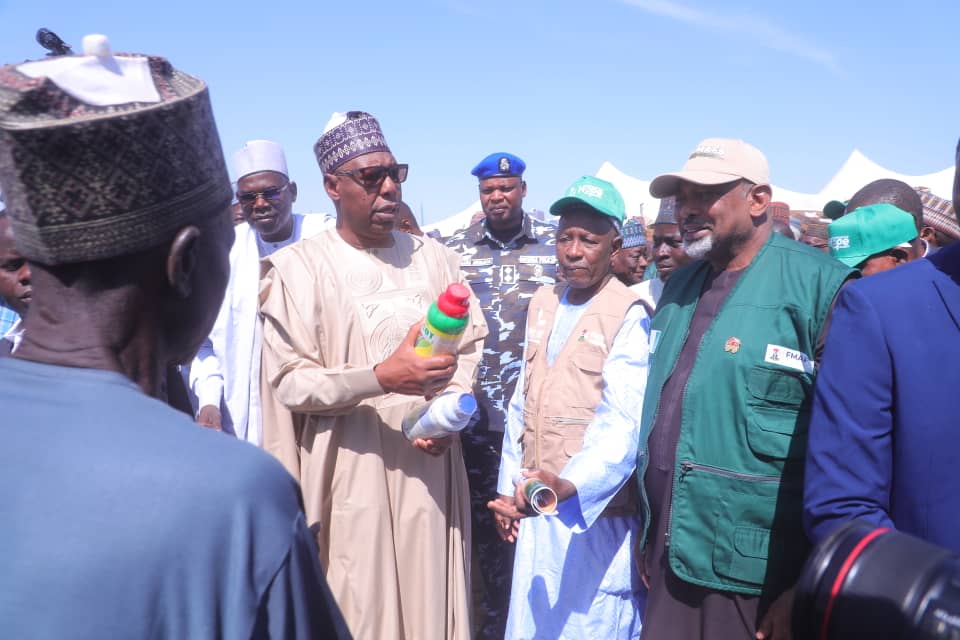
The Minister of Agriculture and Food Security, Senator Abubakar Kyari has reaffirmed the Nigerian government’s commitment to strengthening food security through sustained investment in agriculture under President Bola Ahmed Tinubu’s Renewed Hope Agenda.
Speaking at the national flag-off of the 2025/2026 wheat production season in Maiduguri, the Minister highlighted the importance of the National Agricultural Growth Scheme Agro-Pocket (NAGS-APE) in empowering smallholder farmers and boosting local food production.
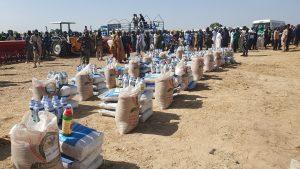
Senator Kyari noted that “the programme provides farmers with access to improved seeds, fertilisers, mechanisation, irrigation infrastructure, and extension services.”
He emphasised that the initiative targets key wheat-producing states, including Borno, Adamawa, Kano, Kaduna, Taraba, and Plateau, and aims to reduce Nigeria’s dependence on wheat imports while strengthening national food security.
“We are committed to ensuring that Nigerian farmers have the tools, inputs, and knowledge to succeed,” Kyari said. “Through this programme, thousands of farmers across the country are now better equipped to cultivate their land and achieve higher yields,”Senator Kyari said.
Following the Minister’s address, Governor Babagana Umara Zulum expressed deep appreciation for the Nigerian Government’s support and acknowledged Minister Kyari’s leadership in prioritising Borno as a key state for wheat production.
He described the programme as “a declaration of hope, resilience, and commitment to ensuring that no family in Borno goes hungry.”
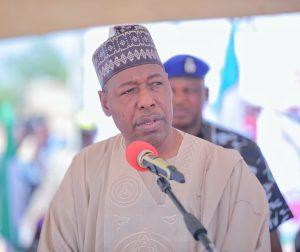
The Governor highlighted the state’s remarkable progress in agriculture, noting that smallholder farmers now have access to modern irrigation systems, solar and conventional pumps, mechanised tractors, fertilisers, and extension advisory services.
“Thanks to these interventions, farmers across Damasak, Baga, Gala, Bama, Dikwa, Monguno, Bayo, and other areas are now cultivating their lands year-round,” Governor Zulum said.

He further revealed that in areas such as Baga, Monguno, and Kauwa, farmers produced yields sufficient to feed their families for up to two years.
The Govenror also credited partnerships with the World Food Programme (WFP) and the Food and Agriculture Organisation (FAO) for supporting vulnerable farmers, including returnees, women-led households, and youth in 10 conflict-affected local government areas.
The Governor commended Nigerian initiatives such as the Presidential Agricultural Insurance Scheme, which protects farmers from climate risks including floods, droughts, and pest outbreaks.
He also praised the Borno Commissioner for Agriculture and the State Agricultural Transformation Team for sustaining agricultural growth, strengthening local markets, and improving social cohesion in post-conflict communities.

“This collaboration between the Federal Government and Borno State is ensuring that agriculture remains a central pillar of peace, recovery, and shared prosperity,” Govenor Zulum said, noting that the state is on course to achieve year-round wheat production driven by science, modern technology, and resilient farming practices.
Commissioner Bawa Musami warmly welcomed all participants to the official flag-off of the Agricultural Input Distribution under NAGS-APE for the 2025-2026 dry season wheat production.
He thanked the Federal Ministry of Agriculture and Food Security for selecting Borno as the launchpad for this national initiative.

Also Read: Nigeria Leverages Technology, Innovation to Boost Food Security
Under President Bola Ahmed Tinubu’s Renewed Hope Agenda and Governor Zulum’s long-term agricultural vision, agriculture is being repositioned as a cornerstone of national prosperity.
Together, these programmes aim to expand cultivated land, enhance irrigation and mechanisation, improve access to finance, empower farmers, and boost national food security.
“Today’s event is about more than planting wheat, it is about hope, resilience, and shared prosperity,” Musami said.
He said; “Nigeria consumes over 5.8 million metric tonnes of wheat annually but produces just 150,000 metric tonnes, leaving the country heavily reliant on imports. To close this gap, we must scale cultivation, modernise farming, and increase yields.”

Borno State holds one of West Africa’s largest irrigation potentials, with 400,000 hectares of irrigable land across the Lake Chad Basin, Komadugu-Yobe Basin, Yerzaran Valley, Jerry Bowl, Arrow Dam, and Sunkesha zones. Strategic projects, including the South Chad Irrigation Project (SCIP) and the rehabilitation of the Baja, Kamburu, and Ladari irrigation schemes, are transforming thousands of hectares into productive farmland using solar-powered pumps and modern infrastructure.
The state government has provided free inputs, mechanisation support, subsidised fertilisers, irrigation, and extension services to thousands of farmers, reducing production costs, increasing yields, and strengthening food security. During the 2024-2025 irrigation season, over 2,000 hectares were cultivated under this initiative, highlighting Borno’s role as a national leader in wheat production.