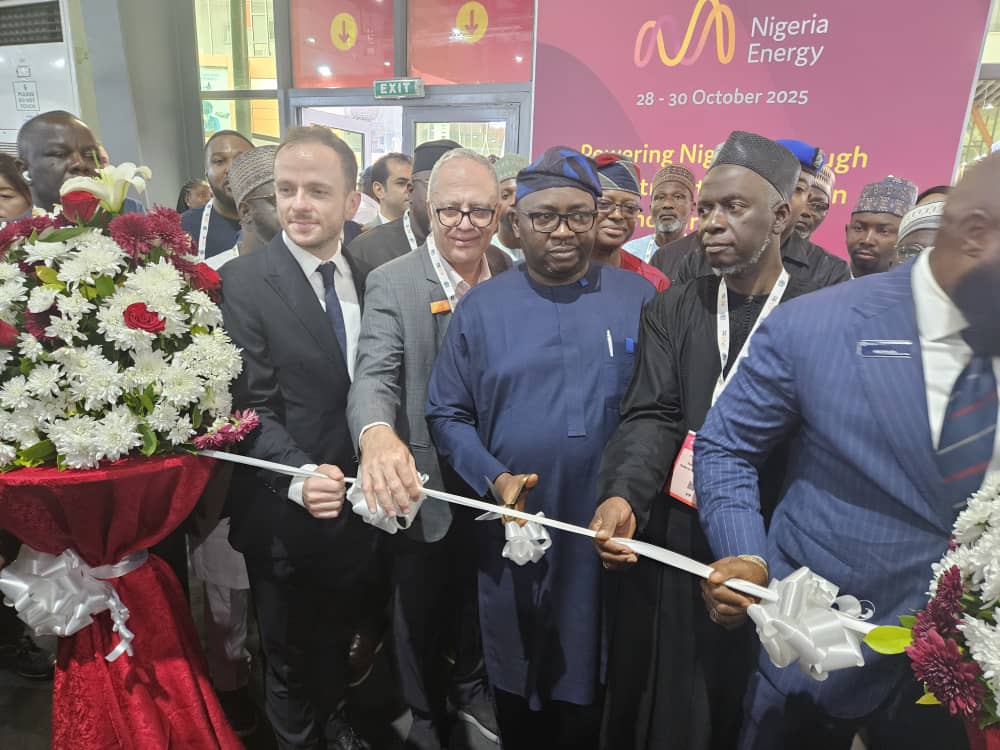
Nigeria’s Minister of Power, Adebayo Adelabu, has reaffirmed the Nigerian Government’s unwavering commitment to transforming the Power sector through strategic investments, innovation, and strong public-private partnerships.
The Minister made the declaration at the Nigeria Energy Forum 2025 held in Lagos State, Southwest Nigeria, where he emphasised that Nigeria is now more open and ready for energy sector investment than ever before.
In his keynote address titled “Powering Nigeria through Investment, Innovation, and Partnership,” Adelabu commended Informa Markets for its consistency in organising the annual event.
He described it as a “vital platform for connecting policymakers, investors, and industry leaders shaping the future of Nigeria’s energy landscape.”
The Minister said; “This theme captures our collective aspiration to build a resilient, inclusive, and sustainable energy future.
“It speaks not only to the urgent need for capital infusion but also to the transformative role of collaboration, especially with the private sector, in driving progress.”
Adelabu highlighted the Electricity Act 2023 as a landmark reform that devolves regulatory powers to the states, promotes competition and encourages private sector participation.
According to him, “15 States have so far received regulatory autonomy to establish subnational electricity markets, with one fully operationalised.”
He also announced the development of the Integrated National Electricity Policy and its accompanying Strategic Implementation Plan, which provides a coherent roadmap for sustainable sector growth, the first such comprehensive framework in nearly two decades.
In pursuit of financial sustainability, the Minister disclosed that the Nigerian Government is deepening power sector commercialization.
He said; “Tariff reforms have led to a 70% increase in sector revenue reaching ₦1.7 trillion in 2024 and projected to surpass ₦2 trillion in 2025. President Bola Ahmed Tinubu has also approved a ₦4 trillion bond to clear verified generation and gas supply debts while implementing a targeted subsidy to protect vulnerable households.”
Infrastructure Expansion
To enhance electricity supply and grid reliability, Adelabu said that “over 700MW of additional transmission capacity has been achieved under Phase Zero of the Presidential Power Initiative (PPI). Phase One of the project, involving Siemens Energy, CMEC, Elswedy Electric, and Power China, aims to deliver 7,000MW of new operational capacity.”
Adelabu also announced the unbundling of the Transmission Company of Nigeria (TCN) into the Nigerian Independent System Operator (NISO) and the Transmission Service Provider (TSP) a major structural reform designed to improve grid operations and expansion.
He said; “To close the metering gap, the Presidential Metering Initiative has secured ₦700 billion for the deployment of 1.1 million meters by the end of 2025, with plans for 2 million meters annually over the next five years, this complements the World Bank’s DISREP program, which will add 3.2 million meters”
Advancing Energy Access
The Minister disclosed that over $2 billion has been mobilsed in the past two years to support Nigeria’s Clean energy and access expansion programmes. This includes the $750 million World Bank DARES programme the $500 million NSIA RIPLE platform, and a $190 million JICA fund, all aimed at expanding renewable and off-grid solutions for underserved communities and public institutions.
Adelabu said; “At the National Power Training Institute of Nigeria (NAPTIN), new facilities have been commissioned to strengthen human capacity, including modern training equipment, simulation infrastructure and hostel accommodations.
“Additionally, new agreements will bring nearly 4GW per annum of solar manufacturing capacity onstream, positioning Nigeria as a regional hub for renewable energy production, with exports already reaching Ghana.”
The Minister called on investors and innovators to seize the vast opportunities within Nigeria’s power sector.
“Nigeria’s power market fundamentals are improving, our policy environment is clear, and our leadership is committed to creating an enabling environment for long-term investment.
“Through sustained investment, innovation, and partnership, we can power Nigeria’s journey toward a brighter, more resilient, and energy-secure future,” he added.