


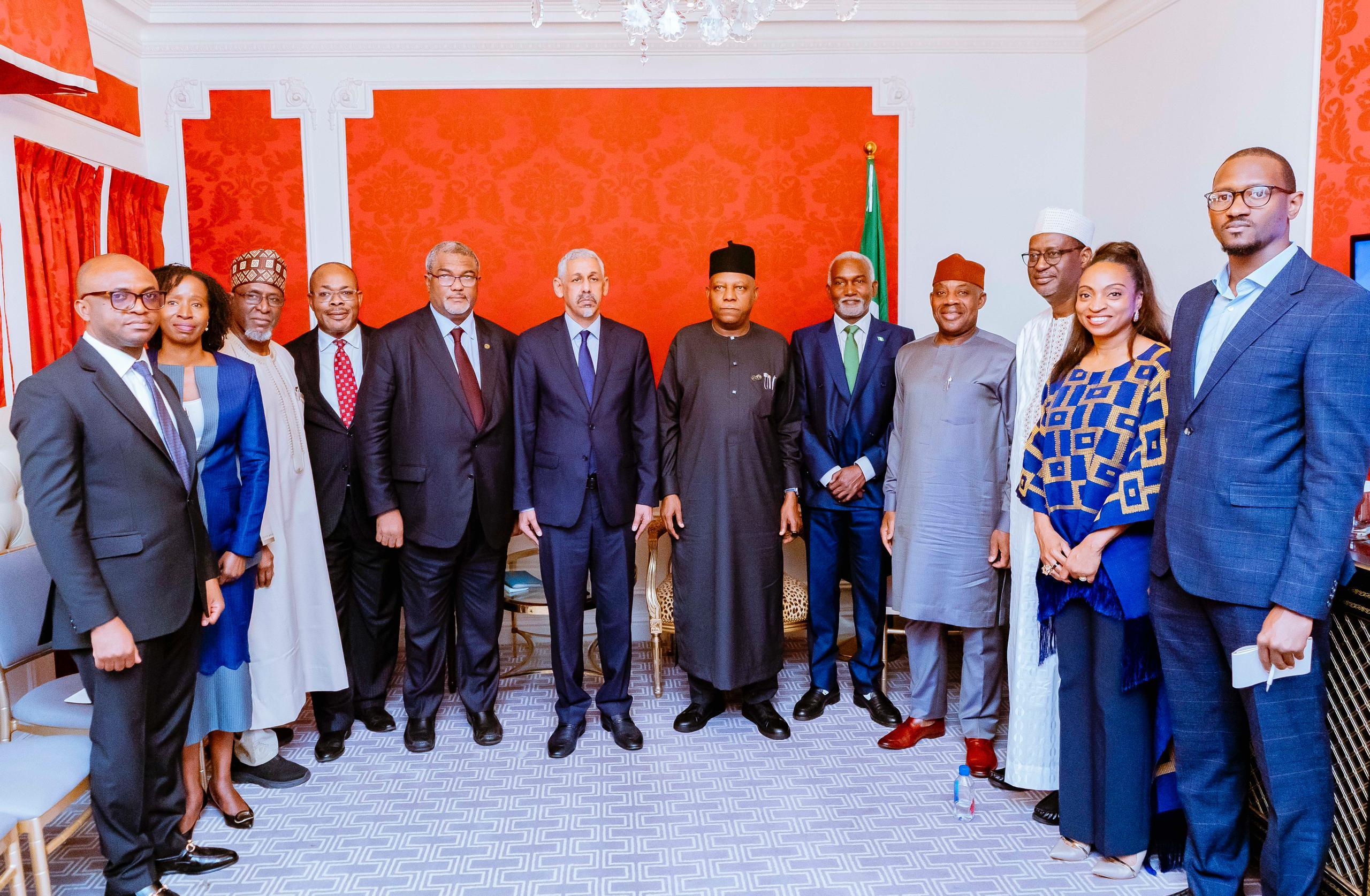
The Nigerian Government has secured enhanced funding commitment from the African Development Bank (AfDB) to operationalise the second phase of the Special Agro-Industrial Processing Zones (SAPZ).
SAPZ Phase 2, which is expected to scale up climate-resilient infrastructure and inclusive agro-industrial growth across an additional 24 states.
The funds will help expand the scheme from the initial eight states and the Federal Capital Territory, Abuja.
This will help diversify Nigeria’s mono-product economy to value-added agricultural export.
Vice President Kashim Shettima requested in New York, during a bilateral meeting with AfDB’s President, Dr Sidi Ould Tah, on the sidelines of the 80th Session of the United Nations General Assembly (UNGA).
STATE HOUSE PRESS RELEASE
UNGA80: Nigeria Secures AfDB Funding Commitment For Agric Ahead Of SAPZ Expansion To 24 States
** VP Shettima meets St. Kitts Prime Minister to strengthen Africa-Caribbean ties
The Federal Government has secured enhanced funding commitment from the… pic.twitter.com/sYDzfagQCz
— Stanley Nkwocha (@stanleynkwocha_) September 28, 2025
Largest Shareholder
Justifying the country’s request, the Vice President said Nigeria is the largest shareholder in AfDB and its portfolio hovers in the neighbourhood of over $10 billion.
“We urge you to further support us in the phase 2 Special Agro-Industrial Processing Zones (SAPZ). You assisted us with $300 million when you were in Liberia. We want to thank you, but like Oliver Twist, we are asking for more because we are poised to diversify our mono-product economy into agriculture, especially value-added agricultural export.
“And we have the potential in all the agro-ecological zones in Nigeria. From the mangrove forest swamps in the south to the Sahelian region in the far north, you can virtually grow anything. In states like Kebbi, the soil is very fertile,” he emphasised.
VP Shettima added that Nigeria boasts a resourceful youth population that is development-oriented and eager to be co-opted into the workforce of the 21st century.
The vice president implored the AfDB president to also look into the issue of the bank’s support for innovation-driven enterprises, instead of focusing only on MSMEs, noting that the digital space offers a vista of opportunities for Africa’s development.
“We can catalyse and accelerate the digital space in Africa. Already, out of the eight unicorns in Africa, five are from Nigeria – Moniepoint, Jumia, and the rest. We want to once again reiterate that we are with you, we are for you, and we will stand by you,” VP Shettima told Dr Tah.
Great Green Wall
In his remarks, Minister of Environment Mallam Balarabe Lawal sought the support of the bank for the Pan African Great Green Wall Initiative, especially Nigeria’s Great Green Wall Project.
He said, “I want to appeal for the extension of your support to Nigeria’s National Agency for the Great Green Wall. The agency is responsible for containing desertification in the Sahelian part of Africa. I also want to plead that you look at what we have done so far in addressing environmental degradation in the 11 frontline States.
“We have already submitted our proposal to the Ministry of Finance on the issue of clean cooking policy, which is also directly linked to the afforestation process. It is important because it will address two issues of deforestation and health.”
Minister of Housing and Urban Development, Alhaji Ahmed Dangiwa, appealed to the AfDB boss to support the ministry in addressing the housing deficit, adding that the housing sub-sector needs substantial funding.
In his remarks, AfDB’s President, Dr Sidi Ould Tah, assured that under his leadership, the bank will spare no effort to provide Nigeria with the support it deserves in terms of developing its human capital.
“My vision for the bank is not as a lending institution, but as a catalyst institution with which to mobilise resources and capital from all over the world to Africa. I hope we can really bring capital to the continent to make the transformation of our continent possible and bring value to the agricultural sector.
“This is why my four cardinal points are: mobilise large-scale capital through partnerships, reform Africa’s financial architecture, convert the continent’s demographic dividend into economic strength for job creation, and industrialise Africa by harnessing its natural resources to add value and build resilient infrastructure.
“These points form my roadmap to guide the bank’s strategy and accelerate Africa’s development, and I’m confident that with your support, the bank will be able to bring transformation to the continent,” the AfDB President said.