


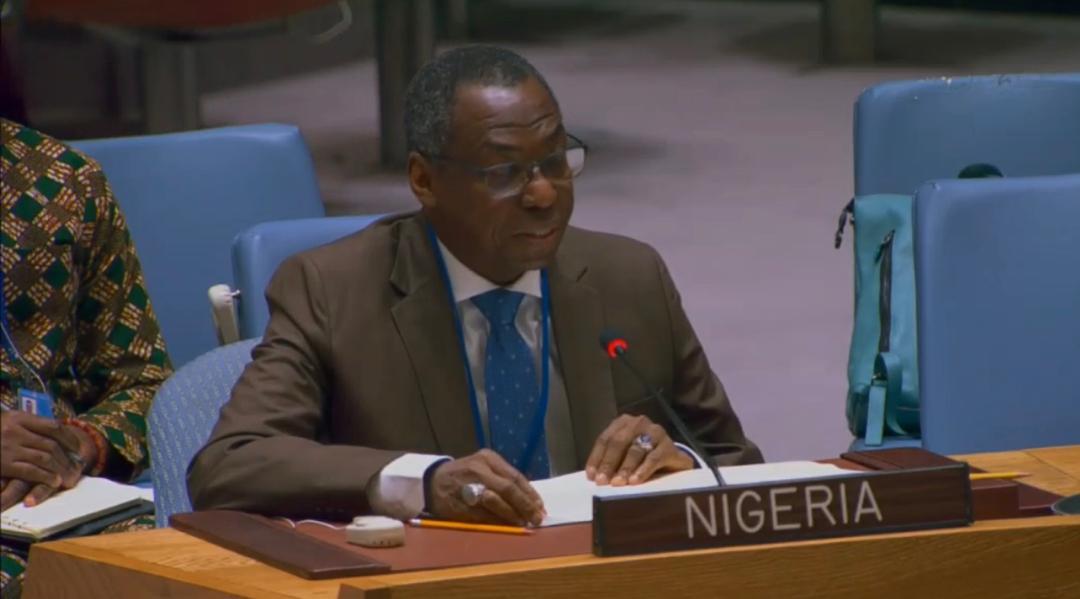
Nigeria has called for a shared regional maritime surveillance system and predictable financing for maritime operations to strengthen security in the Gulf of Guinea.
The Permanent Secretary of the Ministry of Foreign Affairs, Ambassador Dunoma Ahmed, made the call while delivering Nigeria’s statement at the United Nations Security Council (UNSC) High-Level Open Debate on the Maintenance of International Peace and Security at the UN Headquarters in New York on October 29, 2026.
The debate, held under the theme, “Emerging Technologies and Maritime Security: Implications for Peace and Security,” examined the growing impact of technological innovation on maritime security and international peace.
READ ALSO: Nigeria, US Strengthen Security Cooperation Against Transnational Cybercrime
Ahmed acknowledged the increasing influence of emerging technologies on maritime security, particularly in the Gulf of Guinea, noting that organised criminal networks were exploiting tools such as satellite communications to facilitate piracy, kidnapping for ransom and other maritime crimes.
He, however, observed that governments were also deploying similar technologies to strengthen surveillance and reduce maritime criminal activities.
Highlighting Nigeria’s efforts to combat maritime insecurity, the Permanent Secretary cited the Deep Blue Project, which integrates unmanned aerial vehicles, maritime domain awareness systems and an advanced central command and control centre to strengthen surveillance, improve response capabilities and tackle maritime crimes.
He also emphasised the importance of strong legal frameworks in combating maritime offences, citing Nigeria’s enactment of the Suppression of Piracy and Other Maritime Offences Act, 2019, as a significant step towards ensuring the prosecution of offenders.
Ahmed stressed that “the full benefits of emerging technologies can only be realised through effective information-sharing, regional cooperation and sustained capacity-building.”
Against this background, he presented two key recommendations to the Security Council for strengthening maritime security in the Gulf of Guinea.
First, he called for the development of a shared regional maritime picture, urging international partners, the International Maritime Organisation (IMO) and other relevant international institutions to build on UN Security Council Resolution 2634 (2022) by supporting technology deployment and capacity-building initiatives through the Yaoundé Architecture.
He explained that such support would enable national surveillance systems to contribute to an interoperable regional maritime picture, underpinned by regional ownership and appropriate human oversight.
The Permanent Secretary further stressed that developing coastal countries must enjoy equitable access to maritime technologies on fair and affordable terms.
He noted that “technological innovation should narrow rather than widen existing capacity gaps,” emphasising the need to ensure that developing countries were not left behind in adopting emerging maritime technologies.
On sustainable financing, Ahmed advocated predictable funding for regional maritime operations, drawing attention to the framework established under UN Security Council Resolution 2719 (2023), which provides for adequate, sustainable and predictable financing for African Union-led peace support operations.
He urged the Security Council to align its financial framework with the proposed operationalisation of the Combined Maritime Task Force for the Gulf of Guinea, which has been recommended to be headquartered in Nigeria.
The initiative was endorsed by the African Union Peace and Security Council in April 2025.
In his concluding remarks, Ahmed reaffirmed Nigeria’s commitment to working with Gulf of Guinea countries, Regional Economic Communities, the African Union and the United Nations to strengthen collective maritime security.
He emphasised that “emerging technologies must become instruments of collective security,” calling for concerted regional and international action to make Africa’s maritime domain safer for seafarers, coastal communities and international shipping.

