

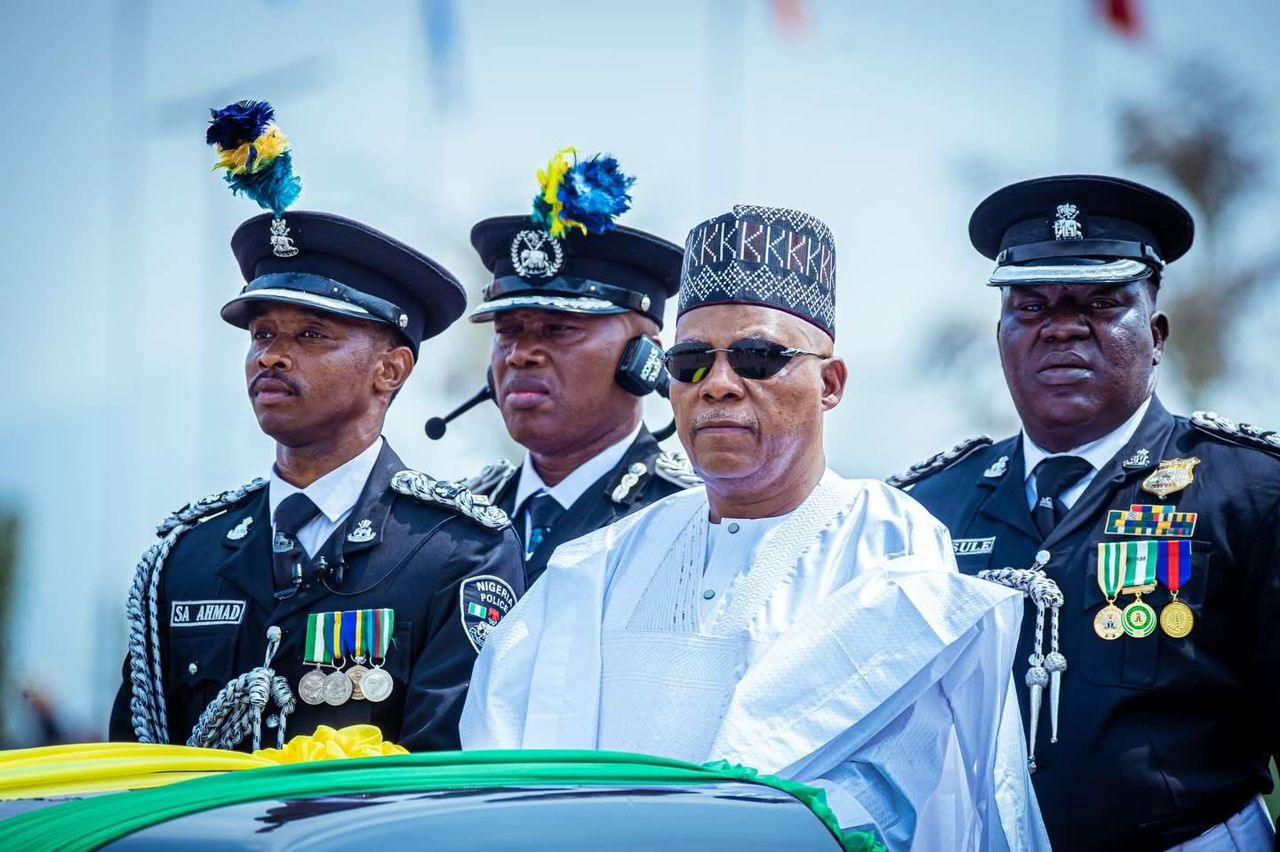
President Bola Tinubu has disclosed plans to deepen investment in police training, intelligence gathering, and modern law enforcement systems in a broader plan to transform the Nigeria Police Force (NPF) in line with global best practices.
He said the Nigerian state owes a permanent moral duty to empower its security agencies, as the nation’s peace is only as secure as the men and women who keep vigil over its citizens.
“We will continue to support these reforms through sustained investment in training and capacity development, modern equipment and technology, improved intelligence and investigative capabilities, and better welfare and working conditions for police personnel.”
The President represented by Vice President Kashim Shettima, said the Nigerian Government would deepen investments in training, intelligence gathering, and modern policing infrastructure as part of his administration’s ongoing reform agenda.
“We are determined to build a Police Force that is well equipped, well trained, and well motivated to confront the complex security challenges of our time. Nigeria must strengthen those who protect the nation. Security is not simply about defending territory or preventing crime. It is the first currency of progress.” He stated
The President while demanding stronger collaboration between citizens and law enforcement agencies, however, cautioned: “The uniform you wear is not a licence for arbitrariness; it is a covenant of service. The badge on your chest is not an ornament of power; it is a reminder of duty.”
Matching the tempo, Nigeria’s Inspector-General of Police, Olatunji Rilwan Disu, declared a “new era” for the Nigeria Police Force architecture set on the ethos of reform, accountability and renewed public trust.
In a series of activities spanning 5 days from March 30 to April 7, 2026, the Nigeria Police Force tested its reputation, redirected perceptions and fostered positive relationships with Nigerians in the 36 states of the country plus the Federal Capital Territory, Abuja.
Commemorative activities included a sanitation exercise, medical outreach, a walkathon, community outreach, and presentation of cheques to families of deceased officers, peaking with a grand ceremonial parade attended by the Vice President of Nigeria and other distinguished personalities and stakeholders, featuring colourful tactical displays.

Held at Eagle Square, Abuja, where ceremony often meets symbolism, Nigeria’s policing future was recast with uncommon clarity by the Inspector-General of Police, Olatunji Rilwan Disu.
In an address delivered in measured tone yet firm intent, the 23rd Indigenous and 33rd Inspector-General used his first national platform not to just celebrate the institution but to define it, anchoring his leadership on responsibility, accountability and public trust.
Setting the stakes, he said, ‘I stand not just as the Inspector-General of Police but as a servant of the Nigerian people, deeply aware of your expectations, conscious of your concerns, and committed to earning your trust.’ This moment will define who we are and who we must become.”
The National Police Day, he made clear, must rise above ritual to a “moment of truth”. A moment to honour sacrifices. A moment to reflect with honesty. A moment to make a clear commitment about the future of policing in Nigeria.”
While appreciating President Bola Ahmed Tinubu for institutionalising the day, the Inspector-General framed it as more than recognition:
“This is not symbolic alone. It is a statement of belief in the Nigeria Police Force and in our capacity to reform, to improve, and to serve this nation better.”
The speech reached its moral centre in a quiet but powerful tribute to fallen officers.

“They did not die for applause. They did not die for recognition. They died for duty. For country. For all of us,” he eulogised. It was not only remembrance but also a charge to the living.
“Every life lost in service is a debt on our conscience. Every fallen officer is a call to do better. To be better. To serve better,” he stated.
The IGP’s address turned decisive with its rejection of impunity.
“The Nigeria Police Force must rise. We must rise above indiscipline. We must rise above misconduct. We must rise above every action that diminishes the honour of this uniform.”
The declaration that followed was stark and unambiguous, setting both public and institutional boundaries.
“Rank will not shield wrongdoing. Uniform will never excuse abuse. Authority will never override the rule of law. There will be no sacred cows,” he stated.
While demanding higher standards, the Inspector-General urged discipline with duty to those who serve.
“A respected and professional Police Force must be built on officers who are supported, trained, and treated with dignity. This leadership will stand firmly with every officer who does what is right. We will improve your welfare. We will strengthen your capacity. We will equip you properly,” he affirmed.
To the Nigerian public, the Inspector-General acknowledged a strained relationship that has long defined policing in the country and committed to a redefinition of the nation’s policing service delivery
“We hear you. We understand your concerns. We acknowledge the distance that has grown between the Police and the people. We are determined to close that gap. You will see a Police Force that is more accountable, more professional, more disciplined, and more human.”
He spoke to the yearning of Nigerians, which aligns with global best practices for “a Police Force that does not intimidate but protects”. That does not alienate but partners. That does not instill fear but earns respect. We will not stand above you. We will stand with you.”
The address did not defer reform to the future but to the present; “We are already moving. We have launched new mechanisms for internal discipline and public accountability. We are investing in training, technology, and community engagement. These are not future plans. They are actions in motion today.”
He further outlined the operational direction with precision: “We are building a Police Force that is intelligence-led, technology-driven, and community-focused.”
Beyond the Force, the Inspector-General placed security within a broader civic compact.
“The Police cannot succeed without the people. And the people cannot feel safe without the Police. Security is a shared responsibility, and together, we will build a safer Nigeria.”
In closing, the message resolved into a statement of redefinition that pointed to a new era.
“This will be a new era for the Nigeria Police Force. An era where integrity is non-negotiable. Where discipline is enforced. Where service is prioritised. And where trust is rebuilt, one action at a time.”
Then, a final line that sought to etch the moment in national memory: ‘Let history record that at this moment, we chose courage over complacency.’ We chose reform over rhetoric. We chose service over self.”
At the 2nd National Police Day held at Eagle Square, Abuja, IGP Disu’s speech did not merely commemorate a national observance; it marked a line between what policing has been and a redirection into what it is projected to be.