

The Nigerian Government has signed a comprehensive Country Partnership Framework with the International Solar Alliance (ISA), marking a major step toward a clean energy future for Nigeria.
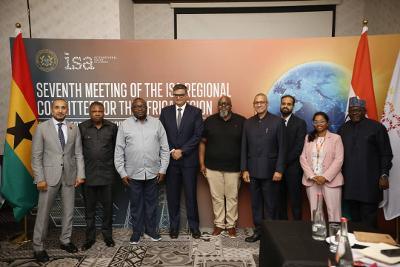
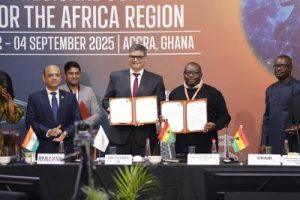
The agreement was formalised by Nigeria’s Minister of Power, Adebayo Adelabu, and ISA Director General, Ashish Khanna, during the ISA’s Seventh Regional Committee Meeting for Africa, hosted in Accra, Ghana.
The event brought together African governments, development partners, and financial institutions to chart a common pathway for expanding solar adoption across the continent.
This was made known by the Special Adviser to the Minister on Media and Strategic Communication, Bolaji Tunji.
Adelabu explained that “the partnership establishes a robust three-year action plan to accelerate Nigeria’s solar energy adoption, focusing on advocacy, capacity building, and programmatic support.”
The collaboration will prioritise scaling up solar applications in agriculture, promoting rooftop solar installations, deploying mini-grids, and establishing a Solar Technology and Application Resource (STAR) Centre.
“A cornerstone of the framework is the creation of a $500 million DRE Nigeria Fund, designed to catalyse investment in distributed renewable energy projects and backed by enhanced regulatory support from the Ministry of Power,” the Minister stated.
He stressed that the initiative would power national development by going far beyond household lighting.
“This partnership is about more than light; it’s about powering development. Decentralised renewable energy solutions are not merely about providing light to households, they are about unlocking development, powering schools and clinics, energising small and medium enterprises, supporting agricultural processing, driving e-mobility, and opening opportunities for digital inclusion in rural communities.” Adelabu said.
“Every mini-grid and solar system deployed means a child can study, a clinic can function, an entrepreneur can thrive, and a farmer can irrigate his fields. This is the transformational promise of renewable energy for Africa.” he added.
The signing, which also saw Ghana and The Gambia enter similar agreements, signals a powerful wave of regional cooperation, placing solar energy at the heart of national development strategies across Africa.
PIAK