

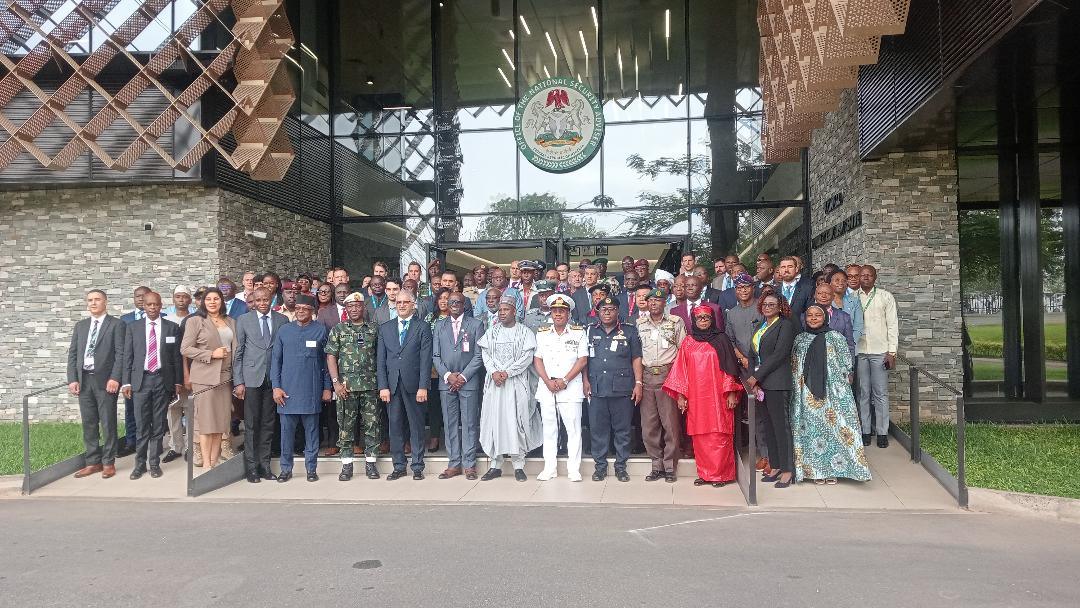
A one-day high-level stakeholder conversation on the “Seeds of Hope” project hosted by the National Counter Terrorism Centre has raised renewed optimism for sustainable reintegration of low-risk repentant combatants through agricultural rehabilitation.
In an atmosphere of cautious optimism, senior defence officials, parliamentarians and humanitarian partners gathered at the National Counter Terrorism Centre in Abuja on Thursday to discuss the future of ex-combatant reintegration in Nigeria.
The event with the theme “Seeds of Hope”, was jointly hosted by the National Counter Terrorism Centre (NCTC) under the Office of the National Security Adviser, in collaboration with the International Institute of Tropical Agriculture (IITA), key embassies, donor agencies and implementing partners.
The conversation was anchored on expanding community-based agricultural pathways to reintegrate low-risk individuals formerly associated with terrorist groups.
The Coordinator of the National Counter Terrorism Centre, Office of the National Security Adviser (ONSA), Major General Adamu Laka, emphasised that the Seeds of Hope initiative represents Nigeria’s evolving shift towards comprehensive, multi-sectoral approaches to stabilisation.
The coordinator explained that beyond kinetic interventions, the country must provide socio-economic lifelines.
“What we’re doing today is no longer just about fighting terrorism, it’s about replacing extremism with opportunity; hopelessness, with livelihood.”
The National Coordinator of Operation SAFE CORIDOR, Brigadier General Aliyu Ali, underscored the urgency of integrating agricultural rehabilitation into peacebuilding strategies.
He said Nigeria must seize the opportunity to “nurture talents and dreams” of ex-combatants who have shown genuine repentance.
While reflecting on military efforts in stabilising conflict zones, he insisted that security operations alone cannot guarantee lasting peace.
“This project offers a vital pathway to show them that there is a future beyond the gun.”
Platform for Stability
Also speaking at the event, the Deputy Director General of the International Institute of Tropical Agriculture (IITA); Dr. Abdoulaye Tahirau described agriculture not merely as an economic tool but as a “platform for stability, hope, and resilience.”
“When agricultural systems collapse, when access to land is threatened, and when rural youth have no economic alternatives, the risk of radicalisation, criminality, and conflict rises sharply,” he said.
Tahiru commended the organisers for embracing a multi-sectoral approach to addressing insecurity, saying the Seeds of Hope programme aligns with IITA’s vision of transforming agriculture beyond yields, toward peacebuilding and inclusive development.
He cited widespread disruptions to food systems in the Northeast, Northwest, and Northcentral, including restricted access to farmlands, threats to extension services, and disillusionment among rural youth.
“The reality is that insecurity has disrupted agricultural production in many parts of Nigeria. Farmers are unable to access their fields. Input supply chains are broken. And young people are increasingly disillusioned,” he lamented.
“Our work is about transforming agriculture into a tool for peace and stability,” he said.
“But we cannot do this alone. It requires partnerships with government, security agencies, civil society, and most importantly political will.”
Bridging the Gap
Chairman House Committee on Peace building and Social Cohesion, Mr Sadiq Abbas Tafida hailed the program’s potential to bridge the gap between security interventions and social recovery.
He described the initiative as “timely and strategic,” especially for conflict-ravaged communities in the North East.
“We in the National Assembly,” he said, “are ready to back this with the kind of policy and funding framework that ensures its longevity.”
He also echoed a broader parliamentary push for a harmonised national rehabilitation architecture that aligns with Nigeria’s counter-insurgency goals and international human rights commitments.
The Chief Coordinator of Seeds of Hope Captain Palash Kawsher, who gave insight into the pilot phase and donor-supported elements of the program, acknowledged the resilience of communities and partners that have made reintegration feasible despite security and logistical challenges.
“It is not just about farming, it’s about giving people back their humanity.”
Hauwa Abu