

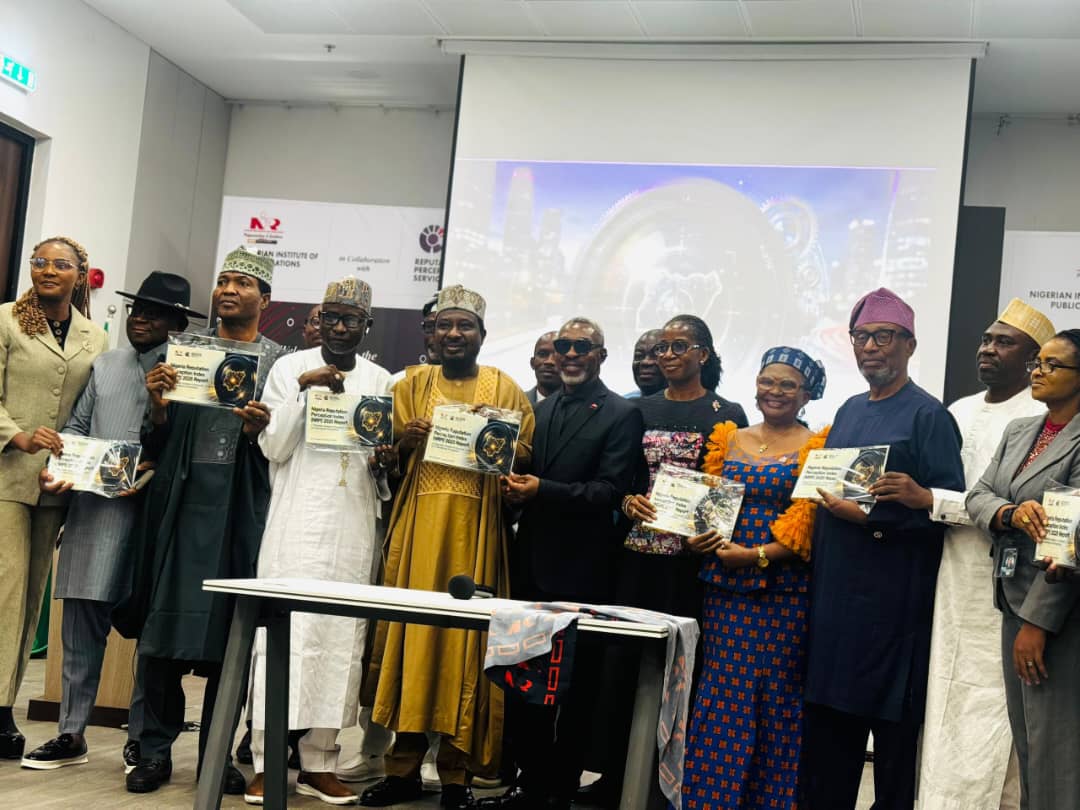
The Minister of Information and National Orientation, Mohammed Idris, has pledged the Federal Government’s readiness to deploy findings from the Nigeria Reputation Perception Index Report 2025 to reshape how the country is viewed both locally and internationally, describing national reputation as a governance issue that directly affects patriotism, diplomacy and investment.
Idris stated this at the public presentation of the Nigeria Reputation Perception Index Report 2025 in Abuja, the nation’s capital
Represented by the Director of Press in the ministry, Suleiman Haruna, the minister said the report provides the government with credible data to confront negative stereotypes and align public policy with citizens’ expectations.
“The National Reputation Perception Index Report 2025 is a pioneering document that interrogates how the global and local public view Nigeria. One critical outcome of this report is that government can use the data to catalyse the correction of negative stereotypes, including those hindering national positioning and patriotism, and not just foreign perceptions,” he said.
While commending the Nigerian Institute of Public Relations (NIPR) for elevating reputation management to a national priority, Idris stressed that the persistent trust gap between government and citizens underscores why reputation must be treated as a core governance concern.
“Let me commend the NIPR, under the leadership of Dr Ike Neliaku, for being forward-thinking and bringing national reputation to the front burner. The trust deficit between government and citizens endures because reputation is a governance issue. Therefore, governance has to make more effort to be in the interest of citizens,” he said.
According to the Minister, in a global environment where perception increasingly shapes outcomes, the report would serve as a strategic policy tool.
“In an era where perception shapes reality, this report stands as a strategic asset. It will inform public policy reforms, enhance diplomatic engagements, and improve investment inflows,” Idris added.
He said the administration of President Bola Ahmed Tinubu had already begun deliberate efforts to strengthen Nigeria’s image, linking reputation directly to governance performance.
“The government of President Bola Ahmed Tinubu is conscious of the fact that reputation is a derivative of governance. When you grow, your reputation grows. When you don’t, your reputation drops,” he said.
Idris cited ongoing initiatives aimed at projecting a more accurate and positive national image.
“Deliberate efforts like the National Values Charter and the National Reputation Management Group are already running to bring out the best of Nigeria to its local and foreign audiences. Projects in infrastructure, security and social investments are being pursued to support this objective,” he added.
He assured Nigerians that the ministry would fully engage with the report and apply its recommendations, stressing that sustained commitment across sectors was essential to translating perception into prosperity.
Also speaking, the Deputy President of the Senate, Senator Barau Jibrin, said the Nigeria Reputation Perception Index provides both a mirror to reflect the nation’s strengths and weaknesses and a compass to guide policy reforms and national reorientation.
“The Nigeria Reputation Perception Index provides us not only with a mirror to reflect our strengths and weaknesses, but also with a compass to guide policy reforms and national reorientation,” Barau said.
According to him, Nigeria has taken a bold step to systematically assess its perception across key dimensions, including governance, economy, security, institutions, culture, innovation, and social trust.
“I want to commend the organisers, researchers and partners behind this initiative for the foresight, professionalism and intellectual rigour that have culminated in today’s presentation,” he said.
“The introduction of a nationally grounded Reputation Perception Index marks a significant milestone in Nigeria’s journey towards evidence-based governance, strategic national branding and institutional accountability,” Barau added.
He noted that in today’s interconnected world, national reputation is no longer a matter of sentiment or propaganda but a strategic asset.
“How a nation is perceived by its citizens, investors, development partners and the global community directly influences its economic opportunities, diplomatic leverage, social cohesion and democratic legitimacy,” he said.
“Countries that understand, measure and deliberately manage their reputation are better positioned to attract investment, tourism, innovation and global partnerships,” Barau added.
In his remarks, the President and Chairman of Council of the Nigerian Institute of Public Relations (NIPR), Ike Neliaku, described reputation as a critical factor influencing investment decisions and national credibility.
“Reputation must be governed with the same seriousness as economic value. A more credible Nigeria would be cheaper to secure and more attractive for investment,” he said.
Neliaku disclosed that the project took about seven years, from its conception in 2019, involving engagements with organisations in Nigeria, Africa, Canada and other countries.
“We are recognised by law and mandated to regulate the practice and profession of public relations and use it to intervene in policy direction to ensure that Nigeria’s national interest and reputation are in good standing,” he said.
“This exercise is designed to reposition reputation as a strategic national asset—one that should inform public policy, diplomatic engagement, investment attraction and genuine national rebranding,” Neliaku added.
He said the event went beyond the presentation of a report.
“What we are unveiling today is a national capability driven by reputation intelligence, which is essential for economic transformation,” he said.
The keynote speaker, Ambassador Joe Keshi, said protecting Nigeria’s reputation was essential to achieving economic transformation, diplomatic influence and global respect.
The event, themed “Evidence, Perception and Nigeria’s Global Standing,” was organised by the NIPR in collaboration with Reputation Perception Services and attracted key stakeholders from the public and private sectors, including the Director-General of Voice of Nigeria, Malam Jibrin Baba-Ndace, and the Managing Director of the News Agency of Nigeria, Ali M. Ali.
PIAK