

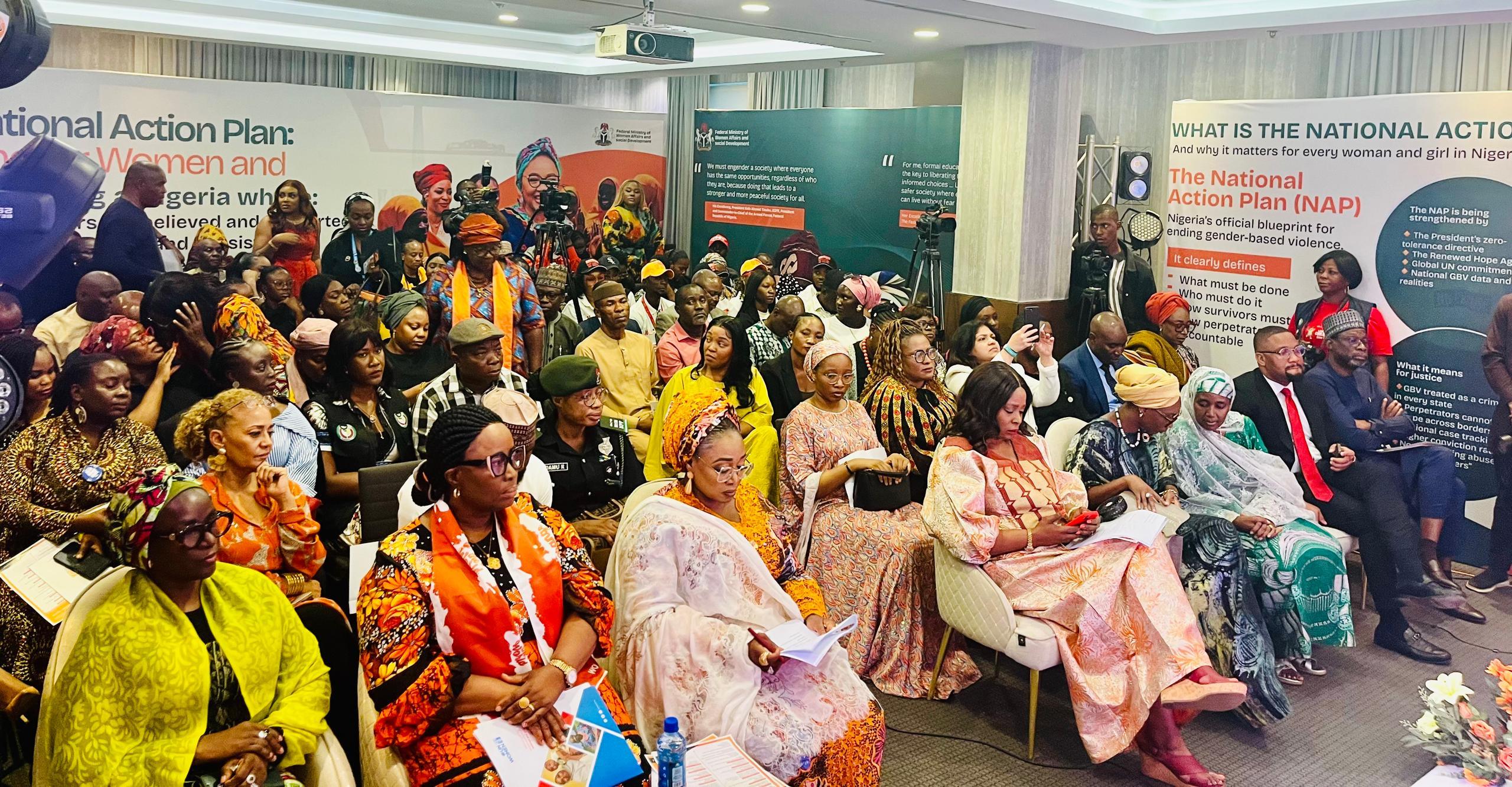
The Nigerian government announced plans to establish an Emergency Gender-Based Violence Response Fund to address critical financing gaps in prevention initiatives and support services for survivors.
Minister of Women Affairs, Hajiya Imaan Sulaiman-Ibrahim stated this at a high-level engagement to commemorate the 16 Days of Activism Against Gender-Based Violence, GBV, in Abuja, the nation’s capital.
The event was organised in partnership with an international NGO, Women for Women International.
Sulaiman-Ibrahim said the establishment of the fund became urgent as less than 0.5 percent of the national budget currently went to GBV prevention and response, leaving safe spaces and survivor support
centres severely under-resourced.
She decried the increasing cases of attacks on women and girls, including the recent abduction of schoolchildren in Kebbi and Niger States and the kidnapping of six female directors.
The minister described those incidents as “a national emergency that underscored the vulnerability of women across the country.”
According to her, “the survey, showed that 28 percent of women aged 15 to 49 had experienced physical violence, while 40 percent had suffered emotional abuse.”
She said that in spite of rising reports, the national conviction rate remained below five percent.
The Minister explained that “the proposed response fund would form part of the Ministry’s 9-Pillar Renewed Hope Social Impact Intervention Programme.”
Sulaiman-Ibrahim said “the initiative seeks to strengthen institutions, expand safe spaces, and improve justice delivery through specialised gender desks and courts in every state.”
READ ALSO: UNFPA, PPFN trains 50 community leaders to address GBV cases
She added that efforts were underway to raise the national GBV conviction rate from five percent to 25 percent by 2026, alongside plans to establish comprehensive support centres in every senatorial district.
Sulaiman-Ibrahim commended recent landmark convictions and called for a compassionate review of Ochanya’s case to ensure justice was served.
She also urged government agencies, development partners, civil society organisations, traditional rulers, religious leaders, and the media to align with Nigeria’s National Action Plan.
Ending GBV, she said, was both a moral responsibility and a development priority, essential for national stability and economic progress.
The UN Women Representative in Nigeria, Ms. Beatrice Eyong, noted that while Nigeria had ratified key conventions and enacted laws such as the VAPP Act and Child Rights Act, enforcement remained weak.
She stressed the need for stronger legal implementation, ensuring perpetrators were held accountable, and expanding awareness programmes to help both women and men recognise and prevent GBV in all its forms.
Response Systems
Eyong also underscored the importance of response systems, referencing one-stop centres set up through the Spotlight Initiative.
“These centres provide integrated services, including legal aid, healthcare, psychosocial support, and economic reintegration for survivors,” she said.
Eyong emphasised the critical roles of traditional leaders and men in promoting prevention and protection initiatives, alongside the use of technology and digital solutions to strengthen those efforts.
CEO of Women for Women International, Thelma Ekiyor, outlined the organisation’s structured Stronger Women, Stronger Nations programme, which provided 12 months of leadership training, economic
empowerment, and community engagement.
Drawing lessons from 14 conflict-affected countries, Ekiyor emphasised five key areas:
- Protection and safety
- Public awareness
- Strengthened legal enforcement,
- Provision of shelters, and men’s engagement.
She added that Women for Women International was ready to collaborate with the Ministry of Women Affairs to implement those programmes,
scale interventions, and make Nigeria a blueprint for regional gender-based violence prevention and response.
Online Harassment
UNDP Resident Representative in Nigeria, Ms. Elsie Attafuah, highlighted the urgent need to tackle the growing challenge of technology-facilitated violence, including online harassment, cyberstalking, non-consensual sharing of images, hate speech, and cyberbullying.
She stressed that safeguarding women and girls in digital spaces is critical for sustaining Nigeria’s economic growth, democratic participation, and social cohesion.
Ms. Attafuah emphasised UNDP’s commitment to integrated solutions, noting programs that support women’s economic empowerment, digital
literacy, access to justice, and survivor-centered services.
“Ending GBV is not a 16-day commitment, it is a 365-day responsibility,” she remarked, urging stronger collaboration among government agencies, civil society, private sector, and communities.
Executive Director, Planned Parenthood Federation of Nigeria, Dr. Okai Haruna Aku, said Gender-based violence remains a pervasive human rights violation that demands collective and sustained action to create a society where every woman and girl can live free from fear and harm
He said this year’s theme serves as a powerful reminder of the urgent need to address the root causes of gender-based violence and foster a
culture of respect and equality.
The global theme for this year’s 16 Day of Activism Against Gender Based Violence is, “UNiTE to End Digital Violence Against all Women and Girls.”