


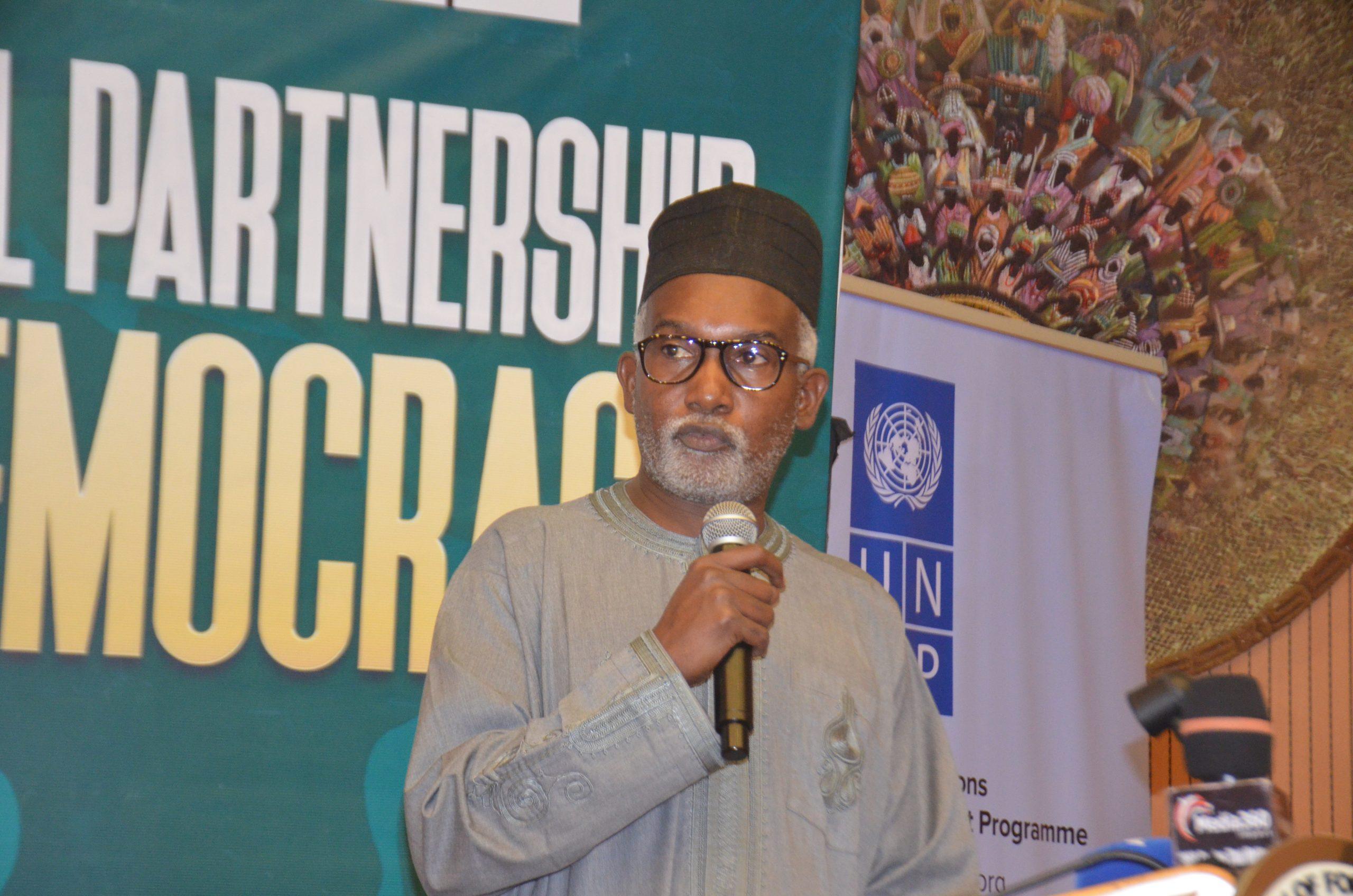
The Nigerian Government and the United Nations Development Programme (UNDP), have taken a significant step toward strengthening democratic governance in West Africa with the launch of the Regional Partnership for Democracy, (RPD).
The RPD is an Africa-led initiative with strong endorsement from ECOWAS and regional peace institutions.
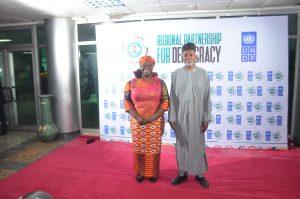
At the launch in Abuja, Nigeria, Nigeria’s Minister of Foreign Affairs, Ambassador Yusuf Tuggar, who was one of the signatories to the RPD, described the RPD as a transformative framework designed to reinforce democratic resilience through African values, contextualized governance models and inclusive institutions.
He said the initiative responds to the region’s mounting challenges, including political instability, electoral malpractice, shrinking civic spaces, and the erosion of public trust in state institutions.
“Through this framework, we seek to not only strengthen electoral institutions by deploying early warning and rapid response mechanisms against unconstitutional transitions, but also elevate youth and civil society as indispensable democratic actors, counter disinformation and lay the foundations for long term governance and stability” he said
Amb. Tuggar emphasised that the RPD is President Bola Ahmed Tinubu’s contribution and Nigeria’s “gift to Africa”, aimed at strengthening governance systems anchored in legitimacy, accountability and long-term sustainability.
“Together, we can build a future where African democracy is not imposed or borrowed, but genuinely owned and enduringly strong” Ambassador Tuggar said.
Similarly, the UNDP Resident Representative Elsie Attafuah, who was the second signatory to the RPD, hailed the partnership as a bold step in reaffirming democracy as the anchor of peace and development in West Africa.
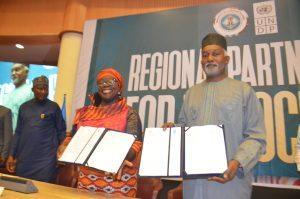
She praised Nigeria’s leadership, noting that the RPD would help rebuild trust in governance, promote inclusive participation, reinforce credible elections, and elevate the voices of youth, women and persons with disabilities.
“It is Africa led, regionally anchored and globally significant, grounded in our belief that the access to Africa’s governance challenges lies within Africa itself. Through its four pillars, the Regional Partnership for Democracy will first of all strengthen democratic institutions and public accountability” she said.
Compact of Values
Attafuah stressed that the initiative was not merely a programme but a compact of values shaped by African leadership and grounded in regional realities.
“The Regional Partnership for Democracy will be implemented, not from Abuja alone, but across West African capitals, institutions, and communities, ensuring true regional ownership and shared responsibility for results. Our shared aspiration is a West Africa where democracy delivers peace, prosperity, and dignity, where diversity is strength and accountability is the norm” she added.
Also, the ECOWAS Commissioner, Political Affairs, Peace and Security, Amb. Abdel-Fatau Musa commended the launch, calling the initiative timely amid growing concerns over unconstitutional changes of government and the manipulation of democratic processes across the region.
Representing the ECOWAS Commission President, Dr. Omar Alieu Touray, Amb. Musa warned that rising extremism, misinformation, constitutional abuses, and weakening opposition structures are undermining democracy. He said the RPD provides a credible platform to balance security, development and democratic governance, and urged all member states to embrace reforms that strengthen institutions, uphold term limits, empower youth and women, and deepen rule of law across the region.
“The right balance must be struck between democracy, security, and development. ECOWAS is therefore delighted to know that the Regional Partnership for Democracy has taken these concerns on board in this policy document. ECOWAS counts on the regional leadership of Nigeria and in partnership with UNDP to implement the RPB program” he noted
The Director-General of the Institute for Peace and Conflict Resolution (IPCR), Dr. Joseph Ochogwu reinforced the importance of the new framework, describing it as a “collective reawakening” that recognises democracy and peace as mutually reinforcing pillars of regional stability. He highlighted that weak institutions and broken social contracts provide fertile ground for conflict and affirmed IPCR’s commitment to supporting the RPD through research, conflict analysis, early warning, and capacity building.
The Senior Special Assistant to the President on Foreign Affairs, Amb. Ademola Oshodi echoed this sentiment, noting that democracy is a continuous, evolving process that requires constant improvement and adaptation.
Reflecting on the example of Cabo Verde, he underscored the importance of strong institutions, transparency, inclusive development, and multilateral cooperation.
Amb. Oshodi cautioned that global populism, complex geopolitical shifts, and climate-induced pressures are challenging democratic systems but insisted that democracy remains the surest path to inclusive and just societies.
Across all statements by several other speakers at the event, a shared message emerged: the RPD represents a unified regional effort to rebuild democratic norms, strengthen accountability, and ensure that democracy delivers tangible benefits for citizens.
Under the new arrangement, the RPD Secretariat will be housed in Nigeria’s Ministry of Foreign Affairs, with a technical team supported by the UN in Abuja to ensure regional inclusiveness
The initiative aligns with the African Union’s Agenda 2063 and the UN Sustainable Development Goals and is open to all West African countries, with potential for continent-wide adoption.